
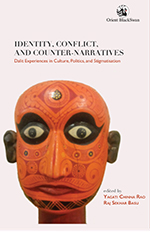
Although this is likely to be read as a heterodox beginning, I shall begin my review of the book, Identity, Conflict, and Counter-Narratives: Dalit Experiences in Culture, Politics and Stigmatisation, by focusing upon the final chapter, written by Chinna Rao himself. The theme of this chapter is ‘identity’ or rather, a crisis of identity caused by ‘conflict’ between different Dalit communities which have been beneficiaries of the caste-based reservations instituted by the Indian Constitution. The conflict, according to Chinna Rao, ‘has been fueled to a great extent by the state and its political powerbrokers’. This intra-caste conflict among Dalit communities, argues Chinna Rao, is the result of an unconstitutional tampering with Article 341 of the Constitution.
Chinna Rao documents the gradual process of fragmentation among the ‘untouchables’, whom Ambedkar had, all his life, tried to consolidate as a unified political constituency held together by a common history of caste oppression. It had always been the strategy of Gandhi and the Congress Party to engineer divisions among these lower castes, both before the Separate Electorates debates as well as after the Poona Pact. The elements of discord sown during the nationalist movement persisted, and even grew, in the postcolonial era with the people who came to be known as the Scheduled Castes, as per their constitutional denomination, becoming divided not only on the basis of their sub-castes but on political party lines as well.
Beginning with a micro-study of the case of Andhra Pradesh in the last decades of the twentieth century, where the State Government played an active role in enabling categorization of the Scheduled Castes, Chinna Rao records, in synoptic form, comparable processes as they unfolded in Punjab, Haryana, Uttar Pradesh, Karnataka and Tamil Nadu. His critical appraisal of the phenomenon of Dalit sub-classification leads him to the conclusion that, taken together, such sub-classifications have contributed to an irreversible splintering of Dalit unity across the country.
Incidentally, and interestingly, Chinna Rao’s critique of the sub-classification of castes foreshadows the critical interrogation by scholars such as Anand Teltumbde and Pratap Bhanu Mehta of the more recent institutionalization of a caste census across the country.
In the long (somewhat long-winded [?]) Introduction to the book, the editors once again concentrate on ‘conflict’; this time between perspectives on the meaning of the word ‘Dalit’ and the process of Dalit identity-formation. There is a strong plea made for the foregrounding of the non-Brahman (emic) outlook in preference to the dominant, more or less traditionalist (etic) opinions on caste. Quoting Badri Narayan, the editors observe that ‘mainstream histories have always involved the “de-historicisation of Dalits”, which Dalits have identified and responded to by denying the characterization of themselves as passive objects. This denial takes the form of a search for their own history….’ However, there is a regrettable lack of clarity here. The onus of undoing the misrepresentations of history, if vested in the Dalits alone, would make the correct writing of history a rather exclusivist, if not essentialist, endeavour. Fortunately, there is a qualification of this seemingly parochial bias later, with the editors conceding that ‘… individual (Dalit and non-Dalit) attempts at reconstruction of the outcaste castes in recent decades have made valuable contributions in this direction.’ Sekhar Bandyopadhyay, Swaraj Basu and Nandini Gooptu have been mentioned in this connection.
The richest portion of the book, edited by Chinna Rao and Basu, is constituted by the essays which follow the Introduction. These essays are the ‘counter-narratives’ which are intended to take readers away from the dialectics of ‘identity’ and ‘conflict’, and to draw their attention towards the everyday preoccupations and pursuits of diverse Dalit communities, redeeming them from the stereotypical image of chronic victimhood.
The essay by B Ramachandra Reddy highlights the presence of Dalits in the armies of the South Indian kingdoms, in Telugu-speaking regions especially, from as early as the pre-modern period till the period of their recruitment in the colonial army in the Madras Regiment. Much of the Dalit hiring by the British rulers was due to their reputation of being among the so-called martial races of India, though, ultimately, this reputation could not always prevent their prejudicial downgrading to inferior ranks.
The essay by Rajesh Komath, a once-upon-a-time performer of theyyam, a Dalit folk ritual dance practiced widely in northern Kerala, examines the mutations within this performative art over a long-time span. Komath stresses upon the carnivalesque aspect of this dance, during the course of which the dancers, all of them from the ‘untouchable’ castes, dress up as divine figures, gods and goddesses, and are treated as such by the audience, notwithstanding the prevalent caste taboos. Yet once over, the performers return to their customary looked-down-upon livelihoods and lifestyles. Their transient moment of glory is over, but, nevertheless, their experience of empowerment, ephemeral though it has been, has enabled them to raise questions, through the medium of simulation, about the dubious ethics of caste differences and discriminations.
Sudharshana Bhaumik’s essay on ‘Popular Culture and Social Mobility Among the Social Orders of Colonial Bengal’ provides penetrating insights into local cults and minor faiths of lower caste Bengali communities, which, in the opinion of British ethnographers, had very little connection or correlation with upper caste (bhadralok) modes of worship, sanctified as these were by scriptures. Challenging this perception, Bhaumik contends that it was the selective, though not infrequent, instances of upward class mobility of some sections of the lower caste populations which prompted the upper caste establishment to accommodate rather than assimilate these hitherto marginalized sections among ‘respectable’ Hindus. This tendency, argues Bhaumik, to a great extent stemmed the possibility of caste revolt in Bengal.
The final essay by Raj Sekhar Basu is on the complex caste politics of Tamil Nadu. Basu looks into the emergence of a Depressed Classes movement in the early twentieth century Madras Presidency, the Adi Dravida movement, which, in line with Adi (Original Inhabitants) movements in other parts of the country, stood up for the various ‘untouchable communities’, comprising mostly agricultural labourers. The Adi Dravidas distinguished themselves from the other subordinate caste group called the Justice Party, under which banner there was a consolidation of the non-Brahmin intermediary castes. Although both these formations pitted themselves against the Brahmin-dominated Congress Party, they were unable to make common cause with each other because, while the Justice Party was mostly against Brahminism, the Adi Dravidas rallied themselves against the very notion of caste. Besides, the Adi Dravidas did not find themselves opposing the colonial British authorities because, from their vantage-point, the colonial policies offered a promise of liberation from caste servitude, an agenda which was not of fundamental importance to either the Congress Party or the Justice Party.
This anthology is different in at least two crucial ways. It does not accord centrality to Maharashtra as the womb and the cradle of the Dalit movement. By focusing on other locations of Dalit existence across the country, it explores several scarcely celebrated facets of Dalit agency which belie the typecast profile of unmitigated Dalit misery.
Tapan Basu is former Professor, Department of English, University of Delhi, Delhi.