
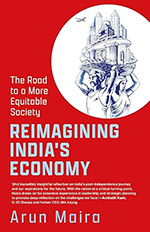
Arun Maira’s Reimagining India’s Economy is not the usual kind of economics treatise. Its strength lies in the rhythm of reflection and narrative, making it a hybrid—part memoir, part case study, part social critique, and at times deeply self-reflective. It reads less like a treatise and more like a conversation with someone who has moved through India’s corporate corridors, policy debates, and consulting assignments, pausing to draw lessons from each.
Drawing on his years in industry, government, and consulting, Maira brings together personal experiences with insights into how large organizations work, and he sets these against the wider shifts being witnessed in India today—inequality, ecological strain, and the decline of trust in public systems. The result is a book that sets out its concerns plainly and presents them in an accessible style, encouraging the reader to engage with the arguments, weigh them against their own experience, and form independent conclusions, rather than just take them at face value.
Maira was educated at The Lawrence School, Sanawar, before studying physics at St. Stephen’s College in Delhi. Sanawar’s demanding routine—early mornings in the mountain air, regular drills, and long hours outdoors under the motto ‘Never Give In’—fostered resilience, camaraderie, and a sense of service. At St. Stephen’s, he encountered a different atmosphere: lively debates, intellectual curiosity, and a strong sense of social responsibility. These formative years run like a thread through his later work, shaping his worldview of how large organizations can build trust, uphold dignity, and draw strength from both resilience and imagination. He joined the Tata group in 1964 and spent over twenty-five years with Tata Motors, rising to Executive Director and guiding the company through major changes in the 1980s. In 1989, he moved to the United States to work with Arthur D Little, where he became a Board member and gained wide experience in restructuring and strategy. Returning to India, he served as Chairman of Boston Consulting Group (BCG) in India from 2000 to 2008, advising corporations on leadership and organizational change. In 2009, he was appointed to the Planning Commission of India, where he worked until 2014 on industrial policy, urbanization, and participatory governance. He has also been active in civil society, serving on the Boards of nonprofit organizations and think tanks, and has written several books, including Remaking India: One Country, One Destiny, Transforming Capitalism: Business Leadership to Improve the World, Shaping the Future: Aspirational Leadership in India and Beyond, and now Reimagining India’s Economy.
The book does not unfold in a linear fashion. Maira begins with the anxieties of today—inequality, fragile institutions, ecological stress—and then circles back to episodes from his own journey that illuminate those themes. The narrative moves between present concerns and past lessons, creating a dialogue across time, richly adorned with incidents, rather than a simple career story.
One of the formative episodes he recalls is his first interview with the Tata group. Asked about his career preferences, he admitted he had a leaning towards government service, the traditional path for bright young Indians who wanted to ‘serve the nation’. The panel’s response—that industry too is public service, because it creates jobs and communities—reframed his idea of service. This early lesson runs through the book: public purpose is not confined to the government; it is a mindset that must infuse organizations of every kind.
Maira illustrates this with the Tata Motors story of the 1980s, when the company, for long the industry leader in standard trucks, suddenly found its primacy under threat. The partial liberalization of the early eighties opened the door to agile light commercial vehicles from Japan and South Korea, and Tata Motors faced the prospect of losing its marketplace standing.
Success required not just incremental tweaks but wholesale re-engineering of production processes, supply chains, and organizational culture. Tata had to rethink design from the ground up, invest in new technologies, and reorganize its workforce to deliver vehicles that were both reliable and affordable. Equally important was the way the company worked internally: frequent interactions across groups, without excessive deference to hierarchy, created a climate where ideas could move quickly and problems were solved collaboratively. For Maira, this was more than a corporate success story. It was a vivid lesson in institutional redesign—the courage to abandon old models and rebuild systems when survival demanded it. He draws a parallel to India today: just as Tata Motors had to secure its industrial base against competitive risks, India must now build resilient, tamper-proof production systems to withstand geopolitical shocks, cyber vulnerabilities and technological manipulation.
Maira recounts how his consulting years at BCG provided another set of lessons. At BCG, he worked with organizations across sectors, grappling with restructuring, strategy, and leadership. He saw firsthand how top-down strategies often faltered unless they incorporated bottom-up insights. Workshops with frontline managers, factory supervisors, and even customers revealed blind spots that boardrooms missed. These experiences sharpened his emphasis on systems thinking—the idea that economies and organizations are not machines with simple levers but living systems with interdependent parts. He also absorbed the importance of listening and participation: restructuring plans that looked elegant on paper often failed unless they were co-created with those who had to implement them. Having witnessed the human consequences of organizational restructuring—layoffs, morale crises, and the erosion of trust—he reflects on the importance of designing a ‘jobs-led growth’ model that restores dignity to work. Finally, his consulting background nurtured his belief in a ‘learning economy’: just as organizations thrive when they continuously learn and adapt, India’s economy must become adaptive, building resilience through innovation, feedback, and institutional redesign.
Maira’s years in the Planning Commission between 2009 and 2014 sharpened his critique of imported frameworks. Policy debates often revolved around GDP growth targets, with models borrowed wholesale from the IMF and World Bank. Maira describes how these frameworks dominated discussions, reducing complex realities to numbers. He challenged this dependency by convening wider consultations—bringing in State governments, civil society groups, and sectoral experts—to highlight India’s diversity.
He insisted that growth without equity was unsustainable and that imported prescriptions ignored India’s institutional fragility. The detail here matters: he recounts how meetings that began with abstract targets often shifted once farmers’ associations or urban planners were invited to speak, exposing the gap between statistical growth and lived experience. These episodes reinforced his conviction that India must craft indigenous models, rooted in its own social and institutional complexities.
The book also turns to experiments in participatory governance, where local communities shaped development priorities. He highlights how transparency and inclusion built trust and resilience in institutions. These stories are particularly powerful because they show that redesign is not only about efficiency but also about legitimacy. His message is clear—without trust and participation, institutions lose their foundation. Applied to industrial systems, the lesson is equally compelling. Tamper-proof production is not only about technological safeguards but also about governance. Systems that are transparent, accountable, and trusted by stakeholders are less prone to manipulation and more aligned with national security objectives.
Industrial policy becomes the arena where all these themes converge. For Maira, it is not a narrow technocratic exercise in tariffs or incentives, but a question of how industry can serve a larger social purpose. He critiques India’s reliance on the Washington Consensus, noting how it produced islands of prosperity rather than broad-based transformation. Since liberalization in the 1990s, India has often looked to the IMF, World Bank, and US policy circles for guidance. These institutions promoted deregulation, privatization, liberalization, and integration into global supply chains. While these prescriptions delivered growth, Maira argues, they failed to address India’s social realities: widespread informal employment, fragile institutions, and deep inequality. The state’s front-facing developmental vigour was now missing. Instead of balanced growth across regions and sectors, existing metropolises saw the bulk of expansion. Cities like Bangalore, Hyderabad and Gurgaon flourished with IT parks and service hubs, but the benefits of urbanization did not flow evenly to smaller towns or rural areas. Agriculture remained underinvested, manufacturing stagnated, and millions stayed in informal work. In chasing GDP numbers, India ended up with islands of prosperity rather than broad-based transformation.
However, global dynamics have now changed. The Washington Consensus, which held that geography was history, is now itself fractured. History is back, as is nationalism. Ideology lurks. The rise of protectionist policies in the United States, especially under Donald Trump, marks this decisive break from the old orthodoxy. If the very architects of globalization are retreating from it, Maira suggests, India cannot afford to cling to outdated models. Instead, India must craft its own industrial policy—one that secures autonomy, embeds equity, and builds tamper-proof production systems resilient to geopolitical shocks.
Maira also draws lessons from China’s trajectory. China did not simply follow external prescriptions but designed its own industrial strategy, combining state direction with market mechanisms. The result was not only rapid growth but also resilience and autonomy. Maira writes that India must similarly design an industrial policy that reflects its own realities, rather than importing frameworks wholesale. He insists that India’s path must be distinct—rooted in democratic participation, sustainability, and equity, rather than authoritarian centralization.
The result is a book that feels both personal and national, both reflective and urgent. By moving back and forth—from present concerns to past episodes, from personal anecdotes to policy debates—Maira makes a compelling case that reimagining the economy is not about chasing GDP numbers but about securing dignity, equity, and resilience. And perhaps that is its greatest strength: it reminds us that reimagining India is not a technical exercise but a societal imperative. In a time when economic debates are often reduced to statistics or slogans, Maira’s voice emphasizes something deeper—that the economy is ultimately about people, their work, and their dignity. This reminder gives the book its lasting resonance.
TCA Ranganathan, former CMD of Export Import Bank of India and former Non-Executive Chairman of Indian Overseas Bank, is co-author of All the Wrong Turns: Perspectives on the Indian Economy (Westland, 2019).