
In the spring of 2017, scarce five months after Donald Trump was first elected to the American Presidency, I was invited by a group of Hindu Americans that called itself Sadhana: Coalition of Progressive Hindus (‘We empower Hindu American communities to live out the values of their faith through service, community transformation, and targeted advocacy work’) to address a gathering of members and supporters on the campus of New York University. The founder of Sadhana, activist Sunita Viswanath, who reached out and invited me, has since created another group called Hindus for Human Rights (HfHR).
For my part, I felt uncomfortable addressing a religious forum of whatever description. But equally, my hosts were concerned that Right-Wing groups like the Infinity Foundation and the Hindu American Foundation (HAF) would try to disrupt the proceedings, knowing that I was to be the speaker. The event was labelled as blandly as possible: ‘An Evening with Ananya Vajpeyi’, giving no indication of the topic being addressed on this occasion.
So much water has flown under the bridge since then—a third term for the Modi government and the re-election of Trump in 2024, not to mention the global COVID-19 pandemic from early 2020 to mid-2023. But at that time, I felt there was a huge gap between the concerns of Hindu Americans and those of Hindus in India. Hindus are a miniscule minority in the US; in India, they constitute over 80% of the world’s largest population.
I feared that by identifying themselves like other ethnic, religious and immigrant communities in America—Muslim, Jewish or Buddhist Americans, for example–Hindu Americans were corralling themselves into a minority mindset, one which made neither cultural nor political sense from an Indian perspective. As the largest religious group in India, now also politically ascendant through a Hindu majoritarian government, and the most elite immigrant group in America, economically outperforming every other nationality, the Hindu claim of needing protection for an endangered identity seemed to me to be equally absurd in both countries.
At the time, I cautioned Sadhana’s membership not to become like the Right-Wing HAF, which models itself on Zionist groups in the US, claiming that Hindus are at the receiving end of Hinduphobia, just like their Jewish counterparts are forever decrying the anti-semitic persecution, allegedly rampant in the American mainstream. Like Zionist Jews, wealthy and successful Hindus in the US use their financial clout and political influence to bring American foreign policy into alignment with the far-Right ultra-nationalist government back ‘home’ (Israel/India).
I was afraid of the staunchly secular, pluralist and inclusive Indian Americans who have built platforms like Sadhana and HfHR becoming indistinguishable from other Hindu groups operating within the framework of America’s culture wars. Coming from such different corners, we had a difficult—though cordial—interaction, and decided by mutual consent to disagree without animus.
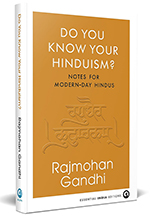
Today, nine years later, seeing the terrifying effects of Zionist zealotry unfold all across West Asia in real time, Jews with a conscience, whether in the US, Israel or Europe are asking themselves what constitutes morally defensible Jewish politics. What should their stance be, so as to not relentlessly weaponize either the long historical memory of anti-semitism or the relatively recent experience of the Holocaust? How should they stop their co-religionists from seeking to oppress and dominate supposed enemies, especially Muslims, whether in Palestine, Lebanon, Iran or elsewhere? And seeing the strain wrought by Hindutva on India’s complex and diverse social fabric, thoughtful Indians too, like Rajmohan Gandhi, want to better understand what it means to be a Hindu or profess Hinduism in increasingly polarized political environments, not just in India or the US, but all across the world.
Liberal democracy has collapsed in the face of a global upsurge of bigotry, hatred and fundamentalism. But it is the capture of the world’s two biggest and most multi-cultural democracies, India and the US, by the forces of religious nationalism (Hindu and Christian respectively) that causes the greatest grief.
Rajmohan Gandhi’s desire to interrogate and educate Hindus who may be losing their moral bearings under the onslaught of Hindutva propaganda, leads him to revisit many major thinkers, teachers, reformers and leaders of modern Hinduism, from Rammohan Roy to Debendranath Tagore, from Dayananda Saraswati to Sri Ramakrishna and from KM Munshi to Vinoba Bhave. He goes over the lyrics of Bankim’s ‘Vande Mataram’ and Tagore’s ‘Jana Gana Mana’; he reconsiders the patriotism and piety of Subhas Chandra Bose and Jawaharlal Nehru. Most of all, he dwells on the Hinduism of his grandfather, Mahatma Gandhi.
Gandhi considers the slogans adopted by the ruling BJP dispensation, from ‘Vasudhaiva Kutumbakam’ to ‘Vishwa Guru’ to India as the ‘Mother’ of Democracy, and measures the distance from the origins of these ideas in the Vedas and Upanishads to their use—or rather, their blatant misuse—in the contemporary ideological rhetoric and policy discourse of the Hindu Right. He also looks at the Hindu diaspora worldwide, that he calculates to be 1.2 billion people (i.e., almost the same as India’s population), and considers popular literature, films and media through which they might be deriving their ideas of Hinduism, right or wrong.
Rajmohan Gandhi undoubtedly covers a huge canvas in a few deft strokes. The sincerity of his effort and the clarity of his moral purpose both come across strongly, enough to move even the most cynical of readers. I was his interlocutor at his book launch in Delhi, and when I teased him about his exegesis of the widely sung prayer, ‘Jai Jagadish Hare’ (which has a rather monotonous tune, I said), he valiantly defended the beauty of this simple song, composed by one Shardha Ram Phillauri (1837-1881) in undivided Punjab.
However, what I find telling about this book is that after an opening 9-point summary of Hinduism, reproduced from an issue of Hinduism Today, a journal published in Hawai’i (Feb 2020), it contains next to no discussion about the doctrines, tenets, beliefs, deities, rituals, texts, practices and dogmas of the Hindu religion. In other words, it isn’t really about Hinduism at all. Rather, it is about the socio-political conditions under which modern Hindu identity emerges in India and globally.
From reform movements and protestant sects in the 19th century, like the Brahmo Samaj and the Arya Samaj, to the ways in which anti-colonial poetry gave us a repertoire of patriotic songs and eventually national anthems for multiple South Asian countries; from Bapu’s desperation to assuage the wounds of communal violence in Noakhali to the irreconcilable positions taken by various nationalist leaders, Hindu and Muslim, around the question of Partition; from the contrast between the secularism of the Congress and the Hindu majoritarianism of the RSS to the battles over history textbooks in the Modi era—most if not all of the ground traversed by Rajmohan Gandhi is that of politics rather than religion.
It could be argued that we have arrived at a juncture when the two are inseparable, but if we grant that, then are we implicitly conceding victory to Hindutva? Are we no longer able to separate out the heart of Hinduism—the quality that in Rajmohan Gandhi’s own words would make ‘Hindu’ an adjective—qualifying an act or an attitude—like Christian mercy or Islamic righteousness or Parsi thrift—from the agenda of Hindutva, which is to redefine India as a Hindu Rashtra and make being a Hindu indistinguishable from being an Indian?
To my mind, the real choice is not between one kind of political Hinduism (secularism) and another kind of political Hinduism (communalism). The question for ordinary Hindus is how to embrace their age-old way of being in the world, and of making rather than breaking connections—between self and other, nature and society, life and death, and most importantly, humanity and divinity. In the song of the 15th century Gujarati saint-poet Narsi Mehta, that Gandhiji so loved, is a line that has the clue:
Vaishṇava jan to tene kahiye je
Pīḍ parāī jāne re…
Only one who empathizes with another’s pain
Can be called a true Hindu…
Ananya Vajpeyi is Professor, Centre for the Study of Developing Societies, New Delhi.