
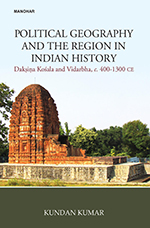
Kundan Kumar’s Political Geography and the Region in Indian History offers a methodologically sophisticated and empirically dense re-examination of early medieval regional formations in South Asia through a sustained study of Dakșiņa and Vidarbha between c. 400 and 1300 CE. At once a work of political history, historical geography, and epigraphic analysis, the monograph intervenes in long-standing debates concerning state formation, regionalization, agrarian expansion, and the conceptual status of the ‘region’ in Indian historiography. Its principal contribution lies in recasting the region not as a pre-given spatial container or derivative administrative category, but as a historically contingent and politically produced formation constituted through inscriptional practice, agrarian restructuring, and ritualized strategies of legitimation.
The study situates itself within a historiographical landscape historically shaped by two powerful interpretive paradigms: first, the declensionist narrative that characterized the post-Gupta centuries as an era of fragmentation and political decay, and second, structural models such as the ‘Indian feudalism’ thesis and the ‘segmentary state’ formulation. Kumar is attentive to these debates, but resists subsuming his analysis within any singular explanatory schema. Instead, he aligns with, and extends the work of scholars such as BD Chattopadhyaya and Hermann Kulke, who have emphasized the centrality of regional processes to understanding early medieval transformations. Kumar’s intervention, however, is distinctive in its sustained engagement with political geography as both method and conceptual framework.
The introduction interrogates the ontological status of the region, arguing that it cannot be treated as an inert geographical given. Drawing implicitly on spatial theory and political geography, he conceptualizes territoriality as an effect of power relations materialized through land grants, administrative divisions, settlement hierarchies, and ritual acts. The early medieval period, in this account, emerges not as a hiatus between classical and ‘medieval’ formations but as a formative epoch marked by the consolidation of regional polities and the articulation of durable territorial identities.
Methodologically, the book is anchored in an extensive corpus of Sanskrit epigraphic material, especially copper-plate land grants. Rather than approaching inscriptions solely as rhetorical proclamations of royal authority, he reads them as spatial documents embedded in particular landscapes. By systematically cataloguing references to villages, rivers, forests, administrative units, and boundary markers, Kumar reconstructs evolving political geographies across nearly nine centuries. This approach—aptly described as a form of epigraphic cartography—enables him to map not only shifts in territorial control but also transformations in the very grammar of political space.
The chapters devoted to Dakșiņa Kośala trace the emergence and consolidation of political authority through agrarian expansion and Brahmanical patronage. Kumar demonstrates that land grants functioned as instruments of both economic redistribution and political integration. By endowing Brahmanas and religious institutions with rights over land, rulers facilitated forest clearance, stimulated agricultural production, and embedded new nodes of authority within rural society. Such grants were juridical acts that delineated territorial rights and codified relations of obligation. The proliferation of administrative units—vishayas, mandalas, and other divisions—corresponded with increasingly articulated hierarchies of governance, suggesting cumulative processes of territorial stabilization rather than episodic assertions of sovereignty.
Importantly, the author resists reading these developments as evidence of ‘feudal fragmentation’. While acknowledging the dispersal of fiscal and administrative rights to local beneficiaries, he emphasizes the integrative dimensions of such transfers. Land grants did not signal the erosion of authority; rather, they constituted a mode of governance through which rulers extended their influence into newly cultivated territories. The political geography of Dakșiņa Kośala thus appears as the product of negotiated relations among kings, Brahmanical elites, and agrarian communities.
The analysis of Vidarbha provides a valuable comparative dimension. Although similar patterns of land grants and ritual legitimation are evident, the political geography of Vidarbha exhibits greater fluidity in administrative nomenclature and boundary articulation. The scholar attributes this in part to Vidarbha’s location within shifting Deccan power configurations. Its incorporation into broader imperial networks necessitated repeated re-articulation of territorial claims. Still, this embeddedness did not efface regional specificity. On the contrary, rulers deployed inscriptional rhetoric and spatial demarcation to assert Vidarbha’s coherence as a political domain.
By examining two adjacent but distinct regions across the longue durée, Kumar demonstrates both structural convergences and divergent trajectories. In both cases, agrarian expansion, Brahmanical patronage, and administrative stratification were central to political consolidation. However, the pace and modalities of territorial integration varied, reflecting ecological conditions, patterns of dynastic succession, and degrees of incorporation into supra-regional polities. This comparative method strengthens the book’s argument that regionalization was neither uniform nor derivative, but contingent upon specific historical circumstances.
Further strength of the monograph lies in its integration of environmental history into political analysis. Kundan Kumar’s close reading of inscriptional references to rivers, forests, irrigation structures, and agrarian categories allows him to reconstruct the ecological contexts of state formation. The transformation of forested zones into agrarian villages emerges as a crucial dimension of early medieval expansion. Political authority was inseparable from environmental modification, rulers and their beneficiaries reshaped landscapes to generate revenue and sustain ritual institutions. In this sense, territoriality was materially grounded in processes of cultivation and ecological reordering.
Equally significant is the study’s attention to the symbolic and performative dimensions of political space. Land grants were not merely administrative instruments but ritualized acts that sacralized territory. Inscriptions invoked divine sanction, recited genealogies linking rulers to mythic lineages, and prescribed severe penalties for those who violated granted rights. The delineation of boundaries was thus both juridical and cosmological. The author’s analysis underscores the inseparability of ritual sovereignty and territorial governance, contributing to broader debates on kingship and legitimacy in early medieval South Asia.
The longue durée framework spanning c. 400 to 1300 CE enables the author to identify patterns of continuity and transformation across multiple dynasties. Rather than presenting a succession of discrete regimes, he emphasizes structural processes that persisted despite political turnover. By the thirteenth century, both Dakșiņa Kośala and Vidarbha exhibit more standardized administrative practices and more clearly articulated territorial hierarchies. This cumulative consolidation challenges narratives that privilege imperial centralization as the primary index of political sophistication. Regional polities, Kumar demonstrates, were capable of developing complex and durable spatial structures in their own right.
The book’s empirical rigour is enhanced by extensive tabulation of inscriptional data. These tables not only provide transparency but also invite further research.
If one were to register reservations, they would concern the scope rather than the execution of the study. The focus on epigraphic material, while methodologically coherent, inevitably privileges elite perspectives. Although Kumar is attentive to the social implications of land grants, the experiences of non-elite actors remain largely inferential. Moreover, while the book engages with major historiographical debates, it might have benefitted from more sustained comparative reflection on other regional formations such as Bengal or the Kaveri delta, where similar processes of agrarian expansion and ritual legitimation have been extensively studied. Such comparisons could have further clarified the distinctive features of Dakșiņa Kośala and Vidarbha.
Nonetheless, these limitations do not diminish the book’s substantive contributions. On the contrary, they highlight the methodological challenges inherent in reconstructing early medieval political geographies. Kundan Kumar’s achievement lies precisely in demonstrating how much can be recovered through meticulous epigraphic analysis informed by spatial theory. The inclusion of maps (where available) and systematic data tables significantly aids comprehension.
Political Geography and the Region in Indian History constitutes a significant intervention in early medieval South Asian historiography. By foregrounding political geography as both analytical lens and methodological practice, the study compels historians to reconsider the epistemological foundations of regional history. The region emerges not as a residual category between village and empire, but as a dynamic arena in which power was articulated, negotiated, and spatially inscribed.
Kumar not only enriches our knowledge of two historically significant regions but also advances a broader methodological proposition: that political authority in premodern South Asia was fundamentally spatial in its articulation and that the ‘region’ must be recognized as a primary unit of historical analysis. As such, this book will likely shape scholarly conversations on early medieval regionalization for years to come.
Amol Saghar is an independent historian.