
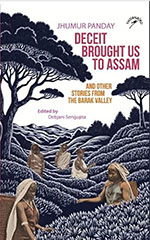
The historically neglected Barak Valley lies in the southern part of Assam and comprises the districts of Hailakandi, Cachar, and Karimganj, which has lately been renamed as Sribhumi. Named after the river Barak that flows across the Valley, it is a fertile agricultural land, and is populated by people belonging to a mix of ethnicities, who speak a number of languages ranging from the Bengali, Meitei, Hindi and Dimasa; though the most popular mode of communication is possibly Sylheti, a dialect of Bengali. The Valley was directly impacted by the Sylhet Referendum of 1947, and continues to struggle with the consequences of displacement and loss of homeland which it resulted in. The collection of ten short stories under review by Jhumur Panday—born on a tea estate in Hailakandi and the author of several widely translated books—mostly tells stories focused on one of the most marginalized people of Assam: the tea garden labourers. The history of those who laboriously work in the tea gardens, one of the most important industries in Assam, languishes in obscurity, or appears as a footnote at best. But the literature of Assam with its dominant interest in narrativizing history seems to have finally trained its focus on telling the stories of these exploited, marginalized people who have contributed so richly to Assam’s economy and culture.
In fact, the very title of the collection brings to one’s attention the unknown fact about the lies that the British colonizers told those brought from far-flung parts of India to Assam to make up for the deficit of labourers required to convert forests into tea gardens. Those lured by promises of riches and an idyllic life included Adivasis and the poorest of the poor. They were made to travel in inhuman conditions with many dying enroute from cholera and other diseases. The rest of the labourers who formed part of the workforce comprised locals, often those displaced by the referendum, who lived in abject poverty and were desperately in need of a livelihood. While recent collections of stories from Assam have featured a story here or there touching upon the lives of tea garden labourers, almost the entire collection by Panday is devoted to giving one a glimpse of their difficult, often tragic, lives. The very first story, ‘Deceit Brought Us to Assam’ tells the story of Chargola Exodus, a labourer named after the exodus of the labourers who had rebelled to escape to the homes they had been displaced from, but were mostly shot at and killed in the process. A distinct note of longing for a homeland, an accompanying sense of loneliness and a growing, painful realization that the desire for home would remain unfulfilled, runs through this story and many others.
The other leitmotif is of the mindless and senseless violence that the labourers are subjected to without any possibility of seeking redressal. Often it is violence that is directed at them from the owners of tea estates and the police, even at the whiff of possible rebellion, or by extremists who simply see them as collateral damage. The fact that many stories situate such violence during the time of pujo, a time of celebration, only underlines the extent of deprivation the labourers are subjected to. Of course, many of the stories—such as ‘Saluk Flowers Have Bloomed’—also suggest the gendered nature of the violence and sexual exploitation women labourers were subjected to by the British who employed them in these tea estates. But these stories also look within the community of tea garden labourers and tragically reveal that the enemy also lies within in stories such as ‘The Witch’, ‘The Boy’, and ‘There Goes Srimati’. Then there are stories like ‘Phoolbasiya Buri Goes Back’ which tie the intermeshed themes of Partition, displacement, loneliness and exploitation in the poignant tragedy of Phoolbasiya finding her way home only in death.
Most of these stories are fragmentary in nature; they are slice-of-life stories, perhaps reflective of the attempts of those living with the immense trauma of losing their loved ones, trying to recollect a past which they can do only in snatches. Often, the stories provide snapshots of present lives mired in tragedy and loneliness juxtaposed against a past that wasn’t idyllic but one in which the weight of difficulties was lightened by sharing it with loved ones. The other contrast that is quietly evoked is between the fecundity of the land and the abject poverty the people are forced to live in, possibly owing to the shift to a capitalist economy. While some of the stories, such as ‘Upstream’, do reveal a stance of resistance, it is the cynicism that runs through many that makes these stories both real and disturbing. Stories such as ‘Saluk Flowers Have Bloomed’ or ‘Enceinte Woodlands’ suggest a collusion between the powerful and those who claim to be leaders of the less privileged, with the latter focused only on personal gains and ambition. It is perhaps this rot of corruption that continues to ensure that while tea garden labourers comprise an important vote bank, their rights continue to be trampled upon even in present times. This very lack of basic rights is hinted at by many stories from the collection that refer to accidents at tea gardens that leave labourers without both a limb and an adequate compensation.
The stories from this collection were translated from Bengali to English by a group of translators that include Debjani Sengupta, who has edited the collection. It is a translation that is very aware of the politics of translating a language with many registers to English, and the dangers of effacing the people and culture the stories represent. Mindful of that challenge and the fact that the original makes use of dialects as markers of people’s location, a fact which Sengupta’s ‘Introduction’ alerts us to, the translation carries several phrases in the original followed with an English translation or explanation, and an extensive glossary at the end that the reader can refer to if necessary. Both the ‘Foreword’ and the ‘Introduction’ provide necessary context to the stories to enable readers to engage better with them. This is not a joyous collection of stories and one that might get a tad repetitive in its thematic focus, but it is an important intervention towards foregrounding a community of people who bring us joy every morning when we partake of that cup of tea, but have so little of it in their own lives.
Shibani Phukan, Associate Professor in the Department of English, ARSD College, University of Delhi, Delhi, has published poems, articles, and chapters especially on the North East and translation studies in national and international journals such as Women’s Link, Fortell, and The Journal of Postcolonial Writing, and in books published by Routledge, Cambridge Scholars, and Lexington Books. One of her significant contributions to Translation Studies includes an essay titled ‘Towards an Indian Theory of Translation’ published in Wasafiri.