
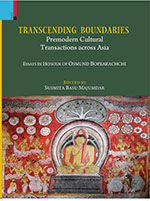
Osmund Bopearachchi, amongst the most prolific and dedicated scholars of Asian history, has inspired scholars across three continents over several decades. Susmita Basu Majumdar brings together more than fifty contributions implicitly or explicitly connected with or inspired by his wide-ranging academic concerns. These are organized into six sections, of which the first four relate closely to archaeology, epigraphy, numismatics, texts, and art and architecture, while the last two deal with Buddhism, and other matters of historical interest. Inevitably, and fortunately, there are overlaps in terms of themes and sources amongst these sections. The volume is very well produced, and lavishly and generously illustrated, a fitting tribute to Bopearachchi’s diverse, passionate and painstakingly meticulous scholarship.
The tone is set in the first part, where Nayanjot Lahiri provides an interesting glimpse into the messy world behind and beyond published archaeological reports. She uses archival material to offer insights into the tentative and complicated process through which archaeological knowledge, in this case of the Harappan civilization, was produced. This is followed by Henri-Paul Francfort’s account of practices of preparing and consuming wine. He provides a heady mix, combining a wealth of archaeobotanical evidence with traces of material remains and textual accounts of production and consumption over a vast chronological and spatial span. Finally, Ariane De Saxce focuses on a single site, Giribawa, in Sri Lanka, which has yielded evidence for the manufacture of glass.
The section on epigraphy and numismatics includes a short note on the term ‘liako’ by Harry Falk. He scrutinizes epigraphic evidence to suggest that it was probably an official designation and not a proper name, as has often been assumed. Also included is Basu Majumdar’s fresh reading of a Brahmi inscription from the Egyptian site of Berenike, and Smita Halder’s analysis of the well-known corpus of inscriptions found at Junnar. Peter Skilling provides the text and translation of inscriptions found embedded within Buddha images in Thailand, accompanied by fascinating visuals. Also well illustrated is Olivier Bordeaux’s contribution on Indo-Greek coinage, and Michael Amandry’s catalogue of Roman coins from the Verehakale hoard in Sri Lanka. Bordeaux urges caution in numismatic studies, emphasizing the need for chemical analysis in addition to the usual focus on visual representations, scripts and the external forms of coins so as to arrive at surer conclusions. Kazim Abdullaev’s discussion, highlighting the problems when the provenance of coins is unknown, is in a sense complementary; he also touches on the untidy, and occasionally murky world of markets for antiquities. François Thierry provides a glimpse of premodern ‘numismatists’—Chinese scholars who described, not necessarily accurately, coins that were produced and circulated in the ‘western’ world. From a different perspective, Lyce Jankowski uses the evidence from Chinese coins recovered from a 10th century shipwreck to provide an understanding of the contexts in which they may have been circulated. Sutapa Sinha studies coin hoards from the Sultanate period in Bengal, emphasizing the uniqueness of the region, where the means of exchange included cowries.
Contributions in the third section deal with a variety of textual traditions. Federico De Romanis explores parts of the work of Cosmas Indicopleustes to trace dialogues across continents, including ways of understanding and representing distances and spatial orientation. Robert P Goldman speculates on the location of the cities that may have inspired the dazzling descriptions of Ayodhya, Kishkindha, and Lanka in the Valmiki Ramayana. Sally J Sutherland draws attention to a more macabre subject—the beheading of demons in the Ramayana. She traces possible antecedents in Vedic mythology and demonstrates how the theme is used creatively by the poet to evoke horror, as well as aesthetic pleasure. Nadeesha S Gunawardana relies on epigraphic and textual sources to reconstruct the links between Nagarjunakonda and Sri Lanka in the early historic period. In a short, stimulating intervention, Max Deeg draws on Chinese accounts of the Buddha at Bodh Gaya after he attained enlightenment, and attempts to map these on to the landscape. Finally, Shonaleeka Kaul focuses on the Rajatarangini to argue for Kashmir’s distinctive relationship with the wider world.
The fourth, and longest section of the volume is devoted to art and architecture. Here, Janice Leoshko traces the prehistory of Ananda Coomaraswamy’s understanding of the roots of art in Sri Lanka and the Indian subcontinent. Laura Giuliano analyses the representations of the svayamvara of Siddhartha in Gandharan art, tracing inter-textual linkages with the Ramayana in particular. Gandharan art forms the focus of Vincent Lefevre’s contribution as well, as he reassesses the significance of sculptures identified as Bodhisattvas, arguing that these could be read as multivalent representations—alluding to the donors even as they embodied elements of Buddhist iconography. This leads on to Monica Zin’s attempt to correlate diverse textual and visual traditions, to arrive at a better understanding of the complex and often exquisitely detailed representations from Kucha, and their linkages with a wider Buddhist network extending through Gandhara to other parts of the subcontinent. Related to this, Satomi Hiyama draws attention to fragments of narrative paintings from the Kizil Grottoes, now preserved in Japan, drawing on a range of textual traditions in order to identify the episodes that are represented. Pei-Ying Lin takes the reader through a study of murals, tracing the ways in which Japanese, Korean and Chinese motifs intermingle. This notion of intermingling, or hybridity, if we wish, is also developed by Tianshu Zhu, who analyses the ways in which Indian elements, often labelled as ‘Gupta’ or ‘Amaravati’, were integrated in complex ways within the iconographic programme that emerged in Qingzhou. The focus on East Asian traditions is followed through by Mark L Blum who draws attention to the visual/calligraphic imagery within Jodo Shin Buddhism in medieval Japan, while David C Andolfatto focuses on a contemporary tradition of woodcarving practiced in Nepal. He both analyses the complex motifs and acknowledges the craftsmen who produced them. John Guy traces the representation of yakshas, associated with symbolic and tangible wealth. Finally, Yin Ker focuses on the 20th century Thai artist, Fua Haribhitak, touching on a wealth of hitherto unknown archival material related to his stay and training in Shantiniketan.
Gregory Schopen’s short and sharp discussion on means of handling money as depicted in early historic inscriptions and Buddhist textual traditions inaugurates the fifth section. Next, Ashwini Lakshminarayanan attempts to trace the presence of bhikshunis in the textual and visual records from Gandhara. Presences and absences, in particular the latter, are also central to Donald Stadtner’s fascinating account of the many ways in which the Buddha’s footprint(s) were imagined, appropriated, and even forgotten through the centuries. Sanjyot Mehendale argues for the need to reinvestigate the relationship between Kushana kingship and Buddhism, based on the possibility of a mobile court that may have relied on support from the monastic world.
Shumpei Iwai argues for a different kind of revisiting—attempting to date the Bamiyan caves on the basis of architectural features and pottery finds. John Clifford Holt’s contribution raises yet another set of issues—the relationship between Hindu and Buddhist philosophy. He argues, persuasively, that in spite of considerable dialogue and sharing between the traditions, there are fundamental differences that must be acknowledged. Jacob P Dalton focuses on fragments of a single text, the Manjusriyamulakalpa, providing a sample translation of this esoteric composition. Lauren M Bausch juxtaposes textual and visual material in her discussion on Avalokitesvara, while Nupur Dasgupta analyses the literary works of Asvaghosa. She draws attention to his choice of genre, language and themes, leading up to a detailed discussion on the Sariputraprakarana, locating its surviving fragments within a complex spatial, temporal and cultural framework. An equally complex framework, developed in terms of a range of visual and textual components, is deployed by Chen Suyu and Runa Jinyi in their study of the iconography of Buddhist guardian deities in Khotan. The section ends with a note on mokhsa, at once delightful and profound, by Patrick Olivelle, who destabilizes our commonsensical understanding of the term by contextualizing its meaning, focusing, in particular, on the Manava Dharmasastra and its commentaries.
In the last section, Guillaume Ducoeur revisits and critiques Georges Dumézil’s well-known and much-contested tripartite theory/formulae to classify and understand Indo-European societies and mythologies. Upinder Singh tracks and unpacks the term ‘Yavana’ from the inscriptions of the Mauryan Emperor Ashoka to post-Mauryan inscriptions from central, western, eastern, and south India, suggesting that contact with the lands and people of the ‘west’ occurred in a variety of contexts. Suchandra Ghosh’s contribution is, in a sense complementary, as she uses the evidence of the Persepolis Fortification Texts to piece together the nitty-gritty involved in travelling between West Asia and the north-western frontiers of the subcontinent. Frank L Holt’s brief and delightful discussion on the murder of Eucratides the Great provides insights into the ways in which sources can be and have been used and misused. There are two regional case studies, based on epigraphic, archaeological, numismatic and textual evidence. K Rajan focuses on Pudukkottai, reconstructing its economic, social, political and cultural history, while Ranabir Chakravarti draws attention to the port of Balipattana, located on the west coast of the subcontinent.
His use of the geniza records is particularly instructive. Lilian Handlin’s contribution pertains to 12th century Myanmar, where ‘wrong views’ about Buddhism were both represented in a shrine, and held up as a warning. Not surprisingly, these ‘wrong views’ pertained to a disavowal of the theory of karma or individual responsibility for action. This was regarded as disruptive of the normative socio-political order. If Handlin’s focus is specific, Parul Pandya Dhar adopts a much broader spatio-temporal sweep connecting India with Cambodia. Using the example of Angkor Wat, she highlights how its meanings have been construed in different, and occasionally diametrically opposed ways through the centuries. Muhammad Kashif Ali and Muhammad Hameed document the history of Nandana through several centuries. On a different, wider plane, Fiona Kidd argues for re-visioning conventional notions about landscape and livelihoods in Central Asia. The volume ends with Manjiri Bhalerao’s exploration of the possibility that the rock-cut caves of western India represent an attempt to replicate the sacred landscape of Magadha.
This whirlwind gallop through the contents, centuries and continents can provide only a fleeting glimpse of the rich treasures that lie between the covers of this massive tome. Readers will find much to mull over—those looking for broad connections will not be disappointed. Neither will those who enjoy poring over details—whether of words, symbols, letters, images, iconography and architectural features. Virtually all the contributions are marked by careful scholarship. And those in search of aesthetic rasas will also find something to suit virtually every taste, in terms of writing styles and language.
Inevitably, some contributors remain in or return to their comfort zones, tapping into well-worn themes which they have investigated and attempted to understand for years, if not decades. Here, expectedly, one finds much that is familiar, reiterated yet again. Also, some of the sources that have been tapped repeatedly have, over the years, become almost canonical—and these rarely yield fresh insights.
Neither of these is a major flaw. The volume contains much more than such repetitions. In fact, it is an enormous, daunting compilation—there is much that is challenging, fresh, exciting, which awaits the patient reader. Also, many authors weave together concerns about polity, economy, society and cultural representations in complex and challenging ways.
Conventionally, we tend to encapsulate the extent of the subcontinent within the frame of ‘Kashmir to Kanyakumari’. Basu Majumdar has expanded that journey, as promised in the title, way beyond the subcontinent—from Cambodia to California. The diversity inherent in this spatial sweep is mirrored in the diversity of themes, questions, methodologies, approaches and the search for connections through these, broadening our horizons in a variety of ways. A truly worthwhile tribute to a scholar whose interests, passions and interventions have enriched so many different fields.
Kumkum Roy is former Professor of Ancient Indian History at the Centre for Historical Studies, Jawaharlal Nehru University, New Delhi.