
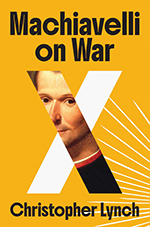
Niccoló Machiavelli, the Italian political philosopher and thinker of the Italian Renaissance, is famous for his two works, The Prince and Discourses on Livy, both published after his death. Another work, Art of War, was published in his lifetime. Machiavelli on War by Christopher Lynch is written as a dialogue narrated by Fabrizio Colonna, who was a condottiero (a mercenary) captain. The dialogue is spoken in the backdrop of a garden, Orti Oricellari in Florence, and is a critique on the conduct of events during that period. The book is a detailed study on Machiavelli’s Art of War, drawn from his accounts as head of Florence’s administration of military affairs and knowledge drawn from ancient texts from the Greek period.
Machiavelli was an active participant in the military-political events throughout his career. He raised Florence’s militias and was instrumental in the re-conquest of Pisa (1509-12), an event celebrated by the inhabitants of Florence and in the republic he served. However, he faced the ignominy of defeat of his militias (1512) at Prato leading to his dismissal, torture and political exile.
Machiavelli’s practical experience varied from initially managing mercenaries to creating a military and also engaging in diplomacy. He had close dealings with half a dozen condottieri, four missions to French courts, one brief mission to Rome to observe the conclave that chose Julius II as Pope and two missions, without command authority, to military camps outside Pisa in unsuccessful attempts to regain control by troops hired by Florence. Thereafter began the militia creation phase, the idea of creating native militia, their shepherding political processes, and training and selecting their captain. He also had a prolonged mission to the papal court giving him an inside view of papal dealings.
In his initial years in public life, he was responsible for overseeing the Chancery in Florence. His first observation was that the state was almost continuously at war. His major observation was that the military commander was a hired foreign professional in command of foreign troops and these troops also rebelled against their captains. That’s when he felt the need for three important aspects of statecraft, raising ‘one’s own arms’; taking your subjects along; and making friends with neighbours. He felt that maintaining peace was an uncertainty and the one who knows how to impose his will on others from a position of strength would prevail in times of war and peace.
For him creating a militia was a necessity and Machiavelli advocated native militia drawn from contadini (farmers) between the ages of fifteen and forty and drew up legislation for their draft. He was able to arm the infantry with firearms in a few years (1527-30). The militias were divided into units of 200 to 250 men headed by locals, and units of 400-450 full-time military professionals headed by constables, who would never serve in their home areas. Their leader, the captain, would be a foreigner. The militia armed, organized and trained would replace the hired mercenaries to function as a cohesive military force, fully motivated and disciplined. The state would extend benefits and control them through a system of punishment for wrongdoings and dereliction of duty, and payment as reward for good work. He thus regarded both punishment and payment as crucial motivators of his troops. He strove for combined arms synthesis of land warfare. His loss at Prato to the Spaniards made Machiavelli delve deeper on reflections and conduct of war, foreign affairs and more prominently into his critique of the mercenary system.
Another important aspect of Machiavelli’s learning was the importance of foreign relations in state affairs and its influence on domestic affairs. Taking lessons from inference from papal intervention, he brought out in Florence Histories how the papacy had weakened the states of Italy through means of spiritual arms of the church. He went on to argue that a well-disciplined and trained native military can withstand the challenges posed by such interferences and through replacement of a mercenary force.
Machiavelli’s reflections on modern-day terms such as grand strategy, military strategy, military operations and tactics are reflected in the Republic’s or the Prince’s mode of making war and covered in the chapter on War Making. He considered the Roman army as his model of success and drew inspiration from it. Military thinkers after him including Carl von Clausewitz (1780-1831) point out that Machiavelli’s understanding of military matters was of a very high order. Machiavelli emphasized that it was not always prudent to rely on established military doctrines as this could mean depending on others’ ideas. He therefore advocates reliance on one’s own arms or ability to conduct warfare. For him the most important element of war to be considered was chance or fortune and the judgment to understand fortune becomes crucial for a captain. Similarly, he advocates the use of alternate ideas such as prolonged siege of enemy, deception, bribery and conspiratorial diplomacy. He goes on to suggest that ‘iron clad rule in war is that there are no iron-clad rules’.
Machiavelli’s most famous reprise is drawn from his work, The Prince. He lays out that the two important features that make a prince or captain stand out are either because he is loved or feared. But the one who makes himself feared more is followed and obeyed more. Machiavelli therefore does not object to tyranny of the prince on moral grounds. That’s one quality that classifies him as ‘a teacher of evil’. Notwithstanding, he also points out that a prince needs to be an excellent human being as glory is reserved for the most excellent human beings. A prince should have war as the objective of all his actions and thought and that becomes synonymous with his being a military commander.
Machiavelli advocates military expansionism alongside establishing domestic order. ‘The necessity to expand arises from the desires of others to dominate you’ is an idea that remains relevant till date. Machiavelli understood tradition after studying, understanding and learning from it. He made war against tradition because of concern and danger posed to both politics and philosophy by the union of philosophical tradition with religion.
The teachings of Machiavelli are known to have helped establish the terms and framework of American constitutionalism. He was studied by Montesquieu, Harrington and John Adams. His observations on the conduct of war and foreign policy remain relevant today in the backdrop of the global conflicts of our times. The need to have one’s own army and arms concept was an idea borne out of his experiences and is now a well-established requirement of countries.
Machiavelli’s observations on leadership traits to strike a balance between love and fear and the need to be an excellent human being are noteworthy.
Major General Nalin Bhatia is a former officer of the Indian Army, and currently Visiting Faculty at the Department of Political Science, Jamia Millia Islamia, New Delhi.