
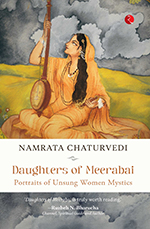
In this book, Namrata Chaturvedi has accomplished the difficult task of merging wonderful storytelling with scholarly rigour. She has reconstructed the lives of unacknowledged, little-documented women saints in India—Sahajobai, Bhuribai ‘Alakh’, Anjana Devi, Vandana Mataji, and Nan Umrigar—who lived between the eighteenth and twenty-first centuries.
As a critique of Weber’s idea about ‘other-worldly’ eastern spirituality, Chaturvedi talks of how these mystics found God in knowing how to serve, instead of turning away from the world. Through lives located in inter-spiritual mysticism, communities of sisterhood, and alternative epistemologies—Chaturvedi reiterates that the lives of saints are spiritual discourses in themselves.
I found the section on methods of data collection very useful. Chaturvedi referred to leading spiritual magazines in India such as Kalyan published from Gita Press, Gorakhpur, which has been continuously in print since 1926; interpreted compilations of the saints’ texts (written and oral); interviewed family members and disciples; analysed notes from field visits; and revisited the history of women’s spirituality in India through material memories that exist in the form of samadhis, chatris, temples, dhams, mathas, ashrams, and community kitchens. She has also looked at literary archives that exist in community libraries, personal collections of patrons and followers; and particularly acknowledged support from community elders, mahants, teachers, and indigenous scholars. This gives a good idea about how to proceed with research in this field, especially when there is a lack of documentation in academia.
Chaturvedi provides an account of how these mystics navigated societal challenges, the nature of spirituality they chose—and through that, how they rewrote gender and social norms. For instance, a remarkable aspect of Sahajobai’s tradition was that women enjoyed central positions as mentors and mahants. Her book of poems, Sahajaprakash, questioned social hierarchies and false identities, even among the men of God.
We also get to read about how the women in the saints’ lives—neighbours, relatives, devotees, and seekers—were part of their spiritual journeys; and how the saints offered transformative experiences through alternative interpretations of everyday life. Here’s an excerpt: ‘One day, a woman came crying to her (Bhuribai) and said that she doesn’t have a son. She requested Bai to perform a miracle. Bai said, “I don’t have one either.” Her words instantly freed the woman from the social burden of providing a son.’
Through this incident, Chaturvedi also documents a rare instance of a woman saint reflecting on the nature of women’s desire. She writes that male saints such as Kabir, Sunderdas, and Namdev discoursed on the nature of desire, primarily men’s desire, by trying to free men from attachments to carnality by speaking of women’s bodies as symbols of decadence and degeneration. But when a young widow came to Bhuribai, she didn’t equate men’s bodies with ugliness or threat. She simply provided a way for women to respect their love by thinking beyond the body.
Vandana Mataji, who was born to a wealthy Parsi family in 1924, formally entered the Christian community at the age of twenty-one and soon became an inseparable luminary of the Christian Ashram Movement in India. An ordained sister in a nun’s habit, she was seen going for lessons in Hindustani music to Ustad Latafat Husain Khan, who was from the Agra Gharana of Hindustani classical music. Her Ustad had composed many poetic pieces (bandishes) under the pseudonym ‘Premdas’. In her own words, it was music that became her main means of entering into meditation. Vandana Mataji also wore saffron robes and maintained that she was a Christian. Through Vandana Mataji’s story, Chaturvedi notes that one can be born Zoroastrian, become Christian and practice Hindu sannyasa and nama japa. In this context, she reflects: ‘In today’s times, can we even comprehend this?’
A central feature of the book is how these saints interacted with other saints—Sufi, Jain and other traditions—revealing the importance of exchanging ideas for spiritual fulfilment and not intellectual display. Bhuribai was only 15 when she met a Sufi yogini, Noori Bai, who became a fellow seeker and like an elder sister to her. Anjana Devi’s spiritual life was beyond cults and a single guru. In her book, And the Mother of Jesus was There, Vandana Mataji has written about the Christian prayer to the divine mother and has shared her reflections on the words of the prayer—about how they carry echoes from the Upanishads and Bhagawad Gita.
Yet, the book also speaks about the everyday struggles in spirituality, reminding us again that spiritual wisdom doesn’t burst forth without agony and chaotic narrative turns. Chaturvedi points out the many resistances—including dogmatic, social and political opposition—that Vandana Mataji had to face. She faced strong criticism from within the Christian community, both in India and abroad, as well as from Hindu activists and social commentators such as Sita Ram Goel.
The hagiographies of Charandas mention that the Delhi gaddi (succession) was given to Sahajobai upon her Guru’s passing in 1782. This resulted in disagreements between the disciples of Charandas; eventually, a court order granted the gaddi to Sahajobai. She managed the gaddi till her passing in 1805.
Chaturvedi also tries to merge rational thinking and legends. For instance, she rationalizes Meerabai and Anjana Devi’s devotion in the following words, ‘…with time, memories fade away. Even the elders forget what they have kindled in the hearts of their daughters. Meerabai was told that Krishna was her husband; Anjana was told that it was possible to directly see her God. Meera and Anjana had trained their consciousness to see God in stone.’
To take another example, Chaturvedi rationalizes the miracles that these women saints performed, ‘Miracles are not isolated events defying the laws of the phenomenal world. They are symbolic extensions of the knowability of the world. Looking deeper within, we can recognize that the phenomena around us and our engagement with them are both limited by our own knowability…. When the spiritual journey begins for a person, she knows only the material world. Her sense of confidence rests on observed reality and a grammar that the world understands. As she goes deep within her consciousness, she experiences the unknown. Over time, the unknown becomes familiar, but only to her…. Since the outside world doesn’t know what she knows, it terms her mad or miracle-maker.’
The book also raises some tough questions. Was Meerabai reborn? Is her association with Madhavi (mentioned in the Brahmavaivarta Purana) and Anjana Devi, who passed away in 1925, a story about rebirths? The author also writes about her own dream visions and how she could make sense of her father’s death with the help of the writings of two exceptional women: Khorshed Bhavnagari and Nan Umrigar.
Through these experiences, Chaturvedi academically converses with the subject of grief and healing. The women saints in the book healed from their brief or troublesome marital lives with spirituality, overcame societal challenges through love and devotion. Chaturvedi herself healed after her father’s death through her spiritual experiences. In this manner, the book is quite transformative as it allows the reader to process and interpret it from their own standpoint.
Juanita Kakoty is a writer and researcher interested in epistemological and ontological queries related to gender, violence and social constructionism.