
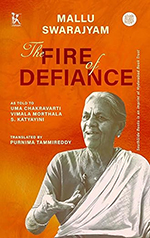
Few women who participated in the Communist-led Telangana movement (1946-51) against the feudal system and the Nizam’s rule have left as vivid and compelling a first-person account as Mallu Swarajyam. The Fire of Defiance, a translation of her Telugu memoir Naa Maate Thupaki Thoota (My Words are Bullets, 2019) makes accessible to a wider readership her recollections of one of the most volatile phases of Telangana history. But The Fire of Defiance presents Mallu Swarajyam in her own voice—with all its spontaneity, digressions, and emotional immediacy.
The memoir begins in the manner of an oral narrative, establishing from the outset its conversational rhythm rather than chronological precision. Her father reportedly wanted to name her Samrajyam (empire) in honour of the British Empire, but her mother Chokkamma, at the suggestion of her Congress-activist brother deeply influenced by the freedom struggle and Gandhi, named her Swarajyam (Independence). More than an evocative name, Chokkamma gave her daughter the moral values that shaped her political life. She instilled in her a deep sense of compassion, a profound sympathy for the oppressed, and an instinctive rebellion against injustice and exploitation. Unsurprisingly, several pages of the memoir are devoted to her, her courage, and her unwavering support for the radical politics of Swarajyam and her elder brother, Bheemireddy Narasimha Reddy, the other influential figure in Swarajyam’s life.
‘Amma was a humanist by nature. She was a courageous lady who hoped the feudal system would change for the better.’ This simple statement captures the essence of her humanistic values, rather than any overarching ideology, that informed Swarajyam’s lifelong struggle to ensure justice to ‘the wretched of the earth’. As she observes after becoming an MLA, ‘Regardless of one’s political leaning or ideology, one must discover the issues that people face and evolve strategies within the legal framework to resolve them’ (emphasis added). Although she eventually became one of the most recognizable leaders of the Communist Party, she disarmingly remarks, ‘All my work in the movement was unplanned; it happened organically.’ Unlike many political memoirs, which retrospectively impose ideological coherence upon youthful activism, The Fire of Defiance presents political consciousness as something that emerged gradually through lived experience, family influence, and direct encounters with oppression. The result is a narrative that feels less like a political testament than an honest recollection of a life shaped by circumstance and conviction.
Equally revealing is the memoir’s account of the role literature played in firing the political imagination of the young rebels. The Telugu translation of Maxim Gorky’s Mother (1906), for instance, profoundly affected not only those who could read but also illiterate women to whom it was read aloud, replacing books based on the Ramayana and the Mahabharata. Gurajada Appa Rao’s poem ‘Puttadi Bomma Purnamma’ (1910), with its powerful critique of child marriages, similarly inspired a generation of young readers to question oppressive social practices.
As it often happens in life narratives, the underwritten and the unwritten promise to be more interesting than episodes that are fully narrated. For instance, contrary to the narrative currently being promoted, Mallu Swarajyam rightly suggests, but does not elaborate, that the main objective of the ‘police action’ of 1948 was to crush the Communist movement in Telangana rather than to ‘liberate’ the Hyderabad State from the Nizam’s rule. Swarajyam is also economical in her description of the disarray the Communist Party was in after the sudden withdrawal of the armed struggle in 1951, seemingly without consultations with even the frontline cadre. She then elides the next three decades (1951-78) of her life and the struggle to adjust to domesticity after leading an adventurous life. Her transition from a guerrilla fighter to a Member of the Legislative Assembly (1978-85) is also treated cursorily.
Purnima Tammireddy’s rendering manages to convey the orality, urgency, and frenetic pace of the original, faltering only occasionally. For instance, ‘Amma, nee banchan’ is translated as ‘I beg you mother’ rather than ‘Mother, I’m your slave’; the acronym NIMS is expanded as National Institute of Medical Sciences instead of Nizam’s Institute of Medical Sciences, and the use of modern management clichés like ‘steep learning curve’ sounds somewhat anachronistic in the memoir’s historical context. In addition to the rather lengthy introduction, which extends well beyond the memoir itself, a translator’s note would have enriched the volume.
The publication of The Fire of Defiance is a product of an interesting collaboration between two independent publishing houses with clearly articulated agendas. While Zubaan is a well-known feminist publisher based in Delhi, SouthSide Books, an English imprint of Hyderabad Book Trust, is ‘dedicated exclusively to material relating to and emanating out of the Telugu/Dakhni speaking States, including material in Urdu, and from the other southern States of India.’ It identifies its target readership as those ‘who are interested in good literature … but are unable to read fluently in their mother tongues’. However, one wonders how much of this memoir will be understood even in English translation by readers unfamiliar not only with Telugu language but also with the complex political history of the erstwhile Hyderabad State in the 1940s and 1950s.
Vijay Kumar Tadakamalla is an academic, translator from Telugu, and Director of the Hyderabad Literary Festival.