
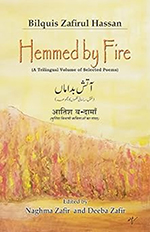
Hemmed by Fire is an elegant book, a loving tribute by her two accomplished daughters, Naghma Zafir and Deeba Zafir, to their very accomplished mother. The book has not only made Bilquis Zafirul Hassan’s distinct poetic voice available to non-Urdu audiences but by featuring translations mostly by women translators, it also metamorphoses into a textual space of female solidarity. The collection of thirty-three poems is divided into five sections. While the first section is not titled, others are titled ‘Poster Poems’ (11 poems), ‘Verselets’ (3 poems), ‘Some Poems Craving Indulgence’ (10 poems), and ‘Ghazals’ (4 ghazals). Clearly, these divisions are based neither on form nor on themes alone.
Bilquis Zafirul Hassan has been one of the significant names in Urdu poetry who have been at the vanguard of Urdu women’s poetry in post-Independence India. Women’s voices in Urdu poetry waned post Partition, just as they saw an unprecedented spurt in the newly formed nation of Pakistan. Oppressive gender laws gave a further boost to voices of rebellion and violence among women Urdu poets of Pakistan. Born in 1938, Hassan had published short stories in popular Urdu periodicals but gave up writing after marriage and devoted herself to the care of her husband and family. She has, over the years, produced anthologies of poetry, plays and short stories. She has also led and mentored women poets through her association ‘Banaat’. Her collections, Geela Eindhan (1996) and Sholon Ke Darmiyan (2004) have been widely admired. Her volume of short stories, Veerane Aabad Gharon Ke came out in 2008, while her translation of English short stories, appropriately titled Maange Ki Aag, was published in 2011. She won the Urdu Akademi Award in 2005. She also writes plays, and her collection of plays titled Tamasha Kare Koi was published in 2012.
Interpersonal poems like ‘A Nazm for My Son’ or ‘Daughters’ leave a long-lasting impression on the minds of the reader. But the interpersonal is not all that bothers the poet. Many poems in the section ‘Poster Poems’ are explicitly political in nature, responding with urgency to the escalating violence, communal hatred and authoritarianism in politics and society. The poet does not engage in ideological debates but in challenging the silences and complicities, poignantly presents the human tragedy it entails. Beyond these themes, most poems in the volume offer a sustained critique of patriarchy, and the structures through which women’s lives are regulated and silenced. Drawing upon women’s lives as an archive of social formation, she questions gender dynamics. In her poem ‘Mother’, she takes a dig at the social typecasting of motherhood:
Now that her role as a mother
Has become a runaway hit,
They do not allow her to perform
Any other (p. 56).
Yet another poignant poem is ‘Suicide’ where the poet hints at the banal lives of women and their everyday death in these lines:
There are several ways of committing suicide.
One can choose any of them.
….
But the most horrible is—
To die while living (p. 107).
The poem ‘Will You be My Friend?’ gives a refreshingly novel articulation to women’s anger by exposing the asymmetrical power equation between husband and wife, where the wife is forced to tolerate his scorn, condescension, infidelities and so much more. The wife reminds the husband that being the ‘better half’, she won’t ‘stoop’ to pay back in the same coin. She then moves on to invite him to be her friend:
My children’s foreheads bear your name.
I have to keep it glowing—
……..
Try being friends, just once!
It won’t be a bad deal—I promise—
So? Will you be my friend? (p. 34).
In poem after poem, Hassan defies confrontational and contestatory politics, and views conflicts with a humane approach without falling into the trap of gendered binarism. In the poem ‘Handle with Care’, the poet underscores the need to handle relationships with care as they are fragile, and any carelessness can fragment them:
In the blink of an eye, they may slip.
From your grasp
And then when you pick them up
Your fingers crack apart (p. 159).
In the poem ‘Extinct’ she again emphatically underlines the futility of confrontation, for she knows that the politics of hate and antagonism cannot lead to happiness. Like Fanon, she seeks healing, making the world whole again through collaboration and friendship:
When the war ends—whosoever wins
Will be left merely
With a pile of corpses.
Of what use is victory?
…….
Surely, there must be a way out
of this Kurukshetra?
Let us come together and look for it
And save ourselves (p. 31).
All these poems explain why Bilquis Zafirul Hassan was uncomfortable being labelled a feminist as the editors write in the Introduction. Simply being a woman poet does not make one a feminist. Western liberal feminism in its universalist goals and thrust on self-empowerment has disavowed cultural specificities and structures of oppression. Hassan echoes similar ideas in her poems where sensitivity and compassionate understanding are privileged over radical ruptures. Sample this outpouring of gentle resistance in the poem ‘Certainly’ which draws attention to the invisibilizing of women’s domestic and emotional labour as wives and mothers:
Certainly
The house is yours—
….
But my blood? My toils?
What about them? (p. 156).
The translations of the poems are of uneven quality—some extraordinarily poetic, some plain, and a few just dull. Translating the ghazal form is always more challenging.
Bilquis Zafirul Hassan’s poetry is the poetry of embodied experiences, gentle assertions, subtle but firm resistance, and a lyrical casting of sisterhood and solidarities. She reclaims agency, not through making a noise, shouting or laughter, but through soft murmurs, smiles, irony and humour—sometimes even extending the hand of friendship and reconciliation in place of outright dissent, in other words, by weaving the everyday life of women in the warp and weft of resilience and remembrance. The volume, a richly deserved celebration, opens a gateway to Hindi and Anglophone readers to this unique voice. One hopes that this is only the beginning and in times to come, Bilquis Zafirul Hassan’s poetry gets the attention it so richly deserves.
Nishat Zaidi is Professor of English and the Honorary Director of the Sarojini Naidu Centre for Women’s Studies, Jamia Millia Islamia. Her recent publication is Vernacular Encounters: Politics and Possibilities (Routledge, 2026).