
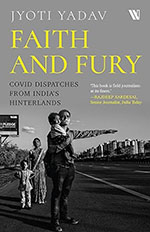
This extraordinary book brings home the fact again that the best writing on the COVID-19 epidemic in India is perhaps written by intrepid journalists, not by people like me, public health researchers. Vidya Krishnan’s work immediately comes to mind. Braving death threats and rape threats, Krishnan’s raw reporting was jaw searing and gut wrenching. She documented the many failures of governance at every step and was rewarded with abuse.
Jyoti Yadav is more modest as she describes what she saw and what she tried to do during the terrible phases of the pandemic. Bravely, she decides to see and document what is happening in India’s heartland, Uttar Pradesh and Bihar. These are not simply hinterlands, but the heartlands of Hindutva.
Jyoti Yadav’s book tracks her journey which bore witness to terrible migrations, police brutality and death. She travels when no one is travelling, visits villages where no journalist has been to, goes to Primary Health Centres, Community Health Centres, District Hospitals, medical college hospitals in State capitals and private hospitals. She talks to people on the ground, to doctors, patients and their relatives, and to administrators and policy makers. She spends hours talking to the Doms at the ghats in Varanasi. She helps desperate patients whenever she can—obtain a hospital bed, obtain an oxygen cylinder. She verifies facts wherever she can and tells you when she couldn’t. She overcomes her own fears when she feels ill—could it be COVID? Yadav’s descriptions of the devastating migration to their village homes of millions of precarious workers thrown out of their jobs in the lockdown, with no food, no water and no transport recall Neeraj Ghaywan’s Oscar-nominated, deeply moving film, Homebound.
The lockdown, with just four hours’ notice, in March 2020, was devastation revisited on a population struggling to recover from the demonetization of 2016. India of course is largely a population of ‘informal workers’, with no formal contracts, no unions representing them, living precariously on subsistence wages in small enterprises in the cities. With these enterprises shutting down, what were they to do? There were no buses or trains—the Shramik trains came much later—they decided to walk back to their villages. This has been described as the greatest migration in the subcontinent after the Partition. Many did not make it, dying along the way. At some places, police sprayed them with insecticide, as if they were vermin.
‘According to the Ministry of Road Transport and Highways, a total of 1.6 crore migrants reached their native places during the lockdown. Out of this, 63.19 lakh migrants were ferried by the Railways in 4,621 Shramik trains between May and August. This means that 42,81,000 migrants either walked or cycled, boarded trucks, booked private buses or used tempos, and even thelas, to reach their villages. And thousands couldn’t make it’ (p. 35). Between March and June, 81,385 road accidents were recorded causing 29,415 deaths. These, like many other dead, did not even make it into statistics.
Yadav recalls the story of Jyoti Kumari, whom she interviews. A teenager from Darbhanga in Bihar. She had bicycled with her injured father, Mohan Paswan, from Gurugram to Darbhanga in nine days, a distance of 1,200 kilometres. She was briefly lionized; ministers promised to pay for her education. But soon the cameras shifted and she has not been able to make it to college, as she had dreamt.
Three reasons why Uttar Pradesh paid such a heavy price: the Central Government permitted the super-spreader, the Kumbh Mela; panchayat polls; and the returning migrants bringing infection to their villages.
It should come as no surprise that the health system collapsed, with lack of beds, lack of oxygen, lack of ventilators, lack of PPE and lack of human power. Bodies piled up—who can forget the image of bodies buried in shallow graves on the banks of the Ganga? Crematoriums broke down and wood for cremations was in shortage. The Government’s response was to fudge data. What Yadav does is to go to the ghats and reveal the true extent of deaths. Stung by these revelations, the Government then put up barricades, large and tall steel sheets, to prevent journalists from visually covering the ghastly sights.
While Yadav talks to the migrants and patients, bringing us their stories, she seems hesitant to tell us about their castes. The majority of the marginalized are of course either Dalits or Muslims.
Yadav provides direct evidence about the underestimation of COVID deaths. Some of these occurred because the afflicted could not reach hospitals; some occurred because they were not tested at health centres when they reached them. Above all, because the Government of UP wanted to hide the massive size of the problem.
The health system failed not due to the virus alone, but four decades of neoliberal cuts to public health and incentives to the private sector in medical care.
Officially, the deaths due to COVID are said to have numbered 5,33,570. The demographer, Professor KS James, Director of International Institute of Population Sciences, Mumbai, was shunted out for publishing a paper arguing that this was a serious underestimation. The demographer Professor Christophe Guilmoto estimated the real number to be close to 2.2 million, the highest in the world after adjusting for the young age structure of the Indian population. What Yadav describes is devastating consequences of state failure. However, she does not ask herself further questions. Having said that, this volume must be made essential reading in all schools of journalism and public health.
Mohan Rao, former Professor, Centre of Social Medicine and Community Health, Jawaharlal Nehru University, New Delhi, is currently an independent public health researcher based in Bangalore.