
The Gallipoli Campaign (also called the Dardanelles Campaign, the Defence of Gallipoli, or the Battle of Gallipoli) was a military operation during the First World War on the Gallipoli Peninsula (now Gelibolu) from 19 February 1915 to 9 January 1916. The Allied powers—Britain, France, and the Russian Empire—aimed to capture the Ottoman Empire, one of the Central Powers, by gaining control of the Turkish straits. This would have exposed the Ottoman capital at Constantinople to bombardment by Allied warships and cut it off from the Asian part of the Empire. With the Ottoman Empire defeated, the Suez Canal would be protected, and the Bosphorus and Dardanelles Straits would be open to Allied supplies to the Black Sea and Russian warm-water ports.
In February 1915, the Allied fleet failed to force a passage through the Dardanelles. An amphibious landing on the Gallipoli Peninsula began in April 1915. Gallipoli was the first major amphibious operation in modern warfare. British (including troops from the British Empire) and French troops landed on the Ottoman-held Peninsula in the Dardanelles Strait. In January 1916, after eight months’ fighting, with approximately 250,000 casualties on each side, the campaign was abandoned and the invading force was withdrawn. It was a costly campaign for both the Allied powers and the Ottoman Empire.
Indian troops played a crucial role in several key battles during the 1915 Gallipoli Campaign, suffering heavy casualties while supporting Allied efforts against Ottoman defences. On 12 May 1915, the 29th Indian Brigade, including the 6th Gurkha Rifles, captured a coastal hill feature west of Krithia, named Gurkha Bluff for their effective action; this marked their first significant engagement in the Helles area. In the third Battle of Krithia, fought on 4 June 1915, the 14th Sikhs (Jat Sikhs) from the 29th Indian Brigade charged Turkish positions at Gully Ravine amid intense machine-gun fire and barbed wire, suffering 82% casualties as nearly the entire battalion was wiped out in close-quarter fighting. Indian units repelled Turkish assaults on 3 and 5 July 1915 near Gully Spur and Gurkha Bluff, with Gurkha battalions pushing back the enemy by 1,000 yards over eight days of counterattacks, while sustaining 40% casualties. In the August 1915 offensive, the 29th Indian Brigade landed at ANZAC Cove on 5-6 August and assaulted Sari Bair Ridge; on 9 August, the 6th Gurkha Rifles briefly crested the summit before artillery and counterattacks forced a retreat.
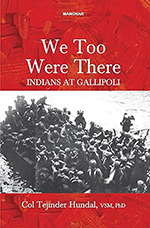
The histories of Gallipoli have traditionally focused on the ANZACs (Australia and New Zealand) and British forces. The book, We Too Were There: Indians at Gallipoli by Col Tejinder Hundal is a detailed military history that focuses on the Indian Army’s role (over 16,000 Indian troops) in the Gallipoli Campaign during the First World War. Hundal’s book seeks to restore the Indian soldiers’ service, sacrifices, and experiences to the narrative. Hundal argues that the ‘spirit of Gallipoli’ wasn’t just an Anglo-Saxon phenomenon. It was a multicultural crucible where Indian soldiers earned the respect of their peers through sheer grit and professionalism. The book follows the 13th Frontier Force Rifles, the Indian Mountain Artillery, and thousands of mule drivers and medical personnel who served on the rugged Turkish peninsula. Hundal doesn’t just provide a dry military report; he reconstructs the campaign through a lens of shared sacrifice.
Col Tejinder Hundal is a serving Indian Army officer with a Ph.D. in Defence and Strategic Studies. He has keen interest in the participation of Indian Army troops in the two World Wars. At over 600 pages, his book is comprehensive and deeply researched. It is built from extensive research into primary sources, including war diaries, personal letters and regimental records. These sources document the deployment of Indian infantrymen, artillery units, mule transport and logistic corps, and the hardships they endured on the Dardanelles Peninsula from April to December 1915. The book includes maps and sketches that help visualize the Dardanelles’s impossible terrain. It doesn’t just recount battles; it delves into mobilization, logistics, adaptation to harsh conditions, and the administrative challenges of war from an Indian perspective. These topics are rarely covered in mainstream histories of Gallipoli.
Hundal highlights how Indian mountain batteries provided the only effective artillery support for the Anzacs in the early days of the landing. A significant portion is dedicated to the 6th Gurkha Rifles and their legendary capture of ‘Sari Bair’, the highest point reached by the Allied troops. Beyond the frontline, the book also talks about the Indian mule corps, who navigated treacherous terrain under constant fire to deliver water and ammunition.
The first chapter of the book, ‘The Activation’ unravels the decisions and strategies of the belligerents (mainly Britain and Turkey) in their effort to capture and defend the Peninsula, respectively. The chapter also discusses the origins of the various Indian Expeditionary Forces and their deployment in the various theatres of war. It finally covers the operations of the 29th Indian Infantry Brigade’s troops in the Peninsula.
‘The Arrangements’ is a chapter which provides a detailed analysis of the recruitment system, patterns, incentives, and the state of the Indian Army (infantry, artillery, and the Imperial Service Troops) in 1914. It also briefly includes the oft-neglected component of the Burma Military Police, which was part of the Indian Brigade at Gallipoli. Then follows ‘The Affirmation’, which is dedicated to the participation and contribution of the Indian troops in the various battles fought in the Peninsula.
The penultimate chapter of the book, ‘The Administration’ discusses the personnel, arms and ammunition, food, water, medical supplies, and the pay and allowances of the Indian troops at Gallipoli. The chapter also deals with issues of reinforcements and reporting of casualties of the Indian forces. The last chapter, ‘The Acknowledgement’, is dedicated to the memories of the soldiers who sacrificed their lives at Gallipoli. The chapter delves into the trials and tribulations of the Indian soldiers. Stories of three Sikh soldiers who participated in the campaign are also highlighted.
Hundal’s central aim is to acknowledge and honour the Indian troops whose contributions have been historically overlooked. The narrative draws attention to the courage, discipline, and heavy casualties suffered by formations like the Sikh infantry and support units. Hundal’s work also serves as a corrective to colonial era histories that minimized the Indian role in favour of Western front perspectives. This makes the book not just historical but also commemorative, appealing to readers interested in hidden or marginalized war narratives.
Hundal’s writing is deeply researched, striking a balance between military strategy and human emotion. It is a vital read for anyone interested in how the Indian Army became a world-class fighting force. The book is most useful for military historians, defence professionals, students of the two World Wars, and readers interested in the overlooked role of Indian soldiers in global wars.
Air Marshal Anil Khosla, (Retd) PVSM, AVSM, VM was former Vice Chief of Air Staff, Indian Air Force.