
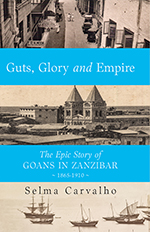
This is an excellent example of a free-flowing narrative history that balances academic conventions with accessible storytelling. At the heart of the narrative is the story of Goan migrants who travelled to Zanzibar, made it their home, made fortunes, dabbled in politics and fashioned their selves consciously and innovatively. In a sense, the story parallels the stories of other migrants but with a new and unusual layer. Goans were Catholics and Portuguese subjects who nonetheless enjoyed the status of British protected subjects, making their experience and location distinct and different. Zanzibar and its merchants were no newcomers to the realities of competing and complementary jurisdictions but the fact that a small section of Goans was able to make it really big is an impressive story. The author chooses to tell the epic story of Goan success in Zanzibar through the lens of individuals and ego-documents, and the result is both a colourful account of personalities and their entanglements in local politics as well as of tensions and stratifications within Goan society. On the flip side, the story is replete with details and moves in too many directions making it difficult for the readers to keep pace with. Also, the explanations proffered for the success of Goan enterprise are inadequate. Nor is there a comparison with other diasporic communities that capitalized on the cracks of jurisdictional ambiguity in Zanzibar.
Goan migrations to Zanzibar occurred around the latter decades of the nineteenth century and followed familiar pathways of South Asian migration. There were labour migrations mostly of sailors and cooks as well as men of enterprise and service with the result that a small but influential group of Goans in Zanzibar soon became well known as influential retailers working for big European firms like Spencer & Co., shop owners, journalists managing the government press and post offices. Carvalho tracks this story by locating specific individuals and we will do the same to highlight the merits of the approach. CR Souza is the principal protagonist who arrived in Goa in 1865 to become one of its richest merchants. His connections with English captains, however tenuous, helped. By 1891, his experience as a table servant and cook brought him in close proximity to Consul (Kirk) and Sultan (Barghash). Souza entered retail trade and became part of what Carvalho calls the Goan shopocracy in East Africa, after which they were able to enter the public sphere as philanthropists and journalists. What is not clear from the account we have is how Souza came to occupy such a prominent place in the island among the small society of Goans, how he set up the retail shop business, where he got his capital from and what his leveraging tactics were in getting the support of European firms like Spencer & Co. On the other hand, the strategies used for expansion are well elaborated. We are told that Goan stores were in marked contrast to Gujarati dukans in décor and outlook; European clientele was cultivated by projecting clean, airy and hygienic stores. We also know how Souza with a small select circle was part of philanthropic societies and negotiated with consuls and royalty to stabilize his position.
Goans in Zanzibar participated in a wide spectrum of activities and had extraordinary socializing skills. Souza like many of his counterparts cultivated close relationships with fellow Goans as well as with the royal household and the consular circuit. They brought to the table an array of skills. Francisco Noronha, for example, who owned a pharmacy business was not a certified doctor but had adequate skills as a compounder to provide auxiliary services to sections of Arab royalty. Even more impressive were his language skills that enabled him to double up as diplomat and broker. In the descriptions that we have of Noronha’s dealings with the Sultan and the English Counsel, we get a clear picture of what enabled sections of the Goan community to prosper and acquire land, and emerge as a major actor in Zanzibar’s modern public sphere. The other key men identified in the charmed circle of elite Goans were Angelo Albuquerque, Dominigo Baptista Pereira, Joao Pedro Souza and Antonio Luis Silva who were among the founding members of two societies, the Society of Francis Xavier and the Society of Sao Jose. How these societies functioned and how they helped mediate the relations of the community with the Sultan and European Consuls is not elaborated. In fact, one of the problems with Carvalho’s narrative is that it moves rapidly in different directions making it difficult to track individual trajectories, analyse larger developments and to make sense of inter-generational Goan success.
An important but under explored aspect of the book is its understanding of the stratified nature of the Goan community in Zanzibar. There were fractures of class and even caste. The author refers to racist expressions and behaviour but without providing a set of clues as to why this was so. The treatment is a little hurried and it is difficult to segregate from the stories of individual Goans, the larger history of racist prejudice or of caste tensions. For the most part it is the saga of great men, the great Souza and his partner Felix Dias, and how they quickly embraced Europeanism. There was something about elite Goans who fitted into the new schemes that the British introduced after 1890 when they assumed the protectorate of Zanzibar. The production of the Zanzibar Gazette was one such project that enlisted Goans as managers. The same was true of the postal service and sanitation departments whose bureaucratic infrastructure held opportunities for Goans. What enabled Goans to assume the status they did in Zanzibar had to do with their unique skill sets: language proficiency, Catholicism, musical aptitude and scribal cum apothecarial skills all of which helped in relocation. Just how these worked in their favour comes through only tangentially in Carvalho’s account. What comes out with greater clarity is the back story of the Goan migrants and the villages they left behind, the descriptions of which are evocative and compelling. In many ways, the book does not offer a new perspective on the larger story of South Asian migrations (Capital and labour) as it does of the social realities of the villages that migrants left behind and of the unusual social and political geography of the tiny State of Goa itself. The book is a compelling read for all those who marvel at the specificities of Goan cosmopolitanism and of the curious layers of experience that Goans underwent in church and comunidade preparing them for adventures overseas.
Lakshmi Subramanian is former Professor of History, Centre for Studies in Social Sciences, Calcutta, and BITS Pilani, Goa. Her recent publications include India Before the Ambanis (Penguin, 2024).