
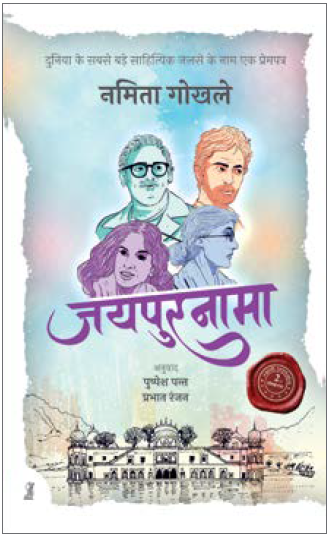
Namita Gokhale is a prolific writer with varied interests. She has written books on diverse issues ranging from travel to spirituality to mythology. Co-founder of the biggest literary festival in India, Gokhale has been recognized as one of the most creative and skilful curators of our times. Jaipur Journals establishes her as a leading satirist of our generation. She writes about the inside world of writers attending literary festivals, seeking approbation, building relationships and struggling with their own inner selves. ‘To Jaipur. January.’ The first line of the book opens a world of possibilities where the young and the old meet and assess each other with an uncanny distrust. Gokhale can make you smile at the littlest of things, and wince when nothing seems to work. There is laughter everywhere but underneath it lies the pathos of human existence.
The desire for recognition, the loneliness of a writer’s world, the naïve ego that crushes her ability to live and accept herself are some of the moments that are talked about in this novel. The wicked banter as in ‘The last question threw him off keel. “In your opinion, Mr Cripps, to what extent is Mr Donald Trump influenced by Donald Duck?” “Every American is influenced by Mr Duck”, he replied, “including Mr Trump.” “So you are a master of Duckology, after all?”… “Quack!” Quack! he replied…”’. Described on the front cover ‘as a love letter to the greatest literary show on earth’ this is the story of the festival and its writers, those who have achieved fame and those who are hoping to reach there, those who love books and those who thrive through contacts. Gokhale knows this world inside out. She writes about the pretensions of the literary world with a mock seriousness and brings out the angst and arrogance of the pen. Here ‘the lady of the poisoned quills’ is Rudrani Rana. Anna Wilde’s journey is another interesting story that weaves an intricate tale of a woman who is drawn to India after watching Jean Renoir’s classic, The River. Each visit gives shape to a new manuscript and a writer is born.
The transition of Raju Srivastava, the thief from Raju to Betaab the poet is reminiscent of Raju in RK Narayan’s The Guide. ‘The story of Betaab’s birth as a poet began with demonetization, and the stacks of thousand-rupee notes he had put away after a recent successful haul. It began with a well-executed burglary.’ The lively poet at the festival is ‘lost and disconsolate’ when he sees the literary world ‘full of privileged hierarchies and lucky chances, of winning streaks and downward spirals of defeat and heart break.’ The fabulous narrative tells us a lot about the superficial structures that build this society. It also reveals the social malaise that goes unaddressed by the privileged class. If gossips and affairs are talked about with salacious delight, venom and vitriol too are characteristic of this world.
Pushpesh Pant and Prabhat Ranjan’s translation not only retains the original fervour but in certain cases accentuates the beauty of the text. ‘A woman with a mane of grey shaded hair’ becomes ‘ek khichdi balon wali mahila’ (p. 236). There are several instances where the translators create a nuanced reading through their choice of words.
Our lives are made up of stories, and writer Namita Gokhale has the gift of sharing these vignettes with vivid intensity. She clasps the intricate human mind and probes the interior with wry humour. One is reminded of the shepherd in Milton’s Lycidas, ‘Fame is… that last infirmity of noble mind.’ Perhaps it is this desire for fame, appreciation and recognition that propels one to write, to speak and gives one the impetus to live. Humour is always at the expense of the other. It is important to note that the Hindi translation lights up the book with a gentle flow marked with acerbic wit. With this book, Gokhale prepares the reader to enter the world of the literary high and mighty; the aspiring and the famous sit together to add flavour to the text. The last line of the book, ‘We are each other’s stories’, invites the reader to enter this world. Pick up the book and you will not be disappointed.
Ranu Uniyal is former Professor and Head, Department of English, University of Lucknow, Uttar Pradesh. She is a bilingual poet and a disability activist. Her recent book of poems, This Could Be a Love Poem For You published by Red River was the second runner up at the The Wise Owl Literary Awards for poetry (2026)..