
The past no longer rests quietly in India today. It has been pulled into public debate to serve the quarrels of the present. Debates that once belonged in seminar halls are now fought out on television and social media, where amateur ‘weekend historians’ often shout the loudest. Ancient and medieval kings are pressed into service for twenty-first-century quarrels. Monuments are renamed, and textbooks are rewritten to match the mood of the moment. What unsettles the sceptic is not the noise but the confidence behind it, which bears little relation to what the surviving records support.
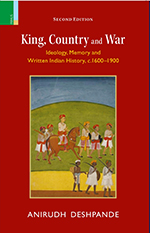
Anirudh Deshpande’s King, Country and War enters this argument as a defence of the historian’s craft. Public scepticism, he argues, is a historian’s duty, and the slow work of reading old sources against their own hidden biases is not merely a scholarly habit. It is a safeguard against invented history.
The book is not one continuous story. Six essays circle different themes, all following the way a fluid pre-colonial past has been flattened to fit modern political needs. Deshpande traces the flattening to colonial writers such as James Mill and Thomas Macaulay, who described India as a civilization that had stopped moving, and to the Orientalist habit of cutting the past into three tidy ages, a Hindu antiquity, a Muslim decline and a British modernity. That scheme became the scaffolding of communal history. The English-educated Indian middle class, Deshpande notes with some bitterness, accepted the caricature and took it for memory.
From here comes the book’s most provocative claim. Secular nationalism and Hindu communalism are two offshoots of the same colonial education system, which first trained Indians to see their own past through narrow and divisive frames. Deshpande takes this further, arguing that the obsession with battles and great men is itself colonial inheritance. Even the anti-colonial historians who set out to oppose this framework ended up preserving its terms.
The force of this is undeniable, though the kinship between the two may need qualification. Both drew from colonial habits of classification, but they did not put them to identical use. Secular nationalism often sought an inclusive civic space, while communalism hardened those categories into exclusion. Nor was the Indian mind wholly colonized. Jyotirao Phule reimagined Shivaji not as a Hindu saviour but as a kunbi-kshatriya set against Brahmanical and foreign oppression, and the Marathi bakhars show indigenous idioms unsettling Westernized frames. Lokhitwadi, Ranade, Chiplunkar and Ramshastri Bhagwat, read closely, show how many-voiced anti-colonial sentiment actually was.
Nowhere is that tension clearer than in the contested legacy of Chhatrapati Shivaji, claimed in turn by Hindu nationalists, by high-caste Brahmins, and by Bahujan-Dalit movements. Deshpande’s careful reading shows instead a practical and tolerant ruler who respected all faiths, built a mosque in his capital for his Muslim subjects, and trusted Muslims with the command of his navy. That record sits awkwardly with every party that invokes his name to divide people. Beneath the portrait runs a sharper argument, which is that the icon was itself manufactured over time, from the poet Bhushan and the Sabhasad Bakhar in Chhatrapati Shivaji’s own century to Grant Duff’s 1826 attempt to compress the Marathas into a single history. The idea of a Maratha nation was born only with the nineteenth-century glorification of the king.
The remaining essays pursue the same dismantling. Examining desh and the history of Indian forts, Deshpande dispels the illusion that people of the past imagined a nation-state with fixed borders. His proof is partly linguistic, since even the word ‘Maharashtra’ is absent from eighteenth-century sources such as Kashiraj Pandit and from an account as late as Godse’s Majha Pravas. Power rested instead on forts, revenue and the protection of local trade routes. The fort was less a border post than a node binding all three into one working system, which is why pre-colonial power cannot be folded onto the map of a territorial nation.
The chapter on the Third Battle of Panipat, 1761, may be the most damaging to popular certainty. The battle is remembered as a religious war between the Hindus and Muslims. Reading the Marathi bakhars alongside the Persian eyewitness account of Kashiraj Pandit, Deshpande dismantles this myth. What he finds instead is financial strain, exhaustion and the cold arithmetic of rival warlords. Ibrahim Khan Gardi, a Muslim commander, fought loyally for the Marathas and died in their cause. Religion did not dictate politics.
The final essay turns to the Bombay Marine, the early colonial navy, and argues that marine surveying and cartography were instruments of imperial expansion, binding scientific knowledge to conquest and new markets. Yet maritime power was also collaborative, carried on by European officers, Indian sailors known as lascars, and Parsi shipbuilders. Deshpande calls this a hybrid history, the navy emerging as an Indo-European enterprise rather than a purely British achievement.
Deshpande’s practice is anchored in micro-history, which turns from grand survey to the closest reading of particular events. It rests equally on the warnings of Marc Bloch against anachronism, the error of judging the past by the values of the present. He reads desh, mulukh and watan in their period sense, showing how far they stand from what ‘nation’ means today, and he cautions against blind trust in official archives, since such records were made by powerful states to serve their own interests. In all this he works in the legacy of EH Carr and Eric Hobsbawm, whose conviction that a historian’s first loyalty is to truth rather than to community identity runs through the whole book.
Memory is where the book is most insistent. Recent scholarship has studied how communities remember through ritual, monument, and public culture. Deshpande, by contrast, treats memory chiefly as a problem to be corrected, an accumulation of political bias to be seen through. He does not deny that communities have their own memories. He refuses only to grant them the standing of documentary evidence. His aim is to dismantle myth rather than to collect it, which is the root of a clarity that makes no attempt to soothe popular sentiment.
There is, however, a forceful objection to be raised. The historian’s power to destroy a myth is largely negative, since proving a story false does not hand people a true one to live by, and few myths rest on claims that evidence can actually test. Here Deshpande’s fine archival work is at its most vulnerable. People believe in the religious character of Panipat, or the sanctity of a disputed site, out of faith and ritual, and evidence rarely moves such belief. A scholar may prove the myth mistaken and persuade fellow academics, and still make no impression on the politicians who control schools and textbooks. Archival work cannot on its own correct so large an imbalance of power, and the book is most honest when it accepts this as a permanent condition rather than pretending to have solved it.
King, Country and War is an important and timely book. Its traditional methods and sharp tone will provoke disagreement, as they should. Deshpande warns bluntly that bad history can give rise to real violence, and his epilogue gathers the six essays into a single ethical claim, that the historian’s loyalty to truth over identity is never won permanently and must be fought afresh by every generation. The historian’s first duty is not to flatter the identities people cling to but to show how complicated the past was. By Deshpande’s measure a history written only to comfort a group is no history at all.
Avanish Patil is with the Department of History, Shivaji University, Kolhapur, Maharashtra.