
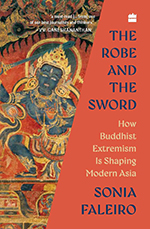
Karuna, metta, mudita, ahimsa—compassion, friendship, joy in the happiness of others, non-harm—Buddhist philosophy and praxis are meant to be synonymous with these values, reflected eloquently in the tradition’s iconography. This book offers a compellingly disturbing contemporary counter-narrative to this perception via the author’s journey through some regions of Buddhist Asia.
The striking cover features ‘Acala, the Buddhist’, an image taken from the collection at the Met, New York, and likely to have been given that intriguing title by a curator. The sword wielding Acala, The Immovable One, Defender of the Faith, is part of the pantheon of the Himalayan Vajrayana tradition. I was reminded of being greeted by other, fierce forms flanking the entrances to Himalayan Buddhist monasteries, their ferocity read within the tradition symbolically as ‘fierce compassion’. A widely loved version of an armed Buddhist deity is Bodhisattva Manjushri, the face serene, the arm wielding the sword of wisdom. The battles here are metaphoric, the sword cutting through the obstacles to spiritual liberation—ego, attachment, greed, ignorance and delusion. I couldn’t help feeling some unease at the generalized deployment of an image from the Vajrayana tradition—with its complex intersection of Buddhist psychology and visual arts left unexplored here—for a book that focuses largely on forms of state-sponsored violence and monastic deviations in the Sri Lankan, Burmese, and Thai contexts.
But then this slim volume is by a journalist, not a historian or a sociologist or philosopher of religion. First published in 2025 as part of the Columbia Global Reports, the book’s declared purpose is to explore how ‘sacred traditions are being weaponised’. Well-received, with the US-based Buddhist magazine Tricycle running an excerpt, it has Pankaj Mishra extolling its ‘intellectual resourcefulness and rigor’ in describing ‘one of nationalism’s most insidious and least-noticed mutations’ while Fatima Bhutto calls it ‘the story of our broken world’.
We reach the core of the book—four chapters—each devoted to Burma, Sri Lanka, and Thailand somewhat obliquely, via serene Dharamsala. There Faleiro meets Lhakpa Tsering whose attempted self-immolation in Mumbai during the visit of the Chinese Premier is seen as a uniquely Buddhist form of protest, harming none but the self. It recalls the supreme sacrifice of the Bodhisattva in the Jataka tale of the Hungry Tigress. But Faleiro interrupts that story to take us on a brisk, demystificatory version of ‘Buddhism for beginners’, especially its reception in the west with bell hooks’s critique of western Buddhism’s privileged white bias, and a passing mention of the 13th Dalai Lama, Thubten Gyatso having founded an army. These strands are not followed through, though. Discussion of violence within the Tibetan context is confined to generalized patriarchal dominance. Neither Tibetan history/culture nor self-immolation as a form of resistance receive the attention they merit. The theme of misogyny and the resistance to it that she traces there, does, however, permeate the narrative.
The book’s focus is the rise of militantly nationalist Buddhism in Southeast Asia, in societies reacting to and shaped by racist imperialism and divisive colonial policy. Its analytical frame is informed by anti-colonial imperatives compounded by deep economic and gender inequalities.
Building on interviews taken on site, as well as the work of scholars, the fast-paced narrative introduces us to a galaxy of characters—a Muslim tutor in rural Sri Lanka, and scholars and journalists who follow militant Sinhala monks’ use of scriptural sanction for ‘well-intentioned’ violence. Sinhala exceptionalism—resting on the idea of the land as Dharmadvipa—deploys ancient myth along with a modern language of dehumanization. The pattern repeats itself in Burma, with the initial targets being Indians, followed by the Muslim Rohingya, with strong parallels suggested with the Indian reality.
The Thai experience is traced via a different triad of nation, religion, and monarchy. Whether it is the young former monk Sukhamla, or the nonagenarian ‘Engaged Buddhist’ Sulak Sivaraksa, individual testimonies lend specificity to stories of xenophobia, monastic corruption, cultish deviations, and forms of structural unfreedom.
Piercing the gloom of this surreal drama of many acts, voices of conscience, reason, and reform appear as beacons of light. Notable are the ‘Kung Fu’ nuns from a monastery in Nepal and young nuns pursuing advanced Geshema Degree in the scholastic Tibetan Buddhist tradition. In Thailand, we see the Santi Asoke movement and the work of the dynamic Thai senior nun Bhikkhuni Dhammananda, whose life as a feminist academic has informed her struggle to become the first fully ordained nun in her country.
With equal parts urgency and empathy, Faleiro’s skilled storytelling weaves sparks of hope and quiet resistance into the fabric of a stained cheevar, the ochre robe that was meant to be a beacon of enlightened quest. Faleiro, a Catholic, self-reflexively inserts her struggle with the violent history of her own tradition into her narrative. As she relates her experience of the sacred in Buddhist temples and dwells on a larger human tragedy, a lyrical melancholy tempers her journalistic gaze.
Maya Joshi teaches Literature at Lady Shri Ram College, University of Delhi, Delhi.