
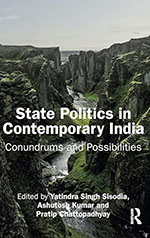
The essays in the edited volume examine the challenges faced by States within a parliamentary-federal polity which has a centripetal institutional framework, while also exploring their capacity to navigate these constraints. Bringing together multi-disciplinary perspectives, the volume treats the constituent States as key analytical units for studying Indian politics as it continues to evolve in an era which has been marked by the emergence of the BJP as the system-defining party. Reading the essays makes it clear that States continue to be vibrant and contested spaces where political processes unfold having national impact, even as the party in power at the centre for the third term has a centralizing political ideology and is currently under strong leadership. By combining theoretical frameworks with empirical case studies, the essays show clearly that for a meaningful understanding of evolving trends in contemporary Indian politics, close attention is required to study the State and sub-State dynamics.
The essays are organized into three well-defined thematic sections that focus on the theoretical, institutional, and empirical dimensions of State politics in India. The opening section lays the conceptual foundation for analysing sub-national politics. The essays situate State politics within a comparative framework, review existing literature, and examine the electoral geography of the two polity-wide parties. KC Suri and Ashutosh Kumar trace the evolution of scholarship on Indian State politics and embed contemporary developments within broader debates on federalism, party systems, and democratic governance. Suri advances a ‘macro-comparative’ perspective, arguing that national political narratives are essentially aggregates of diverse State-level realities. He emphasizes that there can be no one-size-fits-all theory of Indian politics, highlighting that variations across the Indian States are as significant as those among sovereign nations. Suri discusses the different ways in which the scholars have studied State politics, thereby enriching the discipline. His argument is that studying the politics of the States with a comparative perspective and focusing on a particular theme makes it grounded and helps in having a deeper understanding.
Ashutosh Kumar goes beyond a mere review of scholarship to construct a ‘genealogy of thought’ on sub-national politics. He critiques the longstanding tendency to treat the States as administrative extensions of the Centre. His central argument calls for a ‘third generation’ of State politics studies, one that moves beyond the studies that are either State-specific or employ two-State comparative analysis to also take up a comparative framework that studies intra-State and cross-regional variations. Showing how a multi-disciplinary approach enriches the State politics literature, Suraj Jacob, helped with geographical maps, shows disaggregating patterns in the electoral support for the BJP across the States, which may be attributed to their different structural and institutional settings.
Another section of the volume has essays that examine how constitutional provisions, political practices, and institutional arrangements shape the functioning of Indian federalism. It highlights the growing tensions within the system, particularly due to the role of the Governor. Adnan Farooqui’s chapter interrogates the gap between the constitutional ideal of neutrality and the reality of political partisanship, showing how discretionary powers have evolved from exceptional tools into routine instruments of political contestation. Similarly, Shruti Bedi argues that ‘constitutional silences’ have enabled the discretionary misuse of authority, particularly allowing Governors to delay or withhold assent to State legislation. Together, these contributions underscore the centralizing tendencies embedded within India’s federal framework which remain intact since yesteryears even as federalization of politics continues unabated. Rekha Saxena explores how the Union Territories can be located as distinct constituent units within the Indian union in the context of asymmetrical federal arrangements. As such their varied constitutional status reflects the application of the principle of weighted and differentiated equality, which is the hallmark of the ‘Indian model’ of federalism. Overall, these discussions offer critical insights into broader debates on decentralization, democratic accountability, and the shifting trajectories of balance of power between the Centre and States within India’s political system.
Beyond constitutional concerns, the essays also engage with issues of governance and public policy at the State level. Several essays highlight how States have evolved distinct models of welfare and development. Manisha Madhava, through a comparative study of the BJP, AAP, and TMC models, identifies a key shift: voters increasingly prioritize governance capacity and service delivery over earlier clientelistic practices dependent on caste- or community-based patronage. Neeta Tapan, however, cautions that an overemphasis on short-term welfare based on direct transfer of public resources may bring electoral dividends to the parties in power but in the long-term undermines economic sustainability in the concerned State. Ranjana Upadhyay, in her analysis of women voters in Uttar Pradesh, points to a critical contradiction: while parties actively target women through welfare schemes, they remain hesitant to offer them meaningful political representation. Together, these contributions illustrate how States function as laboratories of policy experimentation, driving innovation in welfare and governance, while also revealing emerging tensions and limitations of a patronage democracy. They also make us realize that politics of ‘new welfare’ in contemporary India is not confined to any single State but reflects broader inter-State patterns. Understanding these shifts requires an inter-State as well as intra-State comparative approach rather than isolated State-level analysis. The essays also examine the strategies adopted by national parties to expand their footprint in State politics. Electoral campaigns increasingly blend national narratives with region-specific issues and leadership dynamics, reflecting the need to balance central messaging with local realities.
The section focusing on politics of identities include essays by Hilal Ahmed and Harsh Meena. Ahmed presents a nuanced analysis of minority politics, combining conceptual clarity with empirical depth. He argues that the internal diversity within Muslim communities is crucial to understand the evolving dynamics of Indian federalism. Meena in his study of tribal politics illustrates how the rise of tribal discourse has led to greater political mobilization in Madhya Pradesh and Rajasthan, contributing to democratic deepening in these States.
A major strength of the book lies in its rich empirical case studies covering State-specific essays. The States under study are Madhya Pradesh, Uttar Pradesh, Haryana, Rajasthan, West Bengal, Assam, Telangana and Andhra Pradesh. These essays analyse leadership patterns, nature of electoral competition and social coalitions, and governance challenges across diverse contexts. For instance, studies of northern and western States emphasize the growing importance of development and governance in shaping electoral outcomes. Yatindra Singh Sisodia and Sumit Kumar Jha, in their analysis of Madhya Pradesh, link the BJP’s electoral success to policy performance and welfare delivery, offering a detailed account of its political consolidation. It is the BJP Government’s success in terms of delivery of public services and goods which has allowed it to win the vote of the ‘pragmatic electorates’ of Haryana, Himanshi Malik argues. In contrast, the essays on southern and eastern States highlight the regionalization and pluralization of political competition, where identity politics assumes layered forms, ranging from caste-based mobilizations in the two Telugu States and West Bengal to ethnic assertions in Assam. E Venkatesu’s comparative study of the two Telugu States examines the question of political representation, highlighting a persistent ‘social deficit’ in the inclusion of broader social groups. It argues that genuine democratic deepening requires addressing structural inequalities in representation. Such comparative insights reinforce the diversity and unevenness of political experiences across Indian States.
State politics as a discipline has emerged as a critical arena within political science in recent years in India. The volume makes significant contributions to the literature of State politics in several ways. First, it underscores the centrality of State-level analysis in understanding the trajectory of Indian democracy, challenging approaches that privilege national-level explanations. Second, it offers a nuanced account of federalism by examining the dynamic interplay between central authority and regional autonomy. While acknowledging the rise of centralizing tendencies in recent years, the contributors demonstrate that States continue to remain critical arenas shaping political discourse and governance practices. The volume also shows how regional parties have challenged the dominance of national formations, reshaping the competitive landscape of State politics. Third, the book enriches the growing literature on comparative State politics in India. By analysing multiple States within a single theoretical framework, veering around a common theme, the essays enable the identification of both common patterns and regional variations in the way political processes unfold on the ground. Fourth, through its examination of welfare policies, administrative practices, and development strategies, the volume demonstrates how State governments directly shape the everyday lives of citizens. Finally, taken together, the essays highlight the complex interplay between institutions, political actors, and policy frameworks in shaping State-level governance.
Despite its obvious strengths and contribution to the growing literature on State politics, the essays reflect some limitations which are typical of edited volumes. The most notable is uneven geographic coverage, with certain regions, particularly of western India and the North East, receiving scant attention. A broader set of case studies could have strengthened its comparative scope. The essays fail to present a comparative perspective, taking up two or three State analyses, undertaken by comparativists like Atul Kohli (1987, 1990), Subrata Mitra (2005) and Rob Jenkins (2004) among others.
Additionally, while the volume engages with key debates on ethnic identities, federalism, and electoral politics, its theoretical framework could have been more systematically developed rather than merely providing an overview. Of course, it would have required much deeper engagement on the part of the authors with comparative perspectives on sub-national politics.
Nevertheless, the volume remains a timely and significant contribution to the study of Indian politics. Despite some gaps in thematic integration and regional representation, it offers valuable insights into contemporary State-level dynamics. The volume will be especially useful for scholars, students, and researchers interested in Indian federalism, comparative State politics, and democratic governance.
Shashikant Pandey is with the Department of Political Science, Babasaheb Bhimrao Ambedkar University, Lucknow.