
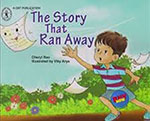
A story running away? Hm…! Sounds odd. I waited for just a moment and then grabbed the book. Personifying a story sounds like an unusual theme for a picture book. How and why did the story run away? Was it caught at the end? Why not read the book and tell the target reader to read it if it is really unusual and interesting?
The generous, captivating illustrations in keeping with the text made me turn the pages and read. Young readers can identify and relate to the activities, the sequence of events of the characters, and more than anything else, to the protagonist Shreedhar who sits with paper and pencil to write a story; quickly followed by the next event of the a ‘flash of white sailing out of the door. His story was gone.’ The story had a good reason to fly away. The wind? No. Then? Read and find out.
Next, the story just didn’t get carried away up in the sky by the breeze. Then there wouldn’t have been a story at all. Our adventurous story paper visits all the other characters in the house, busy in various rooms doing different age-appropriate household jobs. The story encounters the grandfather first, making pickle in the dining room, then grandma in the kitchen, and so on.
Oh! What disastrous encounters, each one of them, for the story paper! The writer obviously becomes a child at heart when she begins writing a picture book. Together with the illustrator whose child-likable pictures reveal his equally child-like state of mind, the book becomes a thrill for the reader.
Shreedhar chases the story paper with a look of amazement and determination to catch it. The running away and the chase continues, humour-soaked for the reader, but hardly so for the story or for Shreedhar.
Finally, what happens to the just-began story—where the paper lands and in what state, and what is Shreedhar’s reaction—is for the reader to find out. Will s/he pity the story paper or Shreedhar?
Well! The reader breathes a sigh of relief as Shreedhar declares with a satisfied look that he has a great idea to write a fresh story, and poses with a fresh sheet of paper and pencil.
Go ahead and read the story, children. You will like it. You can read every page with a chuckle as the text and illustrations develop in a racy manner. And, you know what? At the end, you will also get ideas like Shreedhar to write a story of your own, giving life and adventure to any of your things—like your pencil, your bicycle or your lunch box. Try it. You’ll be amazed at what a beautiful story develops.
One word about the choice of name for the protagonist, Shreedhar. I would want readers to be familiar with our Indian names than shortened forms or pet names like Buntoo or Cheeti and so on.
I wondered if the book had been bilingual, would its impact have been better? It could also be that the pace of the story loses its charm if read in two languages at the same time. So, 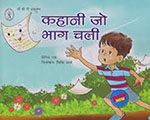 One simple example that struck me was the title itself. The four-word title in Hindi, ‘Kahani Jo Bhaag Chali’, has an edge over the English one, ‘The Story That Ran Away’.
It is up to the individuals to decide which language is suitable for the reader and buy accordingly. Long live such endearing picture books that play a significant role in shaping the feel-good attitude of the young reader.
Indira Ananthakrishnan is the author of short stories, historical and scriptural tales, biographical sketches, plays and picture books for children. Some of her works have won awards from NCERT, CBT, AWIC and Sahitya Academy. Her book from Hachette India, The Phoenix in the Sky was shortlisted at VOW lit fest and her latest book is The Queen Who Ruled the Wave.