
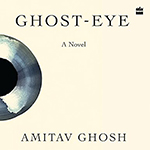
A significant intervention in contemporary climate fiction, Amitav Ghosh’s Ghost-Eye marks the genre by abstaining from the familiar binaries of techno-optimism and apocalyptic determinism. Instead, he undertakes a rigorous interrogation of epistemologies that modernity has systematically delegitimized, arguing that ecological survival depends on recovering suppressed ways of knowing. This extends his sustained engagement with climate crisis, evident in The Great Derangement and The Nutmeg’s Curse, and into fictional terrain that proves more uncompromising than his celebrated Ibis Trilogy or Gun Island.
The novel’s dual narrative structure opens in 1969 Calcutta with three-year-old Varsha Gupta, daughter of a wealthy Marwari industrialist, suddenly demanding fish, a food which is proscribed in her strictly vegetarian household. Psychologist Shoma Bose discovers that Varsha manifests detailed memories of a previous existence as Isha Mondal, a teenage fisherwoman from the Sundarbans who died from a cobra bite. Varsha’s abilities extend beyond simple recollection: she demonstrates exceptional aptitude in identifying fish species by taste, exhibits what parapsychology terms ‘remote viewing’ capabilities, and displays precognitive faculties.
A parallel 2020 narrative, narrated by Dinu Datta, Shoma’s nephew, unfolds during the COVID-19 lockdown as Cyclone Amphan approaches Calcutta. Excavating his aunt’s case files, Dinu engages with Tipu, a young Dalit activist constructing a clandestine network of individuals with anomalous perceptual abilities—’ghost-eyes’—whose knowledges may prove crucial for navigating cascading ecological crises. The temporal architecture itself becomes thematic: understanding the present requires excavating buried histories, both personal and collective.
What distinguishes Ghost-Eye methodologically is Ghosh’s refusal to relegate paranormal phenomena to narrative ornament. Shoma’s collaboration with Dr. Catherine Booth (modelled on parapsychologist Dr. Ian Stevenson) subjects ‘cases of the reincarnation type’ to empirical scrutiny. When Varsha correctly differentiates three morphologically similar catfish species through gustatory analysis alone, Ghosh theorizes this as ‘haptic memory’: the transgenerational transmission of embodied, sensory knowledge. The novel deploys the protocols of scientific investigation going through documentation, verification and peer review, to validate phenomena that Western modernity has consigned to superstition.
The novel’s most provocative theoretical contribution is its concept of ‘environmental prodigies’. Shoma posits that while bourgeois culture recognizes prodigious abilities in music or mathematics, statistically equivalent gifts must exist among subaltern communities. The knowledge may extend to the fields of avifauna, soil composition, ichthyology, or meteorology. These capacities remain unrecognized because they hold no exchange value in industrialized societies. Varsha, possessing a fisherwoman’s encyclopaedic aquatic knowledge, exemplifies epistemic violence: her prodigious abilities are rendered not merely worthless but transgressive within her upper-caste milieu. It is an insight which resonates with scholarship on indigenous knowledge systems and what Boaventura de Sousa Santos terms ‘cognitive justice’—the recognition that diverse forms of knowing possess equal validity.
This critique acquires material grounding through the novel’s excavation of class, caste, and ecological violence. Varsha’s investigation reveals that Isha’s family in Lusibari (a fictionalized, remote island in the Sundarbans), marginalized Bengalis and Munda Adivasis were murdered by criminals seeking their land for commercial aquaculture. Her father Benoy, a shapure (snake-catcher) and Manasa Devi devotee, refused commodification of sacred land; her mother Jhorna possessed uncodified ecological knowledge. The cobra that killed Isha to prevent her sexual violation becomes, in local ontology, an agent of divine intervention. Ghosh thus interweaves contemporary extractive Capitalism with longer histories of dispossession, suggesting that climate crisis cannot be disentangled from caste violence and ongoing wars against indigenous peoples.
The Manasa Devi motif functions throughout as both mythological framework and ontological claim. Varsha bears birthmarks corresponding precisely to Isha’s fatal wounds. Her mother witnessed her own family’s mining operations destroying a Manasa Devi site, killing sacred serpents. Ghosh refuses rationalization: the snake goddess operates not as metaphor but as actant within the novel’s cosmology. By 2020, this pattern scales catastrophically as Cyclone Amphan devastates the Sundarbans which is foreseen by Shoma days before meteorological detection. The novel suggests that what scientific modernity dismisses as myth may constitute a more adequate account of material reality and that divine vengeance operates as geological and meteorological force.
The contemporary sections articulate Tipu’s project: mobilizing ghost-eyes to ensure subaltern survival amid what he theorizes as ‘a war of extermination’. With capital accumulation producing elite ‘doomsday bunkers’ predicated on demographic collapse (‘Malthusian correction’), resistance becomes enacted through survival itself which requires precisely those epistemologies modernity has pathologized. Noor, a Lebanese Druze woman accessing agricultural knowledges from previous incarnations, facilitates reintroduction of climate-resilient cultivars. Their search for Varsha aims to recover salt-resistant rice varieties erased by Green Revolution monocultures.
The narrative’s affective centre emerges through Dinu’s attempts to awaken Varsha’s dormant memories through a carefully reconstructed Bengali meal using ‘invasive’ Asian fish species now established in North American waterways. The irony proves pointed: species deemed threats to native ecosystems are the very fish Isha once knew, now providing sustenance and cultural memory in diaspora. The novel withholds its most startling revelations until late, interrogating the very nature of identity, memory, and kinship across temporal and ontological boundaries. What initially appears as a conventional investigation into past-life phenomena transforms into something far more radical. It becomes a meditation on how consciousness, love, and ecological knowledge persist through forms we’ve been trained not to recognize.
The novel projects its vulnerabilities in bouts of occasional didacticism. Tipu’s exposition on billionaire bunkers and the ‘war of extermination’, while grounded in contemporary reality, sometimes tips toward explanatory excess rather than dramatic embodiment. The sheer density of Ghosh’s concerns ranging from reincarnation to climate catastrophe, from caste violence to indigenous epistemologies and interspecies consciousness strain even sympathetic readers. The novel’s refusal of conventional closure, while thematically consistent with its critique of Western narrative expectations, may frustrate those seeking resolution. Moreover, Ghosh’s investment in vindicating paranormal phenomena as empirically valid, rather than treating them as productive fictions or culturally specific truth-claims, risks alienating readers unwilling to suspend scientific materialism. The novel asks whether we can afford scepticism in an age of ecological collapse, a question that itself warrants scrutiny.
However, Ghosh’s theoretical ambition here is unprecedented. He advances a worldview wherein the sacred operates as material force, spirits constitute historical agents, interspecies love persists across incarnations, and collective ritual possesses ontological efficacy. Against contemporary movements constrained by capitalist realism, Ghost-Eye proposes that survival necessitates not technological innovation but anamnesis, not mastery over nature but recognition of our constitutive overlap within it. This positions the novel alongside interventions in Rights of Nature jurisprudence, wherein rivers and forests have been granted legal personhood from Ganga and Yamuna in India to the Whanganui River in New Zealand, challenging anthropocentric frameworks that treat ecosystems as mere resources.
Ghost-Eye represents Ghosh’s most ambitious synthesis: simultaneously love story, climate critique, spiritual epistemology, and metafictional intervention. It demands engagement with delegitimized knowledges and suggests ecological futures which depend on this recuperative work.
Mir Wafa Rasheeq is a Ph.D. candidate at the Department of Political Science, Jamia Millia Islamia, New Delhi.