
‘Arre, Ma, it was you who taught us that these days there are no male qualities and female qualities. In the twenty-first century, surely these are archaic notions.’
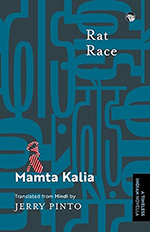
Rat Race tells a story that will be familiar to many middle-class Indian families. The story of parents who spent their lives raising children with love, sacrifice and hope, only to find that the very success they wished for has taken those children far away from them.
At its heart is a couple from a small town who is devoted to bringing up its two sons. Like many parents, they dream of seeing their children study well, find good jobs and make something of themselves. The sons do exactly that. They leave home, build lives of their own and pursue opportunities elsewhere. Yet what appears to be a success story gradually becomes one of loneliness and heartache.
Parents spend years encouraging their children to excel and seize every opportunity that comes their way. In that sense, the rat race is not merely the child’s. The parents too have been running it. When those opportunities carry the children elsewhere, though, disappointment often follows.
One of the strengths of the novella is the compassion with which Kalia portrays each character, without making anyone the villain. The parents’ sorrow is real and recognizable. They are not demanding people. They are simply unable to reconcile themselves to a world in which children no longer see their future in the same place as their parents. The expectations they have carried for years—of sons returning home, of daughters-in-law becoming part of the household, of old age spent surrounded by family—begin to crumble. The sons are still attached to the parents, and miss the home, they are happy to see them when they visit, but their North Star has shifted. Their eyes are straining to look beyond the shrinking horizons of their parents.
‘Ma, I’ll only come back when I have become something. You will simply have to wait!’
And perhaps that is as it should be. As Kahlil Gibran says about children, ‘… their souls dwell in the house of tomorrow, which you cannot visit, not even in your dreams. You may strive to be like them, but seek not to make them like you. For life goes not backward nor tarries with yesterday….’
Kalia places these family tensions within the larger context of a rapidly changing India, where professional ambition, geographic mobility and economic opportunity often demand sacrifices that the previous generations never had to contemplate. The children are not leaving home out of indifference or lack of affection. They are responding to a world that rewards movement, flexibility and ambition. The novel suggests that their choices are not exceptional but representative of a generation reshaped by education, mobility and global opportunity.
Kalia explores these tensions in a style that is refreshingly direct and unadorned. Her prose has the ease of everyday conversation—practical, observant and quietly insightful. Jerry Pinto’s translation mirrors this voice beautifully. The rhythms remain natural and conversational, allowing Kalia’s humour, irony and empathy to travel seamlessly from Hindi into English.
The book encourages parents to consider that children cannot be the sole centre of their lives. Parenthood is an important role, but it cannot be the only identity a person possesses. What happens when the children leave?
Yet while the book is deeply sympathetic towards parents, one occasionally wishes that the sons had been given equal emotional space. We understand the loneliness of the parents intimately, but the children remain somewhat distant. What are their struggles? Do they feel guilt? Do they carry the burden of balancing ambition, family and geography? The novella hints at these questions but does not fully explore them.
Similarly, while the book recognizes the pain caused by parental expectations, it perhaps stops short of examining those expectations more critically. Parents often speak of the sacrifices they have made for their children, but does sacrifice automatically create an obligation? Is parenting an investment that must yield returns, or is it an act of unconditional love? The novella largely sidesteps these questions, and engaging with them more directly might have created a richer balance between the perspectives of parents and children.
Ultimately, Rat Race is not merely about migration or ageing parents but about attachment itself. It asks us to consider how we love those closest to us. Is love a bond that frees, or a bond that binds?
The novella offers no solutions and passes no judgement. Instead, it invites us to look closely at the expectations we place on those we love and the expectations we carry within ourselves. In an age when families are increasingly scattered across cities, countries and continents, that conversation feels both timely and necessary.
Malati Mukherjee is a writer, translator and sometimes poet, based out of the Nilgiris.