
In the early historical record of Attica, before Athens emerged as a city in the form we recognize, the region consisted of scattered settlements. These were not towns in any developed sense. They were villages, kin-based communities, each with its own local council, cult practices, and customary authority. People farmed, herded, married within known networks, and defended themselves as best as they could. Political life was local, and law, where it existed, rarely travelled beyond the immediate community. At some point, this arrangement became insufficient.
The tradition recorded by Thucydides attributes the transformation to Theseus. According to this account, Theseus persuaded, or compelled, the villages of Attica to dissolve their local governments and submit to a single political centre at Athens. Local magistracies were abolished. Administrative and ritual authority was centralized. A common prytaneion was established, along with shared festivals that marked political unity, most notably the Synoecia, the feast of union. Whether Theseus existed as a historical figure matters less than what the story conveys. It describes a transition from dispersed autonomy to consolidated authority, from local custom to shared law.
But perhaps, the story is not as simple. Archaeological evidence suggests that Attica may already have been politically unified by the end of the Mycenaean period, even if physical settlement patterns remained dispersed. Control over resources such as the Laurium mines implies coordination on a scale larger than the village, well before the classical polis took shape. What is clear is that political unification preceded, or at least accompanied, spatial consolidation. Athens became a city not because its population suddenly concentrated, but because power did.
This distinction matters. It allows us to think of the city not simply as density or infrastructure, but as a particular arrangement of authority, law and obligation.
Aristotle, writing in the Politics, treats the city more than as a physical space, as a form of association. The household, he writes, arises from necessity. The village arises from the association of households. The city arises when this association, becomes self-sufficient, capable of sustaining a shared conception of the good. Law is central to this condition. Without law, Aristotle argues, human beings live by instinct and force alone. With law, they form a political community.
In this framework, the city is not merely the merging of settlements. It is the process by which communities agree to place limits on themselves. They surrender certain freedoms in exchange for stability, protection and predictability. Acting collectively, they can withstand famine, regulate surplus, organize defence and arbitrate disputes. Acting alone, they remain exposed. Synoecism, in this sense, is an achievement.
This conceptual framework can be carried into the Indian context once it is freed from the expectation of a single civic beginning. Indian cities have rarely come into being through the dissolution of villages into a shared political centre. More often, they have grown by accumulation, assimilation and absorption. Settlements have preceded cities, persisted alongside them, been enclosed within them, or emerged after their formation. Some villages have survived for centuries inside, expanding urban envelopes. Others have, within a single lifetime, swollen into towns and then into cities without ever passing through a recognizable civic moment. Bombay emerged from the consolidation of islands under colonial administration. Delhi has existed as many cities—founded, destroyed, abandoned, and rebuilt—long before it took the form of the megalopolis it is now.
The results, often in the Indian context, are cities cobbled together sans process, timelines, infrastructure, administrative authority, and civic obligation. Land frequently changes hands, and meaning, faster than the rules governing its use can be written. What appears as disorder is often the trace of these asynchronous processes, a confusion palpable in the sheer vertigo of the vocabulary used to define space in North India.
It is a lexicon that preserves the ghosts of past administrations alongside the realities of present habitation. The region has long been mapped by layered and overlapping divisions: the imperial geography of the Subah, the Sarkar, the Dastur, and the Chakla, shrinking down to the administrative grit of the Zila, the Pargana, and the Tahsil. These were not merely bureaucratic abstractions; they were the vessels of the Iqta and the Shiqq, the Mahal and the Tappa, determining how power travelled and how revenue was wrung from the soil.
At a finer grain, the taxonomy of settlement itself reveals a hierarchy of dignity. A place might be a Gaon or a Basti, a Mauza (a revenue unit) or part of the vast Dehat (countryside). Or it might lay claim to the specific status of the Qasbah (or Balda)—a settlement that was neither a village nor city, yet sustained its own markets (Ganj), enclosed neighbourhoods (Katra), and forms of civic life that were coherent in their own right.
Even within the village, the ground was never undifferentiated. It was mapped by ancient usage: the residential core (Abadi or Abadi Deh) separated from the commons (Shamilat Deh); the Khas (the main settlement) distinct from its dependencies; the Johad (pond) and Chaupal (meeting square) anchoring social life, while the Haat regulated exchange and the Chak reorganized the fields. Finally, there is the Phirni—the encircling road—and the Lal Dora, the ‘red thread’ that froze one such distinction into law, exempting the inhabited core while rendering the surrounding fields available for state acquisition.
What this density of vocabulary reveals is that Indian cities were not built upon cleared ground. They were layered over earlier forms of settlement, each with its own history of land, labour, and authority. Modern urbanization did not erase these forms; it reclassified them, often crudely. What appears today as incoherence is frequently the afterlife of these partial integrations, where villages were enclosed but not absorbed, renamed but not reconstituted. Seen this way, the Indian city is less a failed version of the classical polis than a different historical formation altogether: one in which multiple spatial orders coexist, collide, and endure.
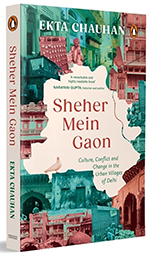
Ekta Chauhan’s Sheher Mein Gaon enters this semantic thicket with the aim of historicizing the memories of Delhi’s uneven urban condition pitted by urban villages. Presenting her work as a corrective to a pervasive ‘knowledge gap’, Chauhan offers what she terms ‘comforting reading’ for those attempting to decode the Capital’s disorder. Her book is ‘a personal and intellectual journey’, as she puts it, into migration, memory and identity; a set of stories about how ‘rural worlds survive in urban spaces’ and what ‘modern’ means in India. She describes Delhi’s urban villages as paradoxical places, ‘ancient and evolving, marginalised yet central’, where centuries-old practices sit beside cafés and start-ups, and where the past remains insistently present. Born of state-led land acquisitions, she argues, these villages were pushed into transformation without being integrated into the civic body of the city. The book promises to travel through those in-between spaces and to show how people remember, resist, and reimagine their place in a Capital ‘always on the move’.
Chauhan’s intuition is that Delhi is not one city. It has never been one city, but an accretion of jurisdictions and ruins, colonies and villages, planned neighbourhoods and legal exceptions.
The danger, however, lies in the seduction of that claim. The key term, ‘urban village’, functions as a loose label rather than a precise analytical category. Chauhan separates out these neighbourhoods, visits them, listens to residents and collects anecdotes. Yet the reader is rarely shown what would make an ‘urban village’ analytically distinct: distinct in morphology, certainly, but also in social organization, in public life, in the texture of power. One does not come away with a worked definition that can travel from Begumpur to Shahpur Jat to Khirki and still hold. In addition, to describe Delhi as a collection of villages risks limiting the vast variety that it contains, a simplistic thrusting of category rather than an inquiry into its nuanced and variegated development. The label tells us little about what ‘village-ness’ actually signifies in a neighbourhood now dominated by rental tenements. It does not explain the characteristics of these urban villages, but briefly touches upon labour, caste and class, gender, and memories of a few. It does not show how memory and everyday life survive, mutate, or are extinguished as land becomes urban property. Without that forensic work, the category remains a label, not a lens. The hinge of the book is therefore empirically light.
Chauhan’s book contains moments where these questions come into view. There are passages rich with anecdote, observation, and suggestive detail. Yet again and again, the analysis is distracted just as it might have deepened. The material appears, but it is not coaxed and kneaded enough. Part of the difficulty is methodological. Oral memory and interview material can do serious work, but only when it is pressed against other frames: planning documents, revenue categories, land histories, caste settlement patterns, histories of craft, worship, schooling and political mediation. Here, the memories are often left as memories. They are recorded but not used to expound on what animates those memories. The result feels closer to reportage, a surface record of a moment, than to a historical or conceptual argument about modernity.
This absence of depth is particularly glaring because Delhi’s urban villages are not simply an irritant inside the ‘planned’ city. They are the product of a specific legal history. The first Master Plan of Delhi (1962), an ambitious document meant to engineer a modern region, had a stunted relationship with the ‘rural’. It treated it as something the city would outgrow, expel, or contain. It gave elaborate prescriptions for zoning, traffic, housing, and industrial estates. It said very little about the villages already caught inside the expanding metropolis. The earlier ‘Work Studies Report’ gestured vaguely toward ‘rural trades and crafts’, as though these settlements might become benign satellites to the industrial city. But the Plan did not build an institutional path for that to happen.
What actually mattered was not what the Master Plan envisioned, but what the state exempted. A 1963 notification freed the lal dora settlements from building bye-laws and, effectively, from the discipline of the plan. The surrounding agricultural land could be acquired for the new Capital; the habitation inside the red line could be ‘left as it is’. This was less a policy than a form of official forgetting. It cheapened acquisition, brought in the sharks, and also created, by default, the creature we now call the ‘urban village’: a settlement physically inside the city and economically tied to its growth, while remaining legally anomalous.
This is the mechanism that Chauhan gestures to, and it is worth lingering on because it shapes everything that follows: the built form, the rent economy, the politics of enforcement. Later planning efforts have tried, sporadically, to claw back control, to end exemptions, to place ‘special regulations’ over these zones, to fold them into heritage and archaeological parks. Yet the foundational condition remains. The urban village is Delhi’s compromise cast into space; an administrative solution that became a social world.
Seen in this light, the contrast between Shahpur Jat and Asiad Village is not merely a contrast of planning styles. It is a contrast of legal regimes. Asiad Village sits inside enforceable rules: sanctioned plans, setbacks, service lines, predictable enforcement. Shahpur Jat sits inside a long exception: negotiated legality, partial services, irregular titles, and an everyday life shaped by what can be built without asking. Delhi’s ‘urban’ cannot be reduced to lifestyle. It is the distribution of legal security and infrastructural entitlement.
Chauhan is at her best when she stays close to the ground. Her opening chapter in Begumpur, built around the founding story of Hukum Chand and the long life of a village inside a Tughlaq-era mosque, contains the seeds of a larger argument. The mosque appears as a habitation, refuge, and shared centre. When the ASI, in the early part of the twentieth century, relocated residents after structural damage, a kind of public life was punctured; the mosque was withdrawn from everyday use and reclassified as heritage. Chauhan notes how elders later speak of the monument with indifference, even irritation. She notices how the space becomes associated with loitering, drinking, fighting; how vandalism and ideological contestation hover around medieval buildings; how ignorance and bigotry lead to locks at these sites which were once the ‘village’.
In Shahpur Jat, the sequence is clearer because the transformation turns on land. The village’s entry into the city begins with notification in the late 1950s, followed by a long period of suspended ownership. Cultivation continues on land already marked for acquisition. Appeals are made and refused, with the familiar argument that a growing city cannot be stopped. Possession comes much later, catalysed by preparations for the Asian Games. Compensation arrives as a finite settlement, while the value of the land, once absorbed into South Delhi, expands beyond measure. What follows is not a rupture but a series of adjustments: construction workers move in, rental housing takes shape, garment workshops occupy older houses, and boutiques and studios later appear along selected lanes. Extended families reorganize themselves around property management, pooling resources, settling disputes internally, and negotiating with tenants as collective units. Social spaces are repurposed and economic control is consolidated. The village is not dissolved into the city; it is refitted to serve it.
Placed side by side, Begumpur and Shahpur Jat reveal a shared pattern. Incorporation occurs without the creation of common civic institutions. One site loses its centre to heritage regulation; the other loses its fields through acquisition and delay. In both, authority migrates rather than disappears, settling into informal arrangements of possession, kinship, and control. Chauhan’s book captures these shifts episodically and with care. What it does not yet provide is a sustained account of how such rearrangements generate new forms of power, redraw boundaries of belonging, and produce a public life that is negotiated case by case rather than shared in common.
This is also a lesson in how inclusion is promised and deferred. Compensation cannot reproduce what land becomes in a metropolis. It is no longer soil but leverage: rent, speculation and intergenerational bargaining power. The temporality of the injury is not immediately realized. The past is priced at agricultural rates, while the future is absorbed into an urban economy whose value continues to rise without limit.
Chauhan notes the commercialization of Shahpur Jat: the arrival of construction workers, the expansion of rental housing, the growth of garment units, and the later phase of gentrification. What remains under described is the social machinery that allows rent to organize everyday life. Once rent becomes central, public life changes its terms. Neighbourhoods dense with tenants, migrants, students, and short-term workers generate constant interaction, but rarely on equal footing. In many urban villages, economic dependence and social suspicion coexist as a settled arrangement. Landlords rely on tenants for income while casting them as morally suspect. That tension weakens collective association and enables arbitrary rule-making.
Belonging becomes conditional, maintained through payment and compliance rather than shared obligation. Kinship networks that regulate property, informal finance that substitutes for formal credit, authority structures that fix prices and discipline tenants, and the tactical use of exemption are not incidental details. They are the means through which urban transition is organized and lived.
This is where Chauhan’s remarks on gender should have done more work. In her introduction she recalls how women’s lives remained tightly circumscribed even as urban infrastructure arrived and the language of modernity took hold. This modernity points to the kind in which men acquire the city’s visible instruments of mobility and authority—money, cars, property, offices—while women are made responsible for continuity. Respectability is belaboured to reassure the community that something essential remains intact even as land, income, and social position are transformed.
In such settings, ‘culture’ does practical work. It regulates movement, polices sexuality, stabilizes lineage, and secures property. Invocations of culture usually resolve into practical decisions about who may rent, who may visit, who may be seen in public, and which relationships are permissible. Chauhan gestures toward these dynamics, particularly in her treatment of outsiders and moral anxiety, but she rarely follows them into the institutions and routines through which they are enforced.
The discussion sharpens when Chauhan turns to affluent unauthorized colonies and farmhouses, because the workings of power are easier to see. In Delhi, legality is navigable, elastic, and unevenly enforced. For the wealthy, rules can be deferred, negotiated, regularized after the fact, or privately substituted with infrastructure of their own. Water arrives by tanker, electricity by generator, security by barricade and guard. The absence of formal sanction does not translate into vulnerability. For poorer unauthorized colonies, the same absence produces precarity. Services must be petitioned for, recognition endlessly sought, and in these times demolition can always be anticipated. What is distributed unevenly, then, is not simply legality, but the capacity to live securely outside it.
This distinction matters because it reveals how ‘urban’ functions less as a shared civic condition than as a stratified entitlement. Chauhan observes this asymmetry clearly. What the book does not pursue is the chain of practices through which it is reproduced: how exemption becomes normalized for some and criminalized for others; how planning law, enforcement, and political mediation combine to make informality either liveable or lethal.
More broadly, Sheher Mein Gaon remains constrained by the oppositions it sets out to describe. The urban village appears largely as residue—an unruly remainder left behind by planning—rather than as a historical form shaped by specific trajectories of land, labour and power. This framing leaves little room to ask what kinds of social or cultural life these places have generated on their own terms. We hear almost nothing about intellectual worlds, religious networks, craft traditions, local figures, or everyday public practices that might give these neighbourhoods coherence beyond their role in the city’s property economy. Without that attention, the urban village risks being defined only by what it lacks, rather than by what it has made and sustained under pressure.
The areas explored in Sheher Mein Gaon sit atop deep and complicated sediments: the residues of older Delhis, the scars of 1857 and Partition, the afterlives of endowment, and the shifting meanings of heritage. Hauz Khas, in particular, poses a question the book might have confronted: why do the architectural remains of great learning complexes in much of the Muslim world continue to function as transregional centres of scholarship, while in India similar sites survive largely as aesthetic fragments, embedded in precarity and neglect? Delhi is full of structures that once organized knowledge, devotion, and public life. Many now feel attenuated, as though the city is burying one generation on top of another in a graveyard of exhausted possibilities.
None of this requires Chauhan to have written a different kind of book. It requires the book to fulfil its own promise: to treat the urban village not just as a paradoxical backdrop of ‘old and new’, but as a site where memory, property, and power can be read together with analytical seriousness. The difficulty is not that Sheher Mein Gaon lacks material; it is that it moves across that material too quickly. It captures the mood of the transition without exposing its machinery. In that sense, the book matters, and it disappoints.
One is reminded of Mir’s sher, who knew something of Delhi’s ruins and the deception of surfaces:
Sarsari is jahan se guzre
Warna har jahan-e digar tha
Cursorily you passed through the world
otherwise, every place contained a world.
The couplet makes two claims at once. Each place, Mir suggests, contains a world of its own—something internally ordered, layered, and distinctive. By using digar, Mir also hints at variety and instability; the world is not only plural but constantly changing, subject to upheaval and ruin. And by describing an entire lifetime as having passed ‘carelessly’ (sarsari), he gestures toward a deeper failure of attention. The world is so dense and various that even a full life can amount to a passing glance. Read alongside the Quranic injunction that the signs of the world are meant for the attentive, the meaning emerges that those who move through places without sustained attention miss the order, the labour, and the meanings that hold them together.
Sheher Mein Gaon passes through places that do, indeed, contain worlds. What it leaves to the reader, and to future work, is the task of staying long enough in each to show how those worlds are governed. Had the book done that work, it would have offered not comfort, but clarity, and with it, sharper understanding of the city Delhi has become.
Nikhil Kumar is an independent writer.