
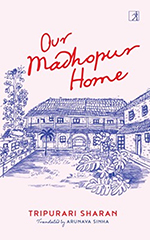
This is a difficult book to review. Of many parts, each displaying a different degree of writerly calibre, the book does not cohere organically as a whole. The genre is a puzzle. Though described as fiction, it is anchored in the form of a life narrative. While this is the standard mode of narration for novels understood as bildungsroman, this novel comprises two first-person narrations and its executed intention appears to be the delineation of social change seen across a particular region of Bihar over a period of a century rather than the tracing of the growth of a central protagonist. Even as this macro-history is focalized through the changing fortunes of a specific family, largely narrated from the point of view of the patriarch Sharma-ji or Baba, yet this character is not one of the narrators.
Sharan chooses to sketch the broad contours of social history through the diary entries of an aging wife and mother, and hold your breath, the musings of a pet dog. Named Laura, this imposing black Labrador is able to quote a stanza of modern Hindi poetry and Kabir’s doha with equal felicity, even as she reflects on the Emergency, the collapsing agrarian economy, and the impact of capitalism and emerging technology on social relations in Bihar amongst a host of several recent political events that should be arguably out of the reach of canine consciousness.
Sharan presents Laura as an affectionate dog, obedient to her master’s training. The lack of irony in this portrayal of a speaking family pet is unexpected.
The leisurely narrative of the novel imitates an oral yarn meandering between different points of a remote past, connecting these with incidents in recent memory or with events unfolding in the present. Depicted with charm, Sharan is able to evoke a certain timelessness that characterizes our memory of remote events: of time moving very slowly or even standing still. This luminous feel of by-gone years imbues the evocation of the Madhopur House, not only in its physical aspects such as the plan and layout of the built premises, but in the unhurried pace of living that it once protected. These parts of the novel work superlatively well, as do the connecting threads between the family and the careers individual members choose to pursue which allows the novelist to portray, as seen above, the expanding scope of a young nation’s political economy and the several milestones that marked the first few decades of its independence.
However, the depiction of this rich social history is interrupted every now and then by Laura the narrator, who in an effort at veracity draws attention to the limits of her knowledge. These jarring reminders interrupt the flow of the narrative and strain credulity. A lighter touch or an understated sense of whimsy in the narration would have lent nuance and play to Laura’s account of the Madhopur home and saved the novel from these disconcerting moments. The rather serious tone is compounded by the fact that the narrative weaves in lugubrious accounts of Laura’s neediness and her neglect by the other narrator of the novel, Dadi.
Dadi’s own narrative is a vivid sketch of feudal Bihar and the decidedly eccentric doings of a caste-bound, patriarchal family, one of the erstwhile smaller royal families of Bihar. Chhotka Babuji, her guardian-uncle, is an unforgettably etched figure as are various people who cower in terror before him. Dadi’s journal entries chronicle events from colonial India to the first few decades after Independence; they cover feudal splendour and colonial spectacle preserved in family lore. She narrates the story of George V’s visit to Ramanpur and the miles-long red carpet laid out to welcome royalty, as well as the vice-like regulations exercised over caste norms, female mobility and education within which constraints she is brought up. It is perhaps these strongly ingrained notions of caste purity that inform Dadi’s antipathy to her husband’s pet dogs. This can only be surmised, for Laura appears to have no answer to the same question raised repeatedly in her narrative. Sharan presents his characters in all their contradictions, making no attempt to airbrush the flaws. Just as Dadi, the epitome of chaste femininity, hurls a stream of choice invectives at her husband in the dead of the night on a public street, she also presides over the neglect and cruelty to all the dogs her husband brings home and trains with so much love.
Is it the guilt, then, over rather gruesome ways in which the four family dogs meet their untimely end, which has led to the present book? It is somewhat strange to see the enormous preoccupation with dogs in a novel interested in social change. It seems clear that the IAS officer Tipu, Dadi and Baba’s youngest son, who is a quiet presence throughout this novel, is a hat tip to the author. Given this connection, it is possible to see the book as autofiction rather than as an imagined narrative. The unclear demarcation and blurring between the author and narrator are some of the characteristic features of autofiction, and it is perhaps Tipu who embodies the human voice of Laura. Giving his voice to a pet and positioning her front and centre in a narrative may have perhaps appeared as a way to exorcise haunting memories. It is tricky to understand the motivations that led to this novel; reviewers can only suggest hypotheses.
Arunava Sinha has made available for the non-Hindi audience an eminently readable translation in which he manages to retain the unmistakable stamp of provincial Indian life. A cursory Google check on the wedding rituals mentioned in Dadi’s story seems to indicate that she belonged to a Maithili family. Dadi recalls feeling bereft after her wedding on listening to the unfamiliar speech registers in Sharma-ji’s family. Since the represented culture of the novel is from a specific part of Bihar, it is but natural to wonder if the original work in Hindi had resonances of the rich storehouse of different languages in the region such as Maithili, Bhojpuri, etc., and if these have had to be necessarily erased from the translation. A note from the translator would have added immense value to the book.
Tripurari Sharan has produced a complex non-linear narrative that cannot fail to engage the reader. Despite its rather interesting flaws, it brings alive a fascinating documentation of social change and flux seen through the life trajectories of an intergenerational family.
Rohini Mokashi-Punekar teaches at the Department of Humanities and Social Sciences, Indian Institute of Technology Guwahati. She is the translator of On the Threshold: Songs of Chokhamela (Altamira Press, 2005 and The Book Review Literary Trust, 2002).