
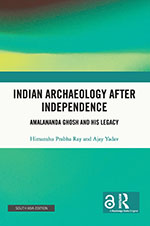
For the generalist interested in Indian Archaeology, this study of Amalananda Ghosh appears long overdue. The Archaeological Survey of India (ASI) was established in 1861. Its 165-year history can be divided into eight decades plus of colonial rule and another seven plus of existence in independent India. Yet notwithstanding this long postcolonial experience it would be fair to say that perceptions of the ASI remain dominated by the Trimurti of three British DGs (Director Generals): Alexander Cunningham, John Marshall and Mortimer Wheeler.
Over the past half century, the reputation of these three has consolidated into a kind of iconic status to such an extent that they dwarf and overshadow other perspectives. By focusing on Amalananda Ghosh, Himanshu Prabha Ray and Ajay Yadav seek to push back against this inherited dogma. Ghosh’s career certainly provides a useful perch to do so and simultaneously also provides an overview of Indian Archaeology after Independence. The wider context of Amalananda Ghosh’s tenure is that of decolonization of the ASI’s approach and mindsets. The book thus points out: ‘A crucial difference between Ghosh and the British Director Generals (DGs) was that his scholarship was rooted in the cultural history of India, rather than in the Classics or in Romano British archeology, as was the case with Marshall and Wheeler respectively.’
Himanshu Prabha Ray is former Professor of History at the Centre for Historical Studies, Jawaharlal Nehru University, and also a former Chair of the National Monuments Authority. Ajay Yadav is a civil servant cum professional historian and is currently pursuing a D. Phil. in Archaeology in the University of Oxford.
Ghosh’s long tenure as Director General—from 1957 to 1968—is certainly unusual for heads of institutions post 1947. The authors in uncovering the priorities he set for Indian Archaeology also provide a corrective to different stereotypes that have accumulated with respect to the Department post 1947. Perhaps the most powerful of these is that post 1947, the ASI had a single-minded focus on locating new Harappan or Indus Valley Civilization sites in India to compensate for the loss of Mohenjo-Daro and Harappa to Pakistan. Thus, Mortimer Wheeler who was appointed as DG in 1944 and continued till 1948 had advised Indian archaeologists: ‘Recent Partition has robbed us of the Indus Valley… . We now have therefore no excuse for deferring longer the overdue exploration of the Ganges Valley. After all, if the Indus gave India a name, it may almost be said that the Ganges gave India a faith.’
A study of Ghosh’s tenure reveals on the other hand, the authors argue, an ‘all round development’ rather than a single-minded focus on Harappan sites on the part of the ASI. The book provides to us a good sense and an overview of this all-round development through some principal milestones of Amalananda Ghosh’s tenure as DG. The list includes the discovery of Harappan sites in the Bikaner region following a recommendation by Sardar KM Panikkar that excavations in Jaisalmer and Bikaner would lead to the discovery of new Indus Valley sites which would compensate for the loss to Pakistan of the iconic Harappa and Mohenjo-Daro. The authors’ contention is that there is little evidence of a ‘rebound quest of a patriotic kind’ propelling the ASI to make good the loss of Harappa and Mohenjo-Daro. Sardar Panikkar may well have been motivated by patriotic considerations but his proposal itself ‘despite being agreed to in full by the then Prime Minister Nehru, was treated in a routine fashion by the Government showing no zeal of any kind, least of all that of the patriotic variety.’ It was only in August 1950, two years after the proposal was mooted, that the formal nod was given to this project.
Amalananda Ghosh would be involved in the Bikaner survey, and he would present some of his findings to the Indian History Congress in Jaipur in 1951: ‘The discovery of these mounds brings the Harappa culture much closer to the heart of India and reveals how deeply it had taken its roots in the Indian soil.’ The authors however also point out that Ghosh was not, in referring to India, referring to the modern nation state but a larger cultural zone from Baluchistan eastwards.
During Ghosh’s tenure as DG, a number of other milestones reveal much about the evolution of Indian archaeology. One success story that stands out is of the reconstruction of the archaeological site of Nagarjuna Konda in the second half of the 1950s when it had become clear that the entire site would be inundated by the construction of the Nandikonda dam on the Krishna river.
The authors also highlight the hosting of the International Conference on Asian Archaeology by India in 1961 (coinciding with the centenary of the ASI) and underline that this was a major initiative during Ghosh’s tenure. An emphasis on engaging with the archaeology of neighbouring countries and extending the frontiers of knowledge across the political boundaries of India as defined in 1947 was ‘a hallmark of Ghosh’s vision’. It seems extraordinary today but ‘Representatives from Afghanistan, Pakistan and Nepal were invited to attend the first meeting of the Central Advisory Board of Archaeology under Ghosh which was held in August 1953.’
In the authors’ assessment, this original vision was lost over the 1970s and later as: ‘ASI lost this momentum as it increasingly focused on Harappan sites and the archaeology of the Epics to the detriment of archaeological research in countries outside India, especially in the historical periods.’ The consequence of this is a general lack of interest in Asian archaeology and in the archaeology of adjacent regions such as Iran, Iraq, Anatolia, Egypt and South East Asia.
This general picture has not changed much. The ASI has marked up significant conservation successes in three countries. Most prominent is of course the Angkor Wat project in Cambodia in the 1980s when ASI alone worked at the conservation of the site amidst debilitating conditions of civil war and genocide. Other projects such as the Vat Phou temple in Lao PDR and the Ananda temple in Myanmar stand out. Nevertheless, in each of these, Angkor included, notwithstanding the ASI’s long presence and engagement with the site, there has been an ‘emphasis on conservation at the expense of research and archaeological engagement with the archaeology of countries of Asia’.
An effort was made to break out of this monument-specific conservation approach through the conceptualization of ‘Project Mausam’ from 2014. The approach in this was to focus on maritime linkages and cultural corridors created by the monsoon winds. The authors however point out that the ‘project continues to be confined to the web pages of the Ministry of Culture’. The wider conclusion reached in this regard is thought provoking and merits being quoted in full:
The experience with Project Mausam has shown it is not easy or possible to reinvigorate archeological research in ASI and to kindle interest in the archaeology of Asia even though the Government has incurred huge expenditure in efforts to do so. There has been radical change in ASI’s ability to undertake research since the 1970s, and only introspection within the organization can help show the way forward.
We can only hope that this book will deepen and energize the debate over the balance to be struck between excavation, research and conservation. The priority being attached to securing World Heritage status for a larger number of monuments and sites in India is obviously both welcome and important. But the significance of new surveys and excavation, the timely publication of reports and a culture of research remain critical to the health and integrity of the institution.
The other thought and takeaway from reading this book and seeing the wide range of records and documents that the authors relied upon is that the ASI’s archive requires proper organization and being made available to researchers. The ASI’s modern history remains largely hidden because the focus of the organization is so firmly on India’s medieval and ancient past. This work shows how rich its archive could be if properly organized and made less opaque. The larger point this book very ably puts across is that the ASI also has a modern persona and a valuable history which is also of relevance in our efforts to uncover India’s pasts.
TCA Raghavan is a former diplomat. His latest book is Circles of Freedom: Friendship, Love and Loyalty in the Indian National Struggle (Juggernaut, 2024).