
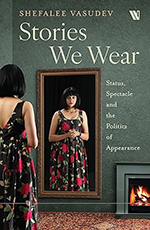
Look closely at a politician’s handloom saree, a celebrity’s ‘airport look’, or even a simple cup of coffee, and a complex social reality begins to reveal itself. We are a society obsessed with looking good, yet wilfully blind to what makes that spectacle possible. Shefalee Vasudev’s Stories We Wear is a brilliant yet unsettling wake-up call that redefines what constitutes our appearance. Across ten detailed and wide-ranging chapters, Vasudev asks readers to think of appearance not as vanity, but as a way of reading society. She invites us to see how identity, belonging, self-fashioning and even resistance are expressed through what people wear, carry, consume and perform. In her hands, appearance expands far beyond garments; even something as ordinary as a cup of coffee becomes a part of one’s social ensemble, a marker of taste, class position and cultural capital.
Vasudev’s long engagement with fashion, culture and public life gives her work depth, but it never becomes inaccessible. Instead, each chapter moves with the ease of conversation while quietly carrying the force of serious social critique. She does not remain confined to the materiality of clothing; she is equally interested in the meanings, exclusions and inequalities that gather around it.
At its core, Stories We Wear is about the unequal world we inhabit and the many ways in which inequality settles onto the body. One of the most distinctive features of the book is its rootedness in Indian social life. Vasudev sprinkles her prose with Hindi words and culture-specific references, some translated and some left open-ended. For Indian readers, this produces an immediate familiarity; for non-Indian readers, it may pose a slight challenge, but it also preserves the book’s geographical context and integrity. The writing draws on theory, reportage, memory, observation and cultural criticism, creating a work that sits interestingly between academic inquiry and literary journalism.
Taken together, the chapters offer a panoramic account of the Indian self, ranging from stories of survival to stories of death, from political clothing to unconscious habits, from celebrity spectacle to the labouring body. In the opening chapter, ‘Kartavya Path’, Vasudev’s observational power comes fully alive as she maps the lives of those she encounters in one of Delhi’s most symbolically charged public spaces. ‘Shoes gave away people, their social status and employment. Or the lack of it,’ she writes. By drawing sharp contrasts and parallels between the privileged and the precarious, she exposes the undeniable class divides etched into everyday Indian life. In ‘Wearing Politics’, Vasudev dissects how Indian leaders craft public image through clothing. From Prime Minister Modi’s signature kurtas to Kangana Ranaut’s elegant sarees, politicians dress for the public in ways the public rarely does. Is their apparent indifference to fashion trends genuine, or calculated to suggest that priorities lie beyond style, with the ‘real issues’ of the public? Indian netas favour ‘traditional’ handloom, cotton, and khadi to project authenticity. But is it a genuine connection, or hypocrisy for voters who can no longer afford these fabrics? Vasudev calls Modi ‘sartorially gifted’. His bright, blingy looks and diverse regional garb, from Manipuri gamcha to Kasavu mundu, are impossible to ignore. However, the noticeable absence of a simple skullcap seems deliberate. ‘How Khadi became Uncool’, spotlights the workers behind the production of khadi. Vasudev traces khadi from Gandhi’s freedom symbol to its current crisis. Weavers toil in obscurity while ‘pure’ fabric prices out ordinary buyers. Chemical fakes flood markets, fooling even experts.
Even everyday routines now demand carefully curated looks. ‘The Airport Look’ reveals the circus that goes on behind the deceptively simple yet stylish travel looks of celebrities. Creating this illusion of effortlessness is a tiring enterprise for all: the makeup artists, the PR teams, and increasingly, the celebrities forced to wear it. No longer limited to celebrities, this ritual has spread; every Indian traveller now broadcasts status and upward ambition through their airport ensemble. Vasudev offers a demonstration of consumerism’s choke hold on us all. In ‘The Devil Wears Green’, she reveals how even the most conscientious shopper cannot truly escape unsustainability. Consumerism breeds its own contradictions. She confronts us with the ugly truths of ‘green’ fashion production, the stark divide between First World desires and Third World labour. The proposed fix? ‘Buy less’. But in today’s relentlessly consumerist and capitalist landscape, how realistic is that prescription, and who will actually heed it? Even coffee, in Vasudev’s telling, has become a form of cultural capital.
Enjoying it is no longer enough; one must also know its origins and methods. Yet the workers who make this refined consumption possible, from Adivasi plantation labourers to baristas, remain largely invisible.
The final chapter, ‘Last Rights’, confronts perhaps the most uncomfortable truth of all: that even death is not equal. Vasudev reveals how the dignity of labour directly determines the dignity of dying. For India’s elites, funerals have evolved into a managed social affair, with ‘death managers’ orchestrating every detail: floral arrangements, catered snacks, even industrial freezers preserving bodies so loved ones can pay their respects before the final farewell. The reality is devastatingly different for backward castes and Dalit families, who are stripped of dignity and basic rights even in death. Vasudev forces us to confront the plight of manual scavengers. Engaged in a practice long deemed illegal, these workers routinely suffocate in toxic septic tanks, only to be refused medical treatment in their final moments. Through a blend of personal memories and stories, she examines the experience and the performance of passing away, asking an uncomfortable question: who gets to depart with honour, and who is stripped even of this final right?
Shefalee Vasudev is not blind to the social hierarchies of India, offering an unflinching account of realities shaped by class, caste, and gender. Through each chapter, she reveals how these forces inevitably weave themselves into the very appearance of the Indian identity. Our daily, social, and professional lives up to the moment of our death are concocted. Not always by choice but by the status the world assigns us. As the title promises, we wear more than clothes, jewellery, or makeup. We wear stories. India’s diverse, layered realities demand we look closer, and Vasudev’s book makes it impossible not to. It is the kind of book that reads with ease but settles heavily in the mind, asking to be revisited long after you have finished reading it.
Muthara Khan is pursuing her M.A. in Gender Studies from Jamia Millia Islamia. She’s currently working as a research intern at Centre for Equity Studies in collaboration with Karwan-e-Mohabbat. Her interests are at the intersection of gender, media and cultural studies.