
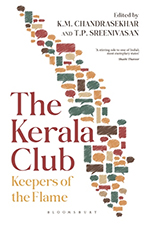
Driving through Kerala today, it is hard to believe that this was one of the poorer States of the country in the 1960s. Lauded as ‘God’s own country’ and hyped for its developmental model, Kerala today can pass as a developed State with human development indicators matching those of European countries. But, as the editors of this book point out, ‘whatever one may say about Kerala, the opposite may also hold true.’ Perhaps as the price of its success, the State finds itself at a crossroads, facing challenges across multiple sectors.
To trace Kerala’s journey, and suggest future trajectories, who better than a bunch of seasoned civil servants? The Kerala Club comprises essays by retired bureaucrats who have observed the State’s progression at close quarters and been intimately involved both in policy-making processes and in programme implementation at the cutting edge. The contributors include retired members of the administrative, police and forest services of the Kerala cadre, and Malayali officers who had a bird’s-eye view from other States and the Central Government.
Kerala enjoyed a historical advantage of progressive Princely States and an ingrained notion of public action. The State was given a headstart in the social sector by the rulers of Travancore and Kochi, who opened schools, even for girls, in the nineteenth century. Christian missionary activity and promotion by social reformers like Sree Narayana Guru and Ayyankali boosted education for all sections of population. Public health too received a boost through the introduction of vaccination by the Travancore State in the mid-nineteenth century.
After the constitution of the State of Kerala, the Communist Government—the first to be elected anywhere in the world—rolled out ambitious reforms that would completely transform the poor agricultural State. Land reforms and redistribution, coupled with priority to education and health, delivery of social welfare, empowerment of labour and women, became part of the political consensus sustained over the years regardless of the complexion of the ruling dispensation.
Today Kerala is the leading State in most social and human development indicators. Poverty has all but vanished; a social security net benefits more than 5 million of the most vulnerable people. Kerala is among the five richest States in the country with the highest number of cars, internet connectivity and housing per thousand people. It is the most urbanized State in the country with 88 per cent estimated to be living in towns.
Adopting a unique developmental path, Kerala leapfrogged from a predominantly agrarian economy to a service-based economy, bypassing the intermediate stage of industrialization. The service sector accounts for almost two-thirds of the gross State domestic product, the share of agriculture having declined to just 8 per cent. Migration of some 4 million persons to West Asia, and a similar number elsewhere outside Kerala, brought remittances that powered the economy. The remarkable Kudumbashree programme provided a unique model for engendering governance, besides providing lakhs of women financial security and improving their status within the family.
In hindsight, however, given a relatively enlightened and less venal political leadership, and an educated and industrious citizenry, Kerala’s journey could also be viewed as one of missed opportunities. With power rotating between the Communist party and the Congress party during most of the past fifty years, each government pursued narrow short-term goals rather than long-gestation plans to create infrastructure, promote investment and strengthen fiscal health. T Nandakumar observes that Kerala offers ‘sobering examples of how political decisions—driven by populism, ideology and misplaced priorities—can distort realities.’ T Balakrishnan adds that ‘the restrictive policies of governments in land, labour and other areas have in fact throttled the growth of the economy’.
Kerala’s is indeed a complex story. The articles in this volume, although of somewhat disparate nature, analyse various aspects of the picture, and what emerges is an excellent portrayal of this extraordinary State presented by knowledgeable first-hand observers with deep commitment—and affection—towards it.
Listing the challenges before the State, S Subbiah asks whether the huge share of the service sector in the economy is truly benefiting Kerala: while the State is home to 15 lakh migrant workers, inordinately large numbers of young Keralites remain unemployed or under-employed; though female labour force participation is comparatively high, it has declined significantly since the 1980s. Discussing the Kudumbashree experience, KB Valsala Kumari points to the meagre presence of women in political leadership, and hopes the substantial social capital that the programme has generated will translate into political capital too. K Ellangovan points out Kerala’s health paradox: ‘despite high public spending, individuals still bear the brunt of healthcare costs’, most of the health budget goes towards salaries at the expense of quality improvement. The State now faces the additional challenge of the rising burden of lifestyle and non-communicable diseases and an ageing population.
Despite having achieved total literacy, Kerala can boast of few institutions of educational excellence and has only marginally benefited from the IT revolution. Private investors being unenthusiastic, students and researchers seeking high-quality institutions have to look beyond the State’s borders. Following a disturbing personal confrontation with vested interests opposing any reform of the status quo, TP Sreenivasan views ‘over-politicisation of the education sector [as] a curse’ that has led to this ‘sad state of affairs’. Bharat Bhushan adds that the multiple staff associations and unions that exist in every department ‘have come to possess veto power over almost every aspect of their organisation’s operations’.
Given the fact that much of Kerala is classified as urban, it is astonishing that sewerage systems even in major towns are practically non-existent, solid waste collection and disposal uncertain and the number of buses on the roads actually declining. Joy Oommen quips that the relentless growth of the urban population has only made Kerala ‘a state of shopkeepers and food vendors in recent years, fuelled by the continuous flow of remittances from abroad’, while little has changed in terms of infrastructure.
The question arises whether the administrative ‘steel frame’ that remains largely unchanged from colonial times is capable of effective governance in the twenty-first century. KM Chandrasekhar argues that the ‘process-driven, hierarchical, rigid, centralised nineteenth-century model’ has actually deepened, and must be replaced with a new outcome-oriented public management. Subbiah makes a case for re-engineering public administration and SM Vijayanand outlines the successes and challenges of Kerala’s People’s Plan for democratic decentralization. B Sandhya contends that with attitudinal change and infrastructural support, the police can play a significant role in social change. Bransdon Corrie makes a heartfelt plea to protect Kerala’s unique ecological legacy with sensitivity and compassion by listening to the ‘voice of forests’.
When civil servants—especially the retired variety—are given free rein to reminisce, the result can be maudlin self-adulation. Happily, the contributors to this volume have stayed above that temptation and the section on personal reflections carries varied articles, ranging from a fascinating piece on the shocking prevalence of slavery in nineteenth-century Kerala and the moving story of an elephant’s journey from the wilds to temple captivity, to fond recollections reflecting a deep connection with the State. Vinod Rai believes that ‘Kerala was the best thing that happened to my career.’ Valuable lessons he learned in Kerala about the influence of ‘people power’ and the critical importance of public participation have been a ‘lighthouse’ throughout his long service, says Amitabh Kant.
The Kerala Club will appeal to the specialist and lay reader alike, not only for dissecting various aspects of the administrative history of the State, listing out and addressing the challenges that confront it today, but for revealing the exceptionalism of the land, its people and, even, its politicians.
Govindan Nair is a retired civil servant who spent his career in Uttar Pradesh, Delhi and overseas. He now lives near the sea in Chennai.