
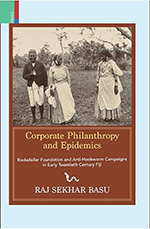
This is absolutely the first time that I am reviewing a book where the text amounts to 107 pages, followed by barely readable primary documents, probably selected, which go on to 840 pages. At a time when the publishing landscape is so bleak, why did Primus Books undertake this venture? What was the importance of bringing in these largely unreadable 840 pages?
Recently, the Government of India introduced vaccination against cervical cancer for young girls at the age of 14 years. This was the HPV vaccine, promoted by the Bill and Melinda Gates Foundation (BMGF). Health activists are up in arms, pointing out that an earlier ‘trial’ had led to deaths among vaccinated young girls in Andhra Pradesh and Gujarat, in an ‘experiment’ carried out by PATH, an NGO. A Parliamentary Standing Committee had strongly indicted PATH, and the Government of India, for permitting this disgrace. Scholars and public health activists point out that since the BMGF is the biggest contributor to the WHO, the WHO’s policies on vaccines are compromised and questionable. They also point to a profound conflict of interest because the BMGF has massive investments in the vaccine industry. Others point out that when the incidence of cervical cancer is declining, hastening this decline could be done by strengthening public health systems so that they can offer regular screening and Pap smears.
Basu traces the long history of corporate philanthropy with reference to Rockefeller Foundation’s (RF) war on hookworm going back to the southern States of the USA. It is so striking that the militarist metaphor used in this campaign enters the world when the RF funds the global war on malaria, using DDT. DDT was devastating environmentally as shown by Rachel Carson in The Silent Spring, published in 1962. The production of DDT was dependent on oil produced by the Rockefeller industries. The RF supported the discredited Khanna Study, on which India’s family planning programme was based; supported the programme itself, in addition to establishing demographic research centres firmly committed to a neo-Malthusian understanding of the population question; the RF also supported demographic journals committed to the same anti-Communist cause.
Raj Sekhar Basu’s book is in a sense tracing the pre-history of these corporate enterprises through his study of the anti-hookworm campaign in Fiji, largely through primary documents in the archives in Fiji. This is supplemented, of course, with an admirable reading of secondary literature on medicine and imperialism. The archives in Fiji will not of course reveal that the RF also gave a trial with the same anti-hookworm campaign in the Princely State of Mysore in the 1920s. As far as I know, no medical historian has worked on this.
The late nineteenth and early twentieth centuries saw the USA arrive globally, even as Britain’s decline was becoming apparent. Leading capitalists like Carnegie and Rockefeller wanted to establish the USA as the leader in science and set up foundations to support specific programmes in universities. The RF wanted to leave its footprint globally. They were acutely aware of the benefits that could accrue to them from these investments, apart from establishing the USA as the leader in modernizing backward countries.
RF had identified hookworm as the ‘disease of laziness’ in southern USA. Dealing with this disease, causing anaemia and thus ‘laziness’, would be one way to increase worker productivity. This would also create markets for goods produced by industries in the northern States.
The success of the campaign in the southern States of the USA emboldened the RF to undertake such campaigns globally. It was also important that medicine would be a tool for imperialism, protecting colonialists from tropical diseases, as well as the workers on plantations.
Hookworm disease was transmitted through poor hygiene and could be eliminated through water supply and sanitation. But that called for investments which no colonial government, and indeed the postcolonial government in India, was willing to make. The latest NFHS-5 (2019-2021) data reveals that 20 per cent of the population of India resorts to open defecation.1 The RF had a magic bullet: mass preventive treatment through medication.
In Fiji, a plantation economy, it was believed that eliminating hookworms would substantially improve worker productivity and bring down mortality. This would also reduce the need to import a constant stream of indentured labour from India. But the author argues, ‘the activities of the foundation were directed more towards the promotion of a capitalist understanding of medicine and public health, the consequences of which were felt in the commodification of health. Medical dependency, technological interventions over social norms and promotion of values that deliberately eliminated local approach to health betterment and well-being’ (p. 99). Towards the end of the programme in Fiji, RF officials were convinced ‘that improving sanitation facilities was the foremost requirement of the hour’ (p. 107). This was of course beyond the ambit of the RF and the anti-hookworm campaigns were wound down globally.
Endnotes
1. It was reported that this data caused the Director of the IIPS, Professor KS James, to lose his job since the PM had declared India was open-defecation free. It is more likely that he lost his job for publishing an academic paper where he argued that the official estimates for COVID-19 deaths were a serious underestimate. In either case, he was hounded out for doing a job he was meant to do: speak truth.
Mohan Rao, former Professor, Centre of Social Medicine and Community Health, Jawaharlal Nehru University, New Delhi, is currently an independent researcher based in Bangalore.