
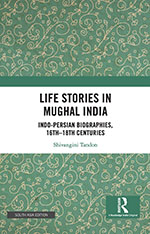
An exemplar of intersections between history and literature, the book explores the socio-cultural contexts of early modern South Asia, focuses on the Indo-Persian tazkiras or biographical compendia, to comprehend life-narratives penned during the Mughal period as a form of history-writing, and contributes to widening the understanding of the political culture and interactions between state and society. The tazkiras, as Shivangini Tandon argues, focused on a notion of selfhood, expressed through community identities and household ties. She studies them not simply to retrieve the life of a particular individual but to examine how this source can construct the narrative of the period. To understand the processes of early modernity, Tandon focuses on the use of tazkiras, which as she observes unfold steadfast interlinkages between state and society that are typically invisible in the historical chronicles of the time. Highlighting the importance of alternative sources and archives, she de-emphasizes the significance of historical chronicles, didactic texts and poetry. Delving into the arena of emotions and mentalities to stipulate the necessity of carving connections between political developments and shifts in emotions and affect, and by its riveting study of elite households in Mughal India, the book stands out as a valuable intervention.
Engaging with tazkiras, a valuable source for the study of Mughal court culture, Tandon investigates the politics of representation and selfhood in the biographies to depict norms of masculinity, civility, etiquette and comportment. Her exploration of the tazkiras establishes that the Mughal courtly rituals were not only appropriated by the kings and nobles to unilaterally represent their authority to the people, but the Mughal courtly culture was also influenced by the non-elite sections of the population comprising slaves, dancing girls, poets, merchants and others. Appraising the genre of tazkiras to probe the society, culture and polity of the Mughal period, she focuses on ‘political’ tazkiras authored during the seventeenth and eighteenth centuries. The use of the epithet ‘political’ to characterize the tazkiras that Tandon evaluates is noteworthy; it is an attempt to identify her concern with the political culture of the Mughal court, the lives and activities of the aristocracy and the ruling elite.
Diving into the ‘political’ tazkiras of the seventeenth and the eighteenth centuries, Tandon researches the lives of the Mughal elite in the context of the processes of state formation and cultural change. The two ‘political’ tazkiras she specifically investigates include Zakhirat-ul-Khawanin written around 1651 CE by Shaikh Farid Bhakkari, a prominent Mughal noble, and Ma’asir-ul-Umara written in the eighteenth century by Shah Nawaz Khan, also a leading Mughal noble. The latter though critical of Bhakkari’s tazkira as unreliable, insignificant and inconsequential, ironically borrowed extensively from it. Nevertheless, Bhakkari’s tazkira not only talks about the nobles and saints he interacted with but also architectural achievements of the nobles including the construction of mosques, tombs, sarais, forts and mansions.
To the contrary, Ma’asir-ul-Umara rarely indulges in the discussion of building activities or memorializing the landscapes or spaces or those who built them. This variation, as Tandon argues, was probably for a reason: while spaces were memorialized in the pre-Mughal period, the Mughal and post-Mughal periods were concerned with spatial and urban dislocation. Nonetheless, all eras celebrated the ‘city’. Significantly, as opposed to the Mughal court chronicles that were silent on the lives of women and their role in social and political spheres, both the above-mentioned tazkiras provide valuable information on not only imperial women like Nur Jahan, Jahanara, and Hamida Banu Begum but also women saints, and the ways in which they defined imperial sovereignty. To analyse the two tazkiras as well as to scrutinize the lives of the saints, their political-religious stance towards the rulers and their participation in the strengthening of imperial sovereignty, Tandon explores yet another early seventeenth century tazkira that comprises the biographies of Indian Sufis, written by Shaikh Abdul Haque Muhaddith Dehlavi, a prominent scholar of hadith.
Foregrounding the realm of domesticity as a political space, Tandon stipulates that the tazkiras were far from being individualistic or narrating the lives of people in isolation. Instead, they focused on the wider social world, and life-stories of persons enriched by household and familial relations and established that the household and court/state were intensely intertwined. In other words, at variance with the historiography based on tarikh tradition or historical chronicles, the tazkiras reflect that the state formation and household activities were part of the same process, and that the household was as much a political space as a social space. Such patterns, as revealed in the tazkiras, lead Tandon into evaluating the importance of emotions—love, friendship, endearment, loyalty—that influenced the organization of the household as well as the court. To further understand the connection between household and state formation, she talks of culinary practices and food etiquette that served as valuable means of articulating authority in the imperial court culture, and as symbols of social habits and identities of the period. Moreover, even as Tandon does not see tazkiras as mere biographical dictionaries but as forms of cultural assertions, she uses them to understand civility, comportment, gender relations, norms of manliness and their social import in fostering social inequalities. These principles of manliness influenced the aristocracy and the ruling elite to nurture their sense of privilege and difference, affected gender relations and recreated other forms of social hierarchies. Yet another representation in the tazkiras is the institution of Milk Fosterage/kinship, and its significance in Mughal court politics. Tandon urges upon its importance and its political dimensions with the case study of Muhammad ‘Aziz Kokaltash’ (Emperor Akbar’s foster brother).
An interesting aspect of the book is an alternative gaze—exhaustive details on women during the Mughal period—provided by the tazkiras that Tandon speaks of, to construct the agency of women, and reflect upon the role of women in carving imperial sovereignty and patterns of the society. In this context, she emphasizes the role of natal affiliations, marriage alliances, affect and emotions in the political process. Tazkiras, when compared with information in the Mughal official records, are extremely valuable for studies on elite Mughal women, who are presented as politically influential, with vast personal economic power, creativity, self-expression, and as patrons of political and cultural activities, particularly, architectural enterprise and building construction. The tazkiras, Tandon asseverates, engaged in the analysis of gender relations, undertake a comprehensive study of Nur Jahan and her family, and present her as an epitome of manliness, who crossed given boundaries of gender and male ascendancy, and sculpted her independent persona. Significantly interesting is the Sufi tazkira of Abdul Haque Muhaddith Dehlavi and his account of female saint scholars or as he calls them ‘pious female saints’, which reconstructs sainthood to explain new benchmarks of manliness and gender relations.
Although the tazkiras, a genre of literature by the elite for the elite, are largely engaged with the life-stories of exceptional, powerful political and social elites, they make random reference though sometimes directly by names and professions to marginal social groups like performers, concubines, slaves, cooks and others, who interacted with the Mughal corridors of power and authority, and were indispensable for the sustenance of imperial and aristocratic households. It is in these contexts that Tandon attempts to redefine civility, manliness, affect, and emotions, and explains the ways in which the sharing of imperial spaces with the peripheral groups resulted in ‘localization of sovereignty’.
The book is an interesting discussion on the information provided by the tazkiras though it may help to corroborate with tarikh or chronicles rather than merely dismissing them. In a few places, the text appears repetitive; some rearrangement of details would have been worthwhile. Nevertheless, it does not take away the merit of the book, its empirical strength, and its compelling significance for those interested in the social, cultural and gender studies as well as literature of early modern South Asia.
Meena Bhargava, former Associate Professor, Department of History, Indraprastha College for Women, University of Delhi, is a historian of medieval and early modern South Asia.