
In 2026, in Mumbai, thirteen-year-old Neel Bapat, one of the protagonists of The Secret of the Star Sapphire, begrudgingly attends an event at the Asiatic Society, where his mother works. Bored by the monotonous speeches at the event, he sneaks out, only to be caught in a centuries-old adventure which is now reignited by a sudden power cut. This is exactly the pattern of the book which, sneaking out of a boring, monotonous way of imbibing history, points to an engaging way of narrating its many stories. Monika Bhatkhande’s book is a classic tale of a powerful object, a stone called the ‘Star of India’, which could cause harm on a large scale if it went into the wrong hands, and three children who selflessly wish to find and protect it.
The narrative has two main timelines: 2026, where Neel and the twins Nahid and Anosh stumble upon a clue to look for the stone; and 1871, where twins Gopal and Tara along with a young Rudyard Kipling are directed by Dr. Bhau Daji Lad to hide the stone. What weaves these timelines together is the connection between history and storytelling. There are many storytellers in the narrative, and the children, in both 1871 and 2026, enjoy listening to stories. Through stories, the narrative harks back to multiple time periods and places, referring to King Ravana, Alexander the Great, Shivaji Maharaj, Mark Twain, Nikola Tesla, and even JP Morgan. The emphasis remains on how stories travel not only between people and families, but also across countries and continents with great influence, impacting the flow of power. In the book, stories maintain the tension between fact and fiction.
While the narrative is fictional, the author sets strong historical and factual limits for herself. Neel, Nahid, and Anosh are fictional characters, but they are surrounded by a cast of historical figures. Moreover, the city, its monuments, and historical events, right down to the exact date of Mark Twain’s arrival in India, are accurate. The same is true for the poems, books, and articles that are mentioned, as quite a few are footnoted and can be looked up. In fact, the narrative seems to encourage readers to verify historical references, as the characters do so often, even using search engine techniques. This dynamic line between fact and fiction is necessary to the story as one of its central questions is whether the Star of India is really as powerful as the stories declare. Each person who sees or hears of the stone experiences a strange attraction to it. At the same time, they also question its power, and whether its links to endless prosperity and wisdom can actually be believed. While I understand the urge to preserve this mystique, especially as the book is aimed at independent readers who are aged ten or older, I would have appreciated a note from the author at the end addressing historical accuracy.
Any adventure narrative, especially one with child protagonists, requires a degree of suspension of disbelief when it comes to its realistic potential. Bhatkhande’s book is self-reflexive about this. The children have access to a car and a driver, which allows them to travel across the city. They are also accompanied by the twins’ bodyguard, a figure who helps maintain the balance between thrill and safety in the book. Like many mystery and adventure books for children, parents are largely absent from the narrative though mentioned through phone calls and texts when the children inform (or rather misinform) them about where they’re going next. There is a refreshing touch of realism, however, when the children get stuck in something as mundane as Mumbai traffic amidst their thrilling adventure.
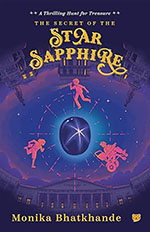
What is striking about the book is that all three children have rich inner lives. Neel grapples with the loss of personal history on his late father’s side of the family. Nahid feels jealous that it was Anosh who got to hear their grandfather’s exciting stories when all she received from him were children’s rhymes. Anosh, on the other hand, admits to secretly liking this because, usually, Nahid got to go out much more often than he could in his wheelchair. Anosh’s complex feelings about how he cannot be a part of some aspects of the adventure are explored without a pitying gaze. Such representation is important because children’s adventure narratives have historically featured only able-bodied characters. When it comes to representing disability, the book makes sure that it is a part of the narrative in its fullness. The cover (designed by Maithili Doshi Aphale) depicts all three children circling around the stone they’re looking for, with Anosh in his wheelchair. There are places in the book, like the crowded Crawford Market, which Anosh cannot access, and other places where he has to be carried over the stairs as there are no ramps.
By locating the search for the stone in places like a fountain in Crawford Market covered with vegetable stalls, or local gardens, and statues, symbols, and inscriptions, or even in museums and hospitals, the book reminds us that we may pass by history daily without even noticing it. For the author, history is not found only in books, museums, and classrooms, but it actually surrounds us, waiting to be paid attention to.
Anagha Gopal , a PH.D. scholar at the Centre for English Studies, Jawaharlal Nehru University, New Delhi, specializes in twenty-first century Indian Children’s Literature in English.