
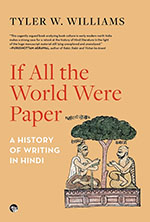
In the book, If All the World were Paper: A History of Writing in Hindi, Tyler Williams makes a substantial case for a material history of Hindi. Books in the pre-colonial period had different uses and readers. While much scholarship has advisedly drawn connections between reading as a social experience rooted in orality, Williams seeks to disturb this paradigm between the primacy of the oral over the written in the precolonial period, and suggests that the history of the written needs to be incorporated not as following the oral but alongside it. Again, much scholarship has also engaged with a long history of Hindi, both in terms of its genres and nationalist connections, but Williams roots it in material production and circulation.
Through four distinct material forms (what Williams calls ‘scenes’) of the precolonial Hindi book, the epic romance (pemkatha/love story or prem-ākhyān/love legend), the bound personal notebook (gutaka), the loose-leaf pothi, or a guru’s copy of a sacred scripture (granth or vani), Williams unveils unique practices of a specific genre with its writers and users. For instance, at the start of the first chapter, he writes: ‘And just as the pemkatha combined elements from Arabic, Persian, Sanskrit, and other Indic literary traditions but was more than the sum of its parts, so too the manuscript codices fashioned to contain the pemkatha drew from multiple book-making and aesthetic traditions, combining them to produce a material text artefact with its own distinct character’ (p. 28). The chapter comes alive with a reading of Maulana Daud’s Candayan, where ‘Daud was acutely aware of the significance of bringing bhasha from the realm of orality into the domain of writing and made vividly present the performative and literate contexts in which he composed’ (p. 30). Williams proceeds to bring into conversation several copies of the Candayan from the very expensive to not, even examining print editions of the pemkatha and shows that these material forms clash with clear periodizations provided by literary historians.
Each chapter also makes clear Williams’s methodology: a copious engagement with the form of the book goes hand-in-hand with the form of the genre. Chapter two, for example, imaginatively titled ‘Saints, Singers, and Songbooks’, begins with a mysterious man and his portmanteau gutaka: the man was apparently a follower of one of the nirguṇ sant traditions of Rajasthan, perhaps a jyotisha (astrologer), and Williams finds that the notebook ‘reflects his personal canon as well as his occupational and social world, rather than a sectarian canon or tradition’ (p. 76). This organization reveals many things: the esoteric gutaka was travel friendly, could double up as personal notes (and ‘personal canon’), did not follow strict sectarian affiliations, and was likely passed on from user to user. Williams’s mastery over his material aside, it’s also a delight to watch his play with language. Williams likens the gutaka to ‘a machine that, in the hands of a competent human operator, could generate ever new and fresh performances of texts to delight, instruct, and enlighten’ (p. 18).
Users were not passively so. Chapter three delineates the religious monks’ active participation in the broader literary, intellectual and religious conversations. Again, the material discovery is at odds with ‘historians of Hindi who, since the 1920s, have generally denied the existence of scholasticism or even intellectual consistency in the compositions of nirguṇ authors’ (p. 132). Finally, the fourth chapter focuses on sacred scriptures of the Sikhs, Dadu Panthis and Niranjanis, and their sheer commitment to writing— ‘the enthusiasm with which these traditions transcribed, collated, copied, circulated, and revered the saints’ words has puzzled many historians of Hindi literature, some of whom have dismissed these communities as “hypocrites” that strayed from the path prescribed by their gurus’ (p. 160). Clearly, matters were far more complicated.
Densely argued but written with a light touch, this is work of monumental archival achievement. The book also makes a case for a study of manuscripts and the need for their preservation. Any scholar of Hindi is very familiar with the landmark position of the Nagari Pracharini Sabha established at the end of the nineteenth century, whose important archives, both book and manuscript, have been critical to telling a history of Hindi and Hindi nationalism. The Sabha carries a large repository of precolonial manuscripts which are finding themselves either not in use or have suffered harm over the past few decades.
Aware of these trenchant histories of meaningful, ideologically motivated and arbitrary archiving decisions, Williams calls us to critically think about the processes ‘historical, political and cultural’ that shape and produce the archive (p. xv).
Certainly, this is the case for Hindi where institutions like the Pracharini Sabha and the Hindi Sahitya Sammelan were copiously invested in the making of an archive but also collected and catalogued to serve their contemporary requirements—meaningfully, they need not be ours. He is also keenly aware of the paradox that might come with the call for preservation, bringing up all sort of questions about access: to books, who then gets to see a book, and who gets to read it, particularly in the context of manuscripts that are often labelled ‘durlabh’. To preserve books might mean to make them useless as books because then they would be imprisoned in glass. These are important questions that need to be answered, and If All the World were Paper is right to ask them.
Aakriti Mandhwani is Associate Professor of English in the School of Humanities and Social Sciences at Shiv Nadar University, Uttar Pradesh. She is the author of Everyday Reading: Middlebrow Magazines and Book Publishing in Post-Independence India (UMass Press, Speaking Tiger, 2024).