
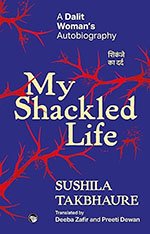
In the field of Dalit literary studies, it is a truth well-acknowledged that Dalit women’s writings in Hindi have been a late arrival. Almost all the notable autobiographies written in Hindi by Dalit women have been published in the twenty-first century. These include autobiographies by Kaushalya Baisantree, Anita Bharti, Kaushal Panwar and Sumitra Mehrol, apart from Sushila Takbhaure. Several autobiographies by Dalit men, on the other hand, including those by Mohandas Naimishray, Omprakash Valmiki, Suraj Pal Chauhan, Sheoraj Singh Bechain, and Tulsi Ram, had all found publishers and a market at least a decade earlier.
Hindi Dalit literature made its first appearance under the aegis of the Adi Hindu movement as early as the 1920s and 1930s, and these earliest instances of Dalit writing in Hindi were almost exclusively by men. In contrast, Dalit women’s self-expression, especially autobiographies, in other languages such as Marathi, preceded Dalit men’s autobiographies in Hindi by nearly two decades. Encouraged by Ambedkar himself, some of the early participants in the anti-caste movement in Maharashtra were women: Kumud Pawde, Meenakshi Moon, Urmila Pawar and Baby Kamble. Their life stories, written by themselves, are characterized by self-consciousness and self-confidence, as well as an awareness of their collective strength as Dalit women. Hence the scholar-critic Sharmila Rege has rightly labelled these personal narratives as testimonios, each being the story of an individual Dalit woman as well as the representation of Dalit women as a whole.
A similar sense of solidarity among Dalit women (or, for that matter, between Dalit men and Dalit women), has been at a discount in the Hindi belt, where, as Sushila Takbhaure’s autobiography Shikanje ka Dard (2011), translated as My Shackled Life (2025) makes clear, the emergence of a Dalit self-assertion movement was effectively stemmed by the extended hegemony of Gandhi’s Harijan uplift programme. It is important to remember that Ambedkar, in his first major publication, Castes in India: Their Mechanism, Genesis and Development (1917), emphatically declared that the caste system, operating under the strictures of endogamy, was an undeniably gendered institution.
Consequently, the politics of patriarchy, inextricably linked with a politics of caste discrimination, was and remains a significant feature of Dalit women’s experiences, both in the private sphere as well as in the public domain. As Takbhaure highlights, even in her parental home, in which she was a well-loved child of her grandmother, mother and father, she suffered from a sense of deep discrimination as a girl child. Her immediate and extended family assiduously coached its daughters to abide by certain normative ‘feminine’ codes of conduct. Restrictions were placed on girls: ‘sometimes in the name of safety and at other times to mould us into the centuries-old ideal of a perfect girl … and I followed them obediently.’ As Sushila grew up, she observed both inside and outside the school, the disparity of treatment meted out to men and women. Ironically, very often the rites and rituals observed by the savarna castes on auspicious occasions, like Rakhi and Pitri Paksha, which had clear male-privileged connotations, were celebrated with equal fervour by the subaltern castes. However, Sushila’s family was an exception in certain ways. Within the household, as Sushila notes, ‘there was no visible discrimination between sons and daughters in either affection or responsibilities assigned.’ Moreover, Sushila’s parents supported her aspirations for higher education. In doing so, though they were not formally initiated into the tenets of Ambedkarism, followed Ambedkar’s exhortation that Dalit parents must first and foremost prioritize educating their children. This was no easy task for Sushila’s parents who had to take up additional work and skimp and save, ‘often going without basic necessities for months’.
Within the constraints of endogamy, Sushila’s parents found an educated groom, a teacher, with better economic prospects. His family was based in Nagpur, and this held the promise of transition for Sushila from her life in a village to life in a big town. Although she found the urban environment more impersonal than the rural one, it provided her with opportunities to enrol for a B.Ed. degree, and also, to eventually find a teaching job at her husband’s school. Nevertheless, her life continued to be oppressive, since along with the pressures she faced as a working woman, she had to cope with the enormous onus of running the home for her loveless husband and his temperamental relatives.
In the world outside the home, her caste identity, that of a Bhangi, continued to be a source of much humiliation. She had no option but to gradually come to terms with the fact that caste consciousness, which she thought she had left behind in the village, persisted in the town as well, forcing many Dalits to often conceal their caste and live in savarna localities.
The only redeeming feature of her otherwise dull life in Nagpur was her introduction to the Ambedkar movement. For the first time in her life, she embraced a life of activism as a Dalit woman, in the process getting acquainted with many fellow travellers, some of whom were also Dalit writers. This radically new turn in her life proved to be the stepping-stone for her to become a writer who would consistently wield the pen to fight for Dalit people’s right to a life of dignity.
In her autobiography, now translated into English by Deeba Zafir and Preeti Dewan, Sushila Takbhaure successfully offers a paradigmatic portrayal of the struggle for survival of a Dalit woman of humble origin in the face of the ‘multiple marginalities’ (a phrase coined by Badri Narayan and AR Misra) which define her predicament. The term ‘intersectionality’ used by Zafir and Dewan in their Translators’ Note is a term which is more frequently deployed today to indicate the interconnected operations of different forms of oppression—gender, class, and caste—which conjointly push a woman towards the receiving end of social subjugation. The term was coined by the African-American civil rights activist, Kimberle Crenshaw, to denote in the American context the intertwined nature of race, class and gender disadvantage of which Black women especially are victims. Crenshaw stresses the importance of taking cognizance of the interlocking nature of the different variables of oppression in order to build solidarities among different constituencies of oppressed people.
With reference to My Shackled Life, while I appreciate the application of the idea of intersectionality to understand the predicaments of both Black and Dalit women, in my opinion, it fails to provide an accurate understanding of the specificity as well as the complexity of the institution of caste. The idea underestimates the inflexibility of its stranglehold on everyone who is subject to it, including the ‘upper’ castes. I wish to affirm that there are at least three major differences between caste discrimination and racial discrimination (in the American context) which need to be kept in mind while making this comparison. Firstly, the logic of racial discrimination is the colour bar, i.e., the devaluation of non-White, people of colour, especially Black people, by White people. On the other hand, there is no obvious divergence in complexion or features of the members of the different castes in Indian society. Secondly, racial disparities are foregrounded by stressing upon the distinction in skin colour and other physical attributes between people from different ethnic backgrounds and become the source of antagonism between them. In contrast, caste stratification is dictated by stressing upon the so-called metaphysical considerations, such as pollution/purity norms, which are authorized and attested by the Hindu scriptures, and thus assume the status of a religious mandate. Thirdly, racial demarcation is essentially a binary opposition between those who are White and those who are not. Conversely, the caste system comprises a carefully constructed top-to-bottom ranking of social aggregates which, in Ambedkar’s words, are arranged according ‘an ascending scale of reverence and a descending scale of contempt’.
In the course of her narrative, Sushila Takbhaure, time and again, illustrates not only the insidious penetration of the Hindu worldview, its convictions, creeds and customs into the psyche of even the ‘lowermost’ castes, but also the profound impact of caste consciousness, in all its perniciousness, on everybody within the Hindu fold. Thus, there are several instances in which Takbhaure and her family find themselves the targets of caste-driven humiliation from members of other backward castes. These examples are symptomatic of what Ambedkar described as the grid of ‘graded inequality’ which characterizes the caste order.
For example, Sushila’s father and brothers who worked as coolies found untouchability being practiced by their co-workers who were from other backward castes. Similarly, Dalit girls, with whom Sushila had struck up friendship in school, would never invite her into their homes as her ‘caste was considered lower than theirs in the hierarchy.… These differences prevented any true friendship from developing.’ Even people of her own caste, the Bhangis, would be more deferential to people from the ‘upper’ castes than to their own caste-fellows. She cites the example of a garbage-collector who pointedly showed his preference for collecting trash from ‘upper’ caste homes than homes of Dalits. As is evident, the caste system functions on the principle of ‘graded inequality’, but the racial binary works in a different manner altogether.
In their excellent translation of Takbhaure’s autobiography, Zafir and Dewan have used the technique of what Sujit Mukherjee has called ‘transcreation’, rather than attempt a mechanical word-for-word correspondence between the original Hindi text and their own English version. Words and phrases with strong local nuances, and therefore ‘untranslatable’, have not been awkwardly forced into the rhythm of the target language, but instead permitted to remain as they are. The inclusion of a glossary at the end of the translation will certainly be of help to readers.
Tapan Basu is a retired Professor from the Department of English, University of Delhi, Delhi.