
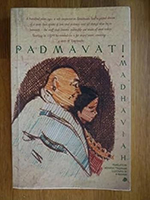
Holding Madhaviah’s Padmavati in hand is akin to travelling over a century back in time and observing Tamil society in action. Entrenched in ritualistic faith, superstitions, caste and class divide, Western thought is seeping slowly into this society through crevices left by age-old customs. Even when studying and speaking English guaranteed an exalted status, the tug of war between tradition and modernity leaned in favour of the former. And, denouncement of practices like child marriage, widow ostracization and disfigurement earned flak.
The novel opens in a small village in Tirunelveli district in south Tamil Nadu. Our protagonist Narayanan is a shy and sensitive young boy and his honest testimony in the court of law leads to his father Sitapathi Iyer’s imprisonment. Despite his father’s misdeeds and notoriety pushing his family into penury, his virtuous mother’s upbringing and erudite teacher Rajagopala Iyer’s guidance infuse right values in him. Gopalan, his friend, who treats him like family also offers support. Over the years, the camaraderie between Narayanan and Gopalan grows and so does their penchant for literature in English and Tamil, and their resolve to excel in studies. Both get married in their teens to girls younger than them; Gopalan to Kalyani and Narayanan to his maternal cousin, Padmavati. Familial responsibilities, self-doubt and inferiority complex, misgivings along with crafty machinations of Gopalan’s younger brother Sangu create a deep chasm in their friendship. But as time rolls by, both truth and peace prevail.
The novel comprises two parts with Part 1 (originally published in 1898) focusing on Narayanan’s growing up years in the rural south and Part 2 (published in 1899), set in urban Chennai. Part 3, left incomplete due to the author’s death in 1925, is summarized in a page at the end of the book. As I closed the novel, I was left with a nagging question about the choice of the book’s title. Padmavati, a young spirited girl with a firm resolve to marry Narayanan, mostly lurks in the background in Part 1. She is waiting to come of age and join him in her marital home. It’s only in Part 2 that her character, a chaste wife for whom her husband’s every wish is decree, matures. Yet, her life journey isn’t given more space or importance than that of Kalyani, Gopalan’s wife, or Savithri, Gopalan’s elder sister. Then, is ‘Padmavati’ a befitting title for a work that dwells upon a bunch of men, women and their predicament?
The title clearly underrepresents a novel that dazzles in layers. At a macro level, it is a tale of two friends, and their victories after many trials and tribulations. It portrays friendship, loyalty, love, lust, anger, grief, betrayal and a broad spectrum of emotions that define interpersonal equations with immense acuity. At a micro level, it is an authentic period picture of Brahmin life in Tamil Nadu with spotlight on the Iyer subcaste.
It may also be hailed as ‘loosely autobiographical fiction’ for the strong similarities between the author and Narayanan. Both are born in Tirunelveli district (the author in a village called Perunkulam and Narayanan in a village called Chirukulam), both study at Madras Christian College and upon finishing graduation (BA degree) teach at the same college for some time. Reverend William Miller, Principal of Christian College, who deeply influences the author’s moral and intellectual values, finds a place in the novel. Replete with references to Othello, Thirukkural and Kamba Ramayanam, the author’s zeal for and proficiency in Tamil and English find strong expression in Narayanan. When it’s asserted that no profession is nobler than teaching, when Narayanan explains to a wide-eyed Savithri why women’s education is of utmost importance, the author’s broad social outlook and reformist vision sparkle.
The novel offers a panoramic view of a society thriving in patriarchy’s vice-like grip with apothecaries, teachers, lawyers, rich landlords, marriage brokers, drama artists and devadasis adding vibrance. That money sufficient for basic comforts acts like a safety net and that its excess leads to erosion of moral integrity are highlighted. That lust and avarice are man’s biggest enemies is elucidated. The twists in plot and a colourful array of characters are the novel’s principal strengths. If women baffle you with their unwavering loyalty to their wayward husbands, men annoy with their weakness for the fair sex. The author paints an ‘ideal’ human being in Seethai Ammal, Narayanan’s mother, a pragmatic, patient and resilient woman with a deep sense of self-respect who genuinely desires happiness for her son and his wife. A few errors could have been avoided with tighter editing: Kalyani is referred to as Kalyanam on pages 194-195, 1982 is written instead of 1892 on page 2 and the book’s back cover strangely carries a brief bio of Tamil author Pudhumaipittan.
In Meenakshi Tyagarajan’s (the author’s granddaughter) translation, Padmavati is extremely readable. When she introduces readers to Chirukulam village on the first page as a village with no shops, only backyards, ‘no kadais, only purukadais’, her verve to retain the Tamil flavour is palpable. Bundled with an insightful introduction by A Madhavan (the author’s grandson) and illustrations by M Krishnan (the author’s youngest son), the novel feels like a precious piece of heirloom.
Divya Shankar, an engineering and sciences graduate, with seven years’ working experience in the semiconductor industry is currently a stay-at-home mother, a freelance writer and an avid reader with a soft corner for Indian literature. Literary fiction, historical fiction and short stories are her favourite genres.