
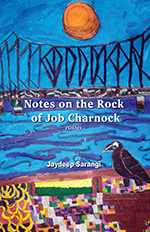
A sense of timelessness marks the cover of Jaydeep Sarangi’s Notes on the Rock of Job Charnock. The sixty-six poems in the collection, too, seem to lose sense of time as they leap across history, mythology, memory, and desire in order to discover the existential sense in living. This is Sarangi’s twelfth collection of poems, manifesting once again, his deep attachment to people and places. A number of themes crave attention here—colonization, industrialization, climate change, urbanization, changing patterns of human relationship, alienation and the collapse of communication.
The city of Kolkata, as the poet himself states in his preface to the collection, is the chief protagonist of these poems. A native of Jhargram, which marks its consistent presence in his poetic imaginary, Sarangi’s intimate geography is constituted by both his janmabhoomi, Jhargram, and his karmabhoomi, Kolkata. While several of the poet’s earlier poems have been addressed to Kolkata, this collection breaks fresh ground in his oeuvre by documenting the multi-axial temper of what the poet calls ‘my city of joy and sorrow’ with its ‘slum’s eye view/ at times dumb, flowing/ even for now, serving’ (‘Myth of a City’).
On 24 August 1690, Job Charnock set up the East India Company’s headquarters on land that was spread over three villages of Bengal—Sutanuti, Kalikata and Gobindapur. Named as Calcutta, this city became the capital and headquarters of the British Empire in India till the early twentieth century. The spirit of Job Charnock, who is looked upon as the founder of Kolkata, haunts these poems in more ways than one. While the Calcutta High Court convincingly established in 2003 that Charnock could not be considered the founder of Kolkata given the fact that settlement in the region predated him, Charnock remains a significant presence in the cultural history of Kolkata and in the psyche of these poems.
The rock mentioned in the title of the collection refers to the mausoleum of Charnock and the special rock it is made of. Built in 1695 by his son-in-law and successor Sir Charles Eyre, the rock of this tombstone, especially brought from Chennai, did not draw much attention till in 1893. Exactly two hundred years after his death, the British geologist Sir Thomas Holland identified it as a new type of rock and named it Charnockite in honour of Job Charnock. Notes on the Rock of Job Charnock can, therefore, be read both as elegy and homage.
Charnock is, perhaps, the first European in India who eagerly embraced native customs of dress and religion. In the poem ‘On his Rock’, Sarangi imagines the man ‘wearing dhoti/ matching your skin, dazzling/ in testimony of affection’, giving up his British apparel, ‘closer-fitting coat, knee-breeches with/ centre front opening, white-brimmed hat’. And though he won over the locals through such measures, the colonizer in Charnock remained firm:
You rode and rode the horse to our ancestors
piercing their land, mud houses and cattle
imposed a name on their land, not in their tongue
unless you realized how your dhoti got maps of
nations, tattered.
Also intact in historical and cultural lore is Charnock’s love for a Hindu woman whom he is known to have saved from burning at her husband’s funeral pyre through forced Sati. According to some accounts, she was a fifteen-year-old Rajput widow named Leela and of such mesmerizing beauty that Charnock was smitten and whisked her away from the pyre to marry her himself, renaming her Maria. Whether she lived as Charnock’s lawful wife or mistress is not clear but this history of intercultural love significantly fuels the thematic energy of the collection through poems that describe the intensity of love and question the logic of time and emotions.
A certain postmodernist schizophrenia marks the book. The movement from line to line, and from poem to poem, often seems restless and chaotic. There is a strong impulse to speak marked by an equal quickness to resort to silence resulting in dense, clipped poetic lines that both yield and withhold meaning. In quite a number of poems, there are similar lines embedded in different poetic contexts, inviting the reader to contemplate on the relationship between the text and the subtext in a poem, and between the part and the whole. These poems, the reader will agree, emerge in the form of notes, an element of raciness and incompleteness built into their very conception.
Myths from various landscapes and cultures fuse here, narrativizing the world as one postcolonial terrain, and life across histories as intricately connected. Sarangi’s familiarity with local myths makes him a cultural ambassador for the lesser known and the obscure. His resurrection of local names in his poems, from time to time, establishes connections between places seemingly remote and yet, resonant spiritually. Thus, the Nile and Euphrates merge with the Beas, Ganga, Subarnarekha and Dulung. Similarly, Dwarka, Pataliputra, Varanasi and Madurai merge with Mesopotamia, Hormuz and Gaza in historical kinship.
The geography of Kolkata suffuses the collection. The poems take us through Howrah, Gariahat, Eden Gardens, James Long Sarani, Prinsep Ghat, Ratan Babu’s Ghat, Belgachia, Sealdah and more. Documenting both slums and high-rises, rural and urban localities, and freedom and claustrophobia, this book attempts to translate the city of Kolkata to the reader in all its wonders and complexities. Notes on the Rock of Job Charnock is, thus, a contemplative reflection on a city’s relationship with itself and its inhabitants. It is, in vital ways, also, a history of the poetic self, dislocated in time and space, and a reminder of the fact that wholeness can, perhaps, best be embraced in fragments.
Basudhara Roy teaches English at Karim City College, Jamshedpur. She is the author of four collections of poems, the latest being A Blur of a Woman.