
If you browse through academic journals, you may find statements by authors, assuring readers that there is no conflict of interest involved in what they have written. In venturing to write on Just Being, Romila Thapar’s account of a life at once full and fulfilling, I thought it best to let unsuspecting readers know that I have known her for almost fifty years—as a teacher, guide, mentor, friend. So, if you continue reading, you do so at your own risk.
In her earliest and path-breaking research on the Mauryan emperor Ashoka, Thapar attempted to understand the extent to which he was a product of his times. Or did he shape them? Or a bit of both? Just Being implicitly invites us to ask the same questions about Thapar, allowing us to discover the complicated, messy spaces for individual agency, as we find her making her way through opportunities, challenges, and occasionally facing insurmountable problems. There are silences, perhaps both intended and unintended spaces that we can explore, think, imagine and speculate about. She alerts us at the very outset that there are experiences that ‘simply dwell in the inner cave of my being’ (p. xvii).
Let me add that it is best to treat the bulky book as not unputdownable—to savour it slowly, pausing, reflecting, wondering, wandering, arguing silently or vociferously, after each of the thirty-one chapters, or better still, around the breaks provided within them. That the narrative is not rigidly linear but loops back and forth, and creates a sense of space. In fact, the text resembles an intricate, densely woven tapestry, with several strands running through it—of people, places, processes, of ideas and institutions, of learning, teaching and research, of cultural practices set against the backdrop of some of the most dramatic, even traumatic decades of the last and the present century, in India and the wider world.
Thapar begins her narrative from her sheltered, happy childhood, growing into adolescence under the shadow of World War II, and the painfully entwined experience of Partition and Independence. We catch a glimpse of her first public speech, delivered in her school, to mark the country’s momentous transition from a colony to an independent nation. While in England, in the 1950s, she witnessed the end of the Stalinist era in the Soviet Union. A fascinating trip to China culminated in a meeting with Mao Zedong and Zhou Enlai. The 1960s found her in the US when Martin Luther King was assassinated, while youth movements erupted in different parts of the world. Decades later, she would meet Nelson Mandela.
Back in India, from the 1960s onwards, she has lived through the regimes of as many as fifteen prime ministers, rivalling the record of the number of US presidents who came and went during the reign of Queen Elizabeth II. So, she is perhaps justified in offering advice:
Prime ministers need an integrated vision for handling social and economic problems if society is to be made better, especially for those below the poverty line—in fact, the actual majority and not the limited majority based on a single religion…. Waffling over priorities in policy and giving them easy acronyms is not the definition of good governance (pp. 132-33).
In a second strand, Thapar steers the reader through her early education in schools in Lahore and Pune, her college education in Pune, Delhi and Shimla, before embarking on her momentous voyage across the seas to the School of Oriental and African Studies, London. Here she grappled with challenging and exciting courses, simultaneously learning and absorbing as much if not more from the vibrant social and political world around her that expanded to embrace colleagues and friends from Africa, Europe, China and Southeast Asia, and led to a dream trip to the Buddhist caves in China. Learning was not confined to lectures—she introduces us to a whirl of books and authors, artists, music, films, plays, and more. These led, amongst other things, to a deeper and abiding understanding of the complexities of colonialism as experienced in different contexts, which inevitably impacted on the postcolonial worlds that Thapar discovered emerging around her. Instead of being swept away by these crosscurrents, she navigated her way through them. Much of her later work and thinking were enriched and perhaps irreversibly transformed by these experiences.
Simultaneously, we find her developing her ideas on Ashoka, delving into his inscriptions, Buddhist texts in Pali, and acquiring a feel for archaeology, learning how to draw, and even make pots. But as, if not more important in the long run, this was when she began exploring the ways in which historical understanding developed in the subcontinent—a passion and pursuit which would fructify, decades later, in a long and thoughtful book, The Past before Us.
Thapar’s description of her return to India in the 1960s is almost tragicomic. Her quixotic effort to set up a brand-new department of History in Kurukshetra University ran into rough weather. Her stint at Delhi University was more fruitful, laying the groundwork for her crucial role in establishing and nurturing the Centre for Historical Studies, Jawaharlal Nehru University, in the following decades.
It is in this context that Thapar carefully elucidates how the discipline has changed—moving away from a preoccupation with rulers to include and understand a wider socio-economic universe. She discusses why and how sources need to be identified and handled carefully, contextualized and analysed, and traces the many strands of historiography—colonial, nationalist, postcolonial—that have shaped our understanding of the past. She demonstrates the excitement and complexity of interdisciplinary approaches using studies on Vedic texts, the Harappan civilization, and the Aryan question as examples, besides emphasizing the need to examine religious traditions as dynamic rather than static.
Thapar contrasts the constantly expanding domains of history with the ways in which the discipline is presented and perceived by non-specialists, especially those invested in perpetuating a majoritarian perspective. Her critique is sharp, stemming as it does from both anguish and anger at the dismantling of institutions, disciplinary spaces, and pedagogical practices built up over several decades. School textbooks, she demonstrates, were and remain in the eye of the storm, subject to deletions and sanitization in an effort to produce docile citizens.
This dismal scenario is juxtaposed with a chapter that captures the excitement of setting up the Centre for Historical Studies—designing courses and systems of evaluation, organizing the library, and recruiting and training students. Thapar paints a vivid picture of discussions, debates, and controversies that went into the making and working of the university. She concludes: ‘The years of my association with JNU were some of the best years of my life’ (p. 252).
Thapar’s post-retirement years have turned out to be as, if not more action-packed than the preceding period. She attempted to intervene to salvage archaeological sites along the Narmada, and to put in place a blueprint for an autonomous educational channel on the state-run television. All these attempts were brusquely stone-walled, as was that to intervene in a project to improve Dharavi. Sadly, and more routinely, some of her public lectures have either been cancelled or re-scheduled in the face of barely concealed pressure from the powers that be.
However, that is by no means all. One finds her constantly thinking about fresh lines of investigation and action—into the complex connections between the subcontinent and Southeast Asia, ways of improving museums, and much more.
The text is populated with dozens of named people (and pets)—members of her immediate and extended family, friends, teachers, students, neighbours, colleagues, and celebrities, who emerge through delightful vignettes. We learn, for instance, that her first close encounter with Gordon Childe, to whom we owe the concepts of the neolithic and urban revolutions in antiquity, was while playing musical chairs! We discover her nervously preparing to accompany the redoubtable DD Kosambi, who agreed to talk with her if she accompanied him on his regular train journey from Bombay to Pune. She notes:
He kept up a conversation right through the three hours, so there were none of the silences that I had feared. I was overwhelmed by his knowledge, not just textual but also of every hill, cave and tree-shrine that one could view from the train window (p. 89).
There are also delicate descriptions of more intense personal relationships.
Almost mid-way through the book is a chapter devoted to family and friends—we meet them in Lahore and Ferozepur, and, of course, in Delhi. Thapar notes how some family members became friends, whereas relationships with others remained more formal. She observes the complexities of family life, where participants enter and leave in the course of the life cycle, and where relationships can and do change during the intervening periods. There is the unalloyed joy of witnessing little children growing up to be mature, caring adults, and the deeply personal grief at the loss of close kin. Both are shared with quiet restraint; both the pleasure and the pain are palpable. There are moving accounts of the sheer joy of accidental friendships, nurtured carefully and cherished over generations, as well as those with colleagues, students and publishers. We also discover her indefatigable energy, to converse with scholars wherever and whenever she encounters them; as well as her all-too human anxieties in the face of physical frailty.
Alongside, we find a strand tracing her academic preoccupations. These included reading various tellings of the Sanskrit epics, analysing political structures and processes, and reconstructing social relations in ancient India. Each of these was informed by a close engagement with sources, and enriched with interdisciplinary perspectives drawn from reading, but as, if not more importantly, engaging in conversations with scholars in academic institutions both at home and abroad. And with these contributions came a slew of honours—honorary degrees from several universities, membership of prestigious academic bodies, and, in 2008, the Kluge Prize, considered to be the equivalent of the Nobel Prize for disciplines such as history.
Knotting these strands together is a thread that carries us through places and spaces, many of which Thapar visited time and again—from Yangon, where she was conceived; Lucknow, where she was born, to Peshawar, Rawalpindi, Lahore, Pune, Delhi, Shimla, where she grew up and out of her familiar world, and then to London, France, Vienna, China…. From the 1960s she was travelling through the subcontinent and across the globe, through the Americas, Europe, Africa and Australia, attending conferences, delivering lectures, researching in libraries and monasteries. We find her making fruitful trips to Sri Lanka, drifting along the Amazon, scaling mountains in Ladakh and Bhutan, dipping her feet in the Oxus, using every conceivable mode of transport—tangas, bullock carts, camels, elephants, trains, trucks, cars, boats, ships and planes. And, with her travels, we discover her favourite foods and drinks, which range from familiar and mouth-watering chaats and guava with tamarind chutney to dizzyingly exotic fare with virtually unpronounceable names.
As one reads, one stumbles across delightful sentences tucked in unexpected places. In describing her tension in trying to conform with the expectations of Delhi’s middle-class society in the 1950s after having tasted freedom in London, she writes: ‘I saw myself as the olive whose pit is removed and replaced by a pimento filling’ (p. 95). Equally vivid is this account of Machu Picchu: ‘During the day, it is crawling with tourists that come like ants around a pot of honey’ (p. 271). Or, elsewhere, ‘the security personnel were like flies on a plate of jalebis’ (p. 609).
I tried making physical and mental lists of all the books/authors, films and varieties of music that Thapar has discovered and enjoyed, soon realizing that there is so much that remains unheard, unread, unseen by readers like me. I was left with the feeling of a sparrow in the presence of a benevolent eagle. I learnt, for instance, about the Gul-e-bakavali, one of her childhood favourites, a fascinating tale about a prince who embarks on a quest for a mystical flower, a story with Persian and Urdu variants that circulated throughout north India. Thapar recounts how, sitting in a dhaba in the Urdu Bazar near Jama Masjid in Delhi, she learnt much more about its contexts from none other than Simon Digby, one of the most renowned scholars of medieval history of our times.
There are also several surprises—big and small. I discovered that she could have become the Indian Greta Garbo and must confess that I was relieved to learn that she was firmly dissuaded by her parents. Would she have had a larger fan following than she has at present? And would it have brought other challenges?
As Thapar repeatedly reminds us, growing up and being a woman is a constant challenge. In the prologue, she states: ‘I have asserted my autonomy as a free, liberated woman’ (p. xix). Yet, this did not come easily. She recounts a narrow escape from an attempted sexual assault when she was twelve. Several years later, reading Simone de Beauvoir’s classic, The Second Sex, convinced her that her dreams were valid. However, it was only through assertions and conversations at home that she was gradually able to claim the space she dreamt about, even as she continued to encounter insidious attacks at her workplace and in the wider world. She has also been subjected to what can only be described as virulent misogyny in recent years, the price she has had to pay for her outspoken stance vis-à-vis Hindutva.
It is more than likely that there can be disagreements and disputes, heated or otherwise, about Thapar’s reconstruction of events and processes, as memories and perspectives almost invariably, and perhaps fortunately, can differ. However, if we get trapped in trying to evaluate the accuracy or significance of each and every statement, we are likely to miss out on the larger picture, the generosity with which Thapar creates and shares the vast and complex canvas of her life, making the difficult choice to be at once vulnerable and brave.
Apart from petty disagreements, there can also be differences regarding conceptual categories. At the risk of over-simplification, one can state that much of Thapar’s narrative revolves around the binary of ‘good’ and ‘bad’ nationalisms, the latter often equated with religious majoritarianism. While not entirely inaccurate, it is perhaps worth considering whether or not nationalism itself needs to be problematized. This is by no means an original idea. As is well-known, some of the bloodiest conflicts in the last century and the present one have been fuelled by notions of national interest, not always buttressed by religious fundamentalism. And, as we move towards a less anthropocentric understanding of the world in the present century, it is a sobering thought that ours is probably the only species that engages in systematic intra-species warfare. I suspect and hope that, moving beyond nationalist frameworks, the next generation will draw inspiration from Thapar’s persistent and passionate pleas for respecting diversity, difference and dissent both within and amongst human societies, and the wider world.
In the prologue, Thapar lets us into the secret of the title of the book. It was one of her closest friends, Rajani Patel, who said: ‘I would like to thank you for just being’ (p. xvii). By the time we reach the last page, or even earlier, we are likely to concur wholeheartedly. And one realizes that, hard as it may be, it is best to resist stereotyping her—whether as a public intellectual or as an intellectual terrorist. The latter, obviously, reeks of violent prejudice. However, while insisting solely or even primarily on the former identity acknowledges her courage and perseverance, it often forecloses the possibility of engaging with the rich, complex, even conflicting uncertainties that Thapar continues to engage with, with clarity, confidence and care. As she asks, almost plaintively: ‘Who would understand that I dreaded being stereotyped (p. 97)?’
As I worked my way through the volume, I could not help wondering whether Thapar’s deep engagement with Sanskrit texts, ranging from the Vedas and Upanishads to the epics, charitas, and kavyas has rubbed off onto her narrative. One can find all the nine rasas mentioned in Bharata’s Natyasastra, the classic text laying down the norms for performative arts in early India. There is love and laughter, sorrow and anger, rage and courage if not valour, traces of the fierce and the horrific, and tranquillity.
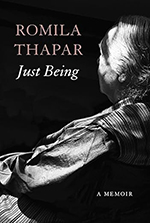
Let me end with the three visuals—one on the cover, and two within the volume—spare, restrained, inward looking. There is a sense of quiet, meditative reflection. While there is much in Thapar’s account that is vibrant and vivid, these provide a glimpse of her inner world, where we need to tread softly, with care, and respect the silence that is as, if not more, eloquent than words.
Kumkum Roy is former Professor of Ancient Indian History, Centre for Historical Studies, Jawaharlal Nehru University, Delhi.