
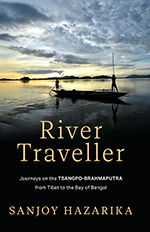
Some books are about rivers, while others try to think alongside them. Sanjoy Hazarika’s River Traveller seems like the latter. Hazarika blends travelogue, political history, ecological reflection and memoir. The book follows the Brahmaputra from its source in Tibet as the Tsangpo, through Arunachal Pradesh and Assam, into Bangladesh where it joins the Jamuna and finally flows into the Bay of Bengal. In this book, the river is not just a place on a map. It becomes a record of memory, violence, migration and survival. Hazarika’s long experience in the Northeast as a journalist, commentator, researcher and public thinker gives his writing both authority and a personal touch. After years of travelling along the Brahmaputra, he collected stories about the land and the people living in the river’s unpredictable world. The book presents a rich account of the lives of ferrymen, fishermen, villagers, soldiers, traders, migrants, tea workers, monks and border communities.
One of the book’s strengths is how it challenges the usual, mainland-focused view of the Northeast. The region is often discussed in terms of crises like insurgency, migration, floods, border disputes or ethnic violence. Hazarika does not avoid these issues and they do come up throughout the book. But he places them in the context of much longer histories of movement and connection in the region. The Mahabahu Brahmaputra or the Burha Luit stands out as a corridor linking Tibet, Northeast India, Bengal and more. Seen from the perspective of the communities living along the river, the Northeast is no longer a frontier. The book is especially engaging when it explores the many layers of history in the river basin. Hazarika looks back at colonial journeys, wartime paths, spy networks and the goals of imperial mapmakers who tried to control the river. The parts about British surveyors and explorers are particularly interesting because they show how the Brahmaputra often defied their need for certainty.
The book starts with an account of his journey in Tibet. The richness of the writing lies in the fact that Hazarika accounts for the socio-economic realities of the people there. Tibet is like a Chinese colony and his writing brings out this systematic exploitation. Coming to the issue of migration, he says that the Brahmaputra basin has always seen people moving freely across areas that modern countries now try to control. Hazarika pays close attention to how these changing river landscapes make simple ideas of belonging more complicated. The river flows through Tibet, India and Bangladesh, but its life and culture go beyond national borders. The book’s discussions of migration and identity politics in Assam stand out. Without taking sides, Hazarika shows how environmental risks, erosion, displacement and worries about population all come together in complex ways. This becomes clear when he reminds one of the earthquake of 1950 and the devastation it left. It was also when the river had a massive course correction. At times, River Traveller feels almost like a farewell to the environment. Climate change is a constant presence in the story. Talks of melting glaciers, unpredictable rain, more sediment, vanishing river dolphins, less navigable water and severe floods resonate with this concern. Hazarika talks of the effects of big dam projects in Tibet and China’s growing construction on the Tsangpo. The book’s environmental message shows how ecological problems affect daily life especially for those who rely most on the river and are most at risk from its changes.
What sets this book apart from typical environmental writing is that it does not idealize the river. The Brahmaputra is grand, but it can also be destructive. The river is shown as an unpredictable force that can not only support civilizations but also destroy them. Tribes living alongside the river have adapted to the river through raised embankments and homes made on bamboo stilts. The people of Chars move along with the river as it is their lifeline. Hazarika touches upon the issues of displacement and how this renders the question of identity complex.
The book makes some profound observations. Large-scale developmental projects have brought unprecedented damage to the river ecosystem. Be it the dwindling population of xihu (bottle-nosed) or the polluted water bodies, the JCB-led and mining have impacted the river and those who depend on it for their livelihood. The scope of the book is immense, just like the Brahmaputra, and touches upon myriad issues. However, the book’s wide scope can sometimes be a weakness. River Traveller tries to cover history, politics, ecology, anthropology, travel, memoir and reporting all at once. As a result, some parts feel less detailed than others. Some topics, especially about current water politics and government policy, might have been stronger with more analysis. Readers wanting a deep academic look at environmental politics or border studies may find the book more descriptive than critical.
Another small weakness is the book’s wide geographic range. Moving from Tibet to Bangladesh is a big task, and sometimes the changes between personal stories and larger historical sections feel random. Still, these loose structures also match the vast and shifting nature of the topic. The Brahmaputra’s story is not easy to tell in a straight line. River Traveller adds to a group of books that see rivers as active forces in politics and knowledge, and not just as scenery. Recently, environmental studies have focused more on how rivers shape memory, power, movement and identity. Hazarika’s book joins this discussion, even if not directly. In his account, the Brahmaputra is a witness to empire, nationalism, military action, ecological crisis and human resilience. Readers who know Hazarika’s earlier books on Northeast India will recognize many of the same themes here like migration, violence, marginalization and memory. Still, River Traveller takes a more thoughtful and wide-ranging approach. Throughout the book, it feels like the author is recording not only the river’s story but also reflecting on his own ties to place, history and belonging.
River Traveller works because it sees rivers as more than just natural features. They are part of history, hold memories and keep records of human hopes and disasters. Hazarika’s book shows that the Brahmaputra cannot be understood only through science, politics or disaster numbers. We also need stories and the mighty river provides us with stories of movement, erosion, survival and loss. At a time of environmental uncertainty and stricter borders, the book reminds us that rivers last longer than political boundaries. They hold histories that no map can ever fully show. Hazarika’s travels into Bangladesh and amongst communities who shared histories with their brethren in India reiterate this.
Parvin Sultana teaches Political Science at Pramathesh Barua College, Assam. Her research interests include gender, migration and minority rights.