
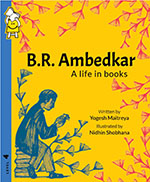
Yogesh Maitreya
B.R. Ambedkar: A Life in Books, is a very imaginative and accessible introduction to one of the tallest leaders India has ever had. The book, without being pedantic, provides a young reader a bird’s eye view of life and times of Babasaheb. It does a fabulous job of introducing young minds to difficult themes such as caste-based discrimination, equity and justice.

The Puffin Book of 100 Extraordinary Indians, 100 inspiring stories of outstanding achievements, is a compilation of stories of different Indians across diverse fields from various eras.Arranged alphabetically, and seemingly written by different authors (no author has been credited), the book feels random.
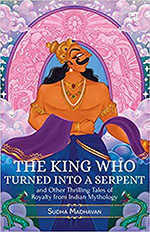
Sudha Madhavan
A collection of stories with a mythological backdrop to it has the potential to attract readers from diverse age groups, especially those who have had a taste of such stories in their childhood. The stories are written in an interactive manner and the connectedness between each of them takes the reader back and forth, weaving into a universe of the epic Mahabharata and sometimes drawing from the Ramayana as well.
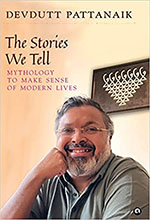
Devdutt Pattanaik
Renowned mythologist Devdutt Pattanaik has picked seventy-two tales, mainly from India’s rich mythology, and used them as a canvas to paint 21st century on. This collection of stories originates from Patnaik’s webcast called Teatime Tales. Why did he pick 72 stories? Well, the reason lies in mythology. 72 steps, 72 hours, 72 names, 72 stupas—all these and more feature in mythology
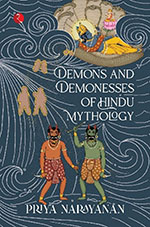
Priya Narayanan
This book is a collection of stories of 17 mythical beings—Asuras, Rakshasas/Rakshasis from Hindu mythology, centered around whom stories are rarely written or discussed.In Hindu mythology, devas or gods are often shown to be virtuous (even their cunningness portrayed as diplomacy and ingenuity) and thus victorious; always celebrated and glorified. Asuras and Rakshasa/rakshasis on the other hand are shown as evil, demonic figures, whose defeat at the hands of devas are symbolized as victory of good over evil.
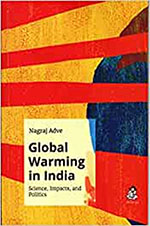
Nagraj Adve
Nagaraj Adve’s Global Warming in India is a brief and practical guide that enables the reader to engage with the discussions, debates and actions about the most pressing social and moral issue before our generation. It is written with a sense of hope and compassion for the ‘ordinary people’ that is largely missing in similar and popular books, which tend to focus more on the specialist and technocratic solutions handed over from above and to which most of us are expected to assent to and participate merely as a consumer or observer.

Amirtharaj Christy Williams
Picking up the book—the name made me wonder how an elephant in Rajaji National Park, far removed from the southern kingdom of Mysore got the name Tipu, fondly called Sultan of the Siwaliks. Amirtharaj Christy Williams’ memoir has the answer, and more! Elephant naming anecdotes abound.An insightful Foreword by Prerna Singh Bindra, India’s leading environmental journalist, tells how Williams makes a case for the Asian elephants, remarkable animals fighting a losing battle as forests get rapidly cleared for human use.
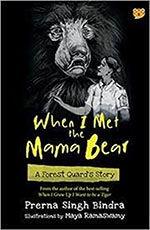
Prerana Singh Bindra
Have you ever wondered why we feel scared or become very excited when we hear about forests? Being born and brought up in metropolitan cities like Delhi, most of my understanding about forests comes from school books and they have usually portrayed forests as dangerous places.

Karthika Lakshmi M
Karthika Lakshmi’s So Shall You Reap was one of two prize winning entries in CBT’s Realistic Fiction category in the 20th Competition for Writers of Children’s Books organized in 2019. The story is about an expedition by students from across India to deposit seed samples in the Svalbard Global Seed Vault, with narrative conflict introduced through ‘vested interests’ who seek to replace the indigenous seed varieties with genetically modified ones.
Sultan Ahmed Ismail
Our Wiggly Friends, Earthworms is a small book of 32 pages. The book can be divided into two major parts; the first and the main part of the book provides various details about earthworms while the second part focuses on the role that earthworms play for soil, and introduces the readers to vermiculture (artificial rearing of earthworms).
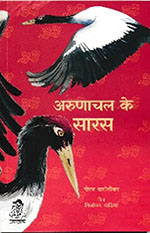
Neeraj Wagholikar
In our country, there are many huge multipurpose hydroelectricity (hydel) projects. These projects involve construction of dams, resulting in huge swathes of waterbodies called backwaters. These backwaters are not just used for electricity generation but are also a direct source for agricultural irrigation, industrial water supply, freshwater pisciculture and drinking purposes. Additionally, these can contribute indirectly to GDP as they can be turned into sites of tourist attraction.
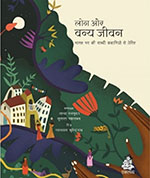
Tanya Majmudar and Sujatha Padmanabhan
India is a country blessed with rich biodiversity. It also is a nation developing at a great pace, locking horns with many other powerful global economies. But we need to keep in mind that development too, comes at a price. If development is not holistic and just anthropocentric, it doesn’t take long for the environment to collapse on itself. Unfortunately, most of the world is facing these after-effects of anthropocentric development.
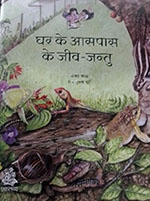
Sanjay Sondhi
We are not alone in this world. We are surrounded by different kinds of living beings and trees and plants. There is no place near or far from us where these living beings do not exist. A dark corner of the house, a wall, even the bark of trees, are home to many living things. And not only bark, even the leaves of trees are home to many different kinds of life-forms. There are eggs stuck on somewhere, and at other places you have caterpillars chomping on them!
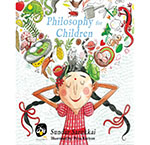
Sundar Sarukkai
In most countries, philosophy as a subject of study is open to students only at the undergraduate level. However, in the last four decades or so, many have argued that there is a dire need to introduce philosophy to students at a much earlier stage, preferably from middle school years onward. According to the proponents of this view, introducing philosophy at this age enables students to critically engage with what they learn and experience, both in school and outside.
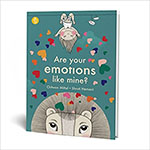
Chitwan Mittal and Shruti Hemani
This book is a canvas of emotions that all age groups paint in their minds every day. For children it is like a picture dictionary where they can identify if unable to express in words as to how they are feeling at a given point of time. The pages take the young readers on a roller coaster ride of happiness, to frowns and smiles, fear and dare, triumph and the importance of living each day looking at the brighter side of the world.
J Krishnamurthy
This happened a few days ago. A new-born calf strayed into our lane. Tender, delicate. Such beautiful bright eyes. Tottering in the lane she mooed so loud that quite a few people came out of their houses. The calf continued to call, looking this way and that. Gradually more and more people gathered. They surrounded her. Someone opened their garden gate. People took her inside with care.
Yemuna Sunny
2022
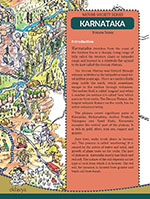
This booklet about Karnataka comes as a new addition to the ongoing Nature-Society Series authored by Yemuna Sunny, which finds ways to think in innovative and imaginative ways about maps. With its striking sketch map and detailed artwork by Trripurari Singh, the book engages with socio-spatial transformations and seeks to converge ‘cartography and art, nature and society, information and criticality, map and text, and knowledge and change’ in the words of the author.
Yemuna Sunny
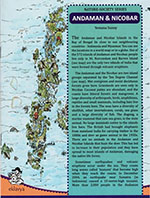
This slim book packs a lot of interesting information facts and figures about Andaman and Nicobar, Union Territory of India. Located in the Bay of Bengal with close proximity to Indonesia and Myanmar, these 572 islands (of which only 36 are inhabited) are very strategic for India’s maritime interest. The relatively untouched beauty of the islands are increasingly facing the twin threats of growing commercialization and large infrastructure projects
Ramu Velar
2021
Tara Books is doing something fantastic. In its Makers series, it is bringing us the voices of craftspeople and folk artists, traditionally anonymous and unheard. I raved about their previous book on the Gond painters of Patangarh and their work, and now here is a new one, A Potter’s Tale, on Ramu Velar, a master potter from Tamil Nadu.
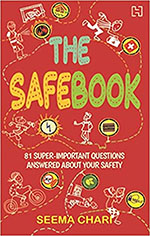
Seema Chari
Better safe than sorry.’ A quote told to all in their childhood and one that stays relevant to this date. As the title suggests, the premise of the book revolves around this quote. Comprising 240 pages and ten sections, the book covers various topics from fire to the internet. A type of instructional book, it gives a guide to staying safe in daily life.