
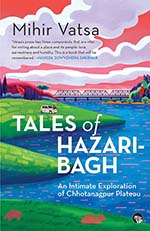
Mihir Vatsa
Tales of Hazaribagh is much more than the exploratory travelogue its title promises: along with a rich, complex narrative of Vatsa’s discoveries of the Chhotanagpur Plateau, it has autobiography, stories of suspense and the supernatural in the best tradition of ghost stories, social critique, historiography, and an intimate introduction to his roads, his waterfalls, his friends and family.
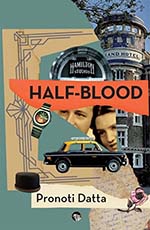
Pronoti Datta
2022
The ‘skein of duality’ that runs through Pronoti Datta’s debut novel gives it its special character, and as one toggles between the past and the present, between people and places, and between culture, politics and history, all of which make up the warp and weft of the story, the reader is drawn irresistibly into its multihued narrative.
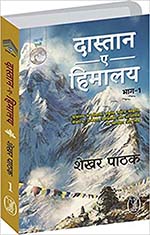
Shekhar Pathak
The Himalaya is an integral part of the natural habitat of India and some other neighbouring countries. It ensures rain in the field areas, and many rivers coming out from the Himalayas, including Ganga, are the basis of life and civilization in north India. The Himalayas have also been a source of cultural identity, not only for people who are living in this region but also for the people of other parts of the country.
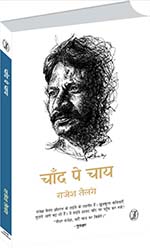
Rajesh Tailang
2022
Mature is the word that comes to my mind the moment I think of Rajesh Tailang, a sensitive writer and actor with a staggeringly successful career in Bollywood and Digital Media. After earning laurels for his acting in movies like Siddharth, Mukkabaaz, and the web series Delhi Crime and Mirzapur, his passion for writing took him to attempt plays, cinematography, and poems.
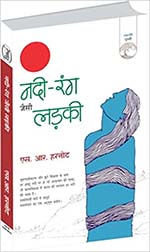
S.R. Harnot
The introductory line of the novel sets the tone for what we witness throughout its narrative. Sunma is no ordinary woman. Her tears symbolize a tenacious grip over the capitalist and globalized reality, and how it has caused a systemic destruction of rivers and natural resources.
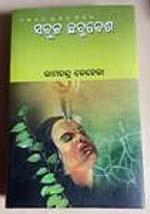
Ramachandra Behera
I put it down to serendipity that I read the short story collection under review shortly after reading Ramachandra Behera’s novel Mukti ra Ruparekha (1990) both in the original and in its just published English translation entitled Contours of Liberation. An amazing novel about the tragic outcome of the conflict between desire for personal pleasure and parental obligation and filial love, the work betokened certain signature qualities of the acclaimed Odia writer, which the short story collection has happily confirmed.
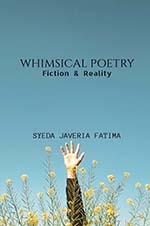
Syeda Javeria Fatima
Syeda Javeria Fatima’s collection of poems is not as whimsical as the title suggests; in fact, it is quite the opposite. Written in simple rhyme schemes, the poems voice the observations of a child’s world which has been marred by experiences too mature for her. Divided into sections that range from spiritual belief to romantic love, and her mother’s sacrificial omnipresence for her family members to friends that include her schoolmates and her grandparents.
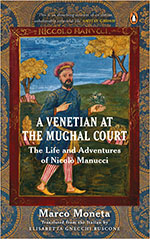
Marco Moneta
Aripper of a yarn that defies the imagination while bringing to light historical nuggets: this is the story of Nicolo Manucci, a semi-literate Italian teenager who ran away from home to become a renowned medical practitioner in Mughal India, a respected diplomat and a chronicler of the age. Marco Moneta recounts Manucci’s colourful tale with a flair that reads almost like fiction, while providing the perspective that makes the book a useful historical record.
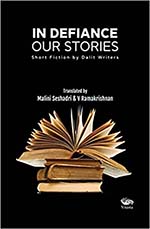
Malini Seshadri
Dalit Literature is not simply literature…Dalit Literature is associated with a movement to bring about change….at the very first glance, it will be strongly evident that there is no established critical theory or point of view behind them; instead there is new thinking and a new point of view’ (Dangle, 1994).Since Dalit writing is, by its very nature, revolutionary inasmuch as it seeks to overturn stereotypes and accepted norms of society and behaviour—therefore, also being transformational—it cannot be concluded that there is a radical ideology at work behind all Dalit writing.
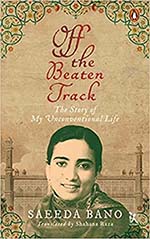
Saeeda Bano
To read Saeeda Bano’s supremely candid, flamboyant, and emotionally charged narrative of her extraordinary life is to launch oneself on a roller coaster ride of high emotional drama that has its own moments of tragedy and comedy. Intense, funny, heart-breaking and inspirational all at the same time, Saeeda Bano’s story is the story of a woman who dared to break taboos.
Isn’t it so difficult to write? Have you ever seen an introduction or a preface written for a feast, or for a treasure trove for that matter? How do you introduce such things… without revealing the secrets?… without robbing the thrill of reading the original pieces?… without repeating the oft-repeated?

We live in a country where too many of children’s realities include not having money to buy what they need, walking long distances to collect firewood, going out to fish for their evening meal, or not having a dry corner to sleep or sit in the house when it rains. These life experiences often include incidents of being displaced by those in power, or being discriminated against by the institutions that are meant to protect, like schools, police, judiciary, health services, local governments

The idea that the child is asexual has been accepted as natural and atemporal for the entire history of modern childhood. Social and moral norms deem that not only families and child-focused institutions, but rather society at large reacts strongly to children’s participation or interest in sex. The current discourses on sexual abuse overarchingly influence family and educational practices

There is a strange conflict in me as a queer trans writer and a queer trans reader of children’s books when I think of books I’d like to see written, published and read. As a reader, I want to see an explosion and not just a disruption. If I am allowed to dream of books, then there is no need for me to dream small. As with many of us marginalized due to the various structures of society like caste, class, language, gender, religion, region, ethnicity, ability, neuro-normativity, sexuality, to name a few, we have very little space to dream and to articulate our desires and dreams.
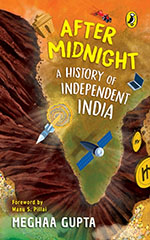
Meghaa Gupta
In 1984, Rajiv Gandhi became Prime Minister and launched a far-sighted tech policy which subsidized and allowed the liberal import of personal computers. A PC at world prices was prohibitively expensive and still out of reach for most middle-class urbanized Indians. The subsidy and easy terms for a loan allowed many to own a chunky PC and institutions also gradually started converting.
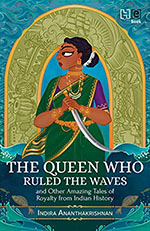
Indira Ananthakrishnan
The annals of Indian history are rich and expansive, filled with the most amazing tales of both valour and idiosyncrasies. School textbooks often gloss over these incidents because it is impossible to capture all of these tales in one comprehensive text and also because textbooks need to build a cohesive narrative, a sequence which may not grasp the complicated and interlinked histories which spread across time and space
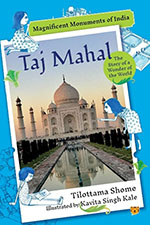
Tilottama Shome
Open the book and you ‘see’ Shah Jahan, imprisoned by his son Aurangzeb, gazing at the Taj Mahal from his prison. Reading on, and with the help of Kavita Singh Kale’s illustrations, you get pulled into the captive emperor’s thoughts and get a peep into his cherished memories. Those of the happy days spent with his beloved wife Mumtaz Mahal. And of the sad days too, when Mumtaz died after giving birth to their fourteenth child
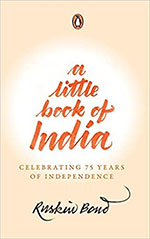
Ruskin Bond
A little book that says it all—from beautiful descriptions of Nature’s bounty, and the history of an ancient nation and its civilization—to memories, old and precious. It is only the talented Ruskin Bond who can do it.
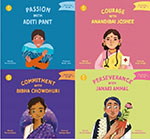
Pervin Saket
What picture comes to your mind when you think of a scientist? Well, when children are presented with this question and asked to draw a scientist at work, more often than not, they draw an elderly or middle-aged man wearing a lab coat and spectacles, mixing chemicals in fancy glassware. Alarmingly, the proportion of children who hold such a stereotypical mental image of a scientist seems quite large: 86.5% in a study done in 1998[1] and 78% in a more recent study[2]!
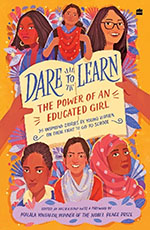
Malala Fund
Whenever I imagine about war, images of the aftermath of war come to my mind. Everything is scattered around. I can see only those people and things that have somehow escaped from the bombings. I can see the ominous silence spread out after the heart-rending blasts. I can see the school which has nothing left now. I can see the children who had come to school with dreams in their eyes, with the belief that everything will be alright if they study.