

Edited by Rob Jenkins and Louise Tillin
The question is: Can Indian democracy survive the series of assaults on it, from Indira Gandhi’s Emergency in the mid-70s to the present decade, when such assaults have been exacerbated? According to Diego Maiorano, Manor’s optimism about the regenerative qualities of Indian democracy in the post-Emergency period is somewhat misplaced in today’s context. Maiorano sees the cumulative damage inflicted on Indian democracy as leaving permanent scars on its institutions.

By Sitaram Yechury
Overall, Yechury’s analysis offers one of the most comprehensive examinations of the predicaments facing the Indian Republic from the benches of Indian political opposition. His Marxist training, academic background, and decades of experience as a senior CPI(M) politician have given his arguments analytical rigour and clarity. However, a significant lacuna remains regarding the question of ‘What is to be done?’.

Edited by Peter Ronald deSouza, Harsh Sethi
Ujjwal Kumar Singh and Anupama Roy focus on the Emergency laws of the era. They trace back the emergence of such laws right from the Law Commission report that led to the enactment of the Indian Penal Code, all the way through colonial and postcolonial laws, till MISA and how it was implemented during the Emergency.

By Rakesh Ankit
The book is embedded in and anchored on the copious exchange of letters among political actors from different parts of the country bringing to the fore the flux of events and imperfections with which they were tackled and reconfigured by political actors, particularly Nehru. It was Nehru, the man of great fortitude and partial failures, whose hands shaped the destiny of India.

History for Peace Tracts, Seagull Books
Hashmi’s logical submission is that even if buildings were designed by Turkish or Iranian architects, they were all built by local masons. The masons embellished these sacred sites according to their own acquired understanding of aesthetic piety.
These can be understood by how the masons, for example, thought that the hemisphere of the dome, even if it represented the idea of the heavens in the Central Asian imagination, looked aesthetically incomplete, which in turn they adorned with a lotus on top of the dome.
Srikrishna Ayyangar
What does the book find? First, the book shows that employing the existing populism model—which posits that populists are defined by ‘the people’ and subsequently identify ‘the other’—is akin to putting the cart before the horse. Ayyangar argues that in India, boundary setting occurs first: the ‘enemy’ is identified upfront, and the idea of the people is ‘capaciously’ constructed from those who do not constitute the enemy.

By Manoj Kumar Jha
He further notes that in the history of Indian politics, the ability of the political actors and stakeholders ‘to mediate between diverse interests exemplified the essence of coalition politics. Coalitions go beyond managing electoral arithmetic to focusing on governance in diverse polity based on negotiation.’ He emphasizes on the ‘spirit of coalition-building’ that is essential to accommodate the divergent

By KV Prasad
The first case study presents an overview of Parliamentary Debates on the deployment of the Indian Peace Keeping Force (IPKF) in Sri Lanka to show ‘how foreign policy was crafted in a federal structure’ (p. 52). Debates in Parliament over the deployment compelled the Government to reconsider its course, creating a precedent for India’s regional strategy rooted in respect for sovereignty and mutual sensitivities.

By Ruhi Tewari
The period from 2004 to 2014 witnessed the consolidation of several women-centric policies. Schemes such as the Mahatma Gandhi National Rural Employment Guarantee Act (MGNREGA) played a particularly significant role by guaranteeing equal wages for men and women and ensuring a substantial female workforce.

By Anurag Minus Verma
This reading experience is akin to a guided walk through the alleys of the virtual world behind our screens. Depending on your tendencies to doomscroll and your screen time, some spots will be familiar, some a surprise, and if the content and spaces under discussion don’t intrigue you much, the commentary and observations are alone worth staying for. Despite the complete absence of an advisory tone but much like a good description, the book slowly nudges you to rethink the time spent on the internet. The author does not judge at all and in fact admits to the strange follies of human nature. That is precisely what makes the introspection easier.
By Aarushi Bhandari
The attention economy is built on the fact that attention is infinite and unlimited. Only time is the limit. Algorithms are made in such a way that a specific amount of time and attention is given to the social media marketplace. Bhandari draws from the Marxist concepts of attention and alienation, along with the works of Christian Fuchs and Jenny Odell, to explain what she means by the international political economy of attention.

By Trina Vithayathil
Minister of Home Affairs, P Chidambaram, in his speech in the Lok Sabha delivered on 7 May 2010 tried explaining how ‘caste-wise enumeration may affect the accuracy of headcount and the integrity of the census’ (p. 103). The veteran political leaders of socialist background who consistently raised the issues of social justice in the Indian Parliament namely Lalu Prasad, Mulayam Singh and Sharad Yadav sensed a conspiracy on the part of Chidambaram and hence forced the adjournment of the Lok Sabha immediately after the latter’s the speech.

By Michael A. Collins
Moving from academic to the media which also represents the dominant caste groups’ interests as the nation’s interests, the book critiques the way elections and their outcomes are articulated and portrayed largely as a ‘zero sum game’ or ‘a winner takes it all’ ignoring the dynamic, aspirational and normative motives of the electorate. The theatricality and the triumphalist nature of the reporting of electoral outcomes or simply put, results which include political analysts, psephologists and other ‘political pundits’, set the narrative and deliberate in such a manner that completely ignores the interests of the Dalits in the country.

By Alexander Lee
Lee’s work begins by highlighting the stark contradiction of impunity prevailing over democracy: despite being a democracy, nearly half of its elected representatives face criminal charges, exemplifying the deep-rooted nature of impunity within its political system. Each chapter then dissects a dimension of this problem—from systemic underfunding to bureaucratic centralization, elite manipulation of postings,
Peggy Mohan, linguist and historian, argued that language is a powerful way into history and not an ‘adult’ subject. Teaching ten-year-olds about migration pushed her to rethink assumptions, from why farmers migrate to how ‘surplus males’ reshape linguistic landscapes. Children’s questions about Ashokan Prakrit or Devanagari sounds have sparked some of her deepest research. She emphasized, ‘Kids don’t want to be patronized. They can do the more difficult things that sometimes we can’t do.’

Manu was part of The Book Review family since he could read and write. He began by writing reviews as a child for the Children’s special issues. As he grew up, his intense passion for drawing led to his designing brochures and covers for The Book Review, and one of them was for the January 2016 issue when TBR turned 40. Uma had asked him a few months ago to design the cover for the January 2026 issue when TBR turns 50,
By Esha Niyogi
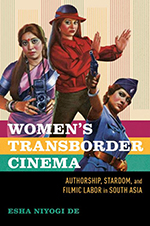
If we look at some of the case-studies examined in the book, the contours of the argument become clearer. Lady Smuggler (1987) is an action heroine film produced by Shamim Ara Productions (headed by star Shamim Ara), co-produced with the Bangladeshi star Babita.
By Sanghamitra Chakraborty
There is hardly any enigma in the life and professional career of Soumitra. A consummate actor, equally proficient in cinema and theatre, Soumitra knew the difference that these two art-forms demanded. He was also fortunate to have been mentored in his early years by Natyacharya Sisir Kumar Bhaduri who gave a new life to Bengali theatre, and later by Satyajit Ray.
Satyajit-Soumitra collaboration has been much discussed in discourses on cinema.
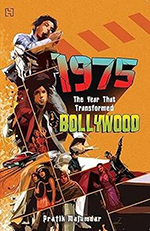
By Pratik Majumdar
1975 marked the rise and decline of leading stars and ‘super’ stars. The ‘anti-hero’, ‘rebel’ image caught the imagination of the audiences, in particular the youth. The characterization and portrayal of heroines underwent a significant change from the stereotypical signifying the changing, modernizing influences affecting the till-then conservative society. They could be shown as having a distinct personality;

Edited by Ashok Vajpeyi
An interesting aside: when my father, TCA Rangachari went to Paris as the Ambassador of India in the mid 2000s, he made it a point to call on Raza. The practice till then was to invite artists to ‘meet’ the Ambassador. My father thought otherwise—after all, such artists were themselves ambassadors of India, though of a different kind.