
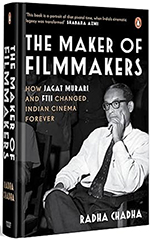
This is the first ever biography of Jagat Murari, the longest serving Principal and later Director of the FTII in Pune. The writer, Richa Chadha, is his daughter and had access to his diary and private papers. In addition, she had support from the Biographers International Organization which ‘Initiated her into the art of biography writing’.
Though the subtitle proclaims: ‘How Jagat Murari and FTII Changed Indian Cinema Forever’, this a hypothesis rather than a widely accepted truth.
The biography begins with the rather straitened and undistinguished family in Patna. Jagat Murari’s father was a Serishtadar at ‘the Patna court’ but the early death of his wife heightened his struggle. Jagat Murari had a distinguished record as a student and excelled at the prestigious Patna Science College, eventually joining it after his MSc as a researcher. He learnt Sanskrit at school and French at college. There is little mention of his political views or his interest in cinema, even though the distinguished film music director Chitragupta was presumably his senior at college. He learnt the virtues of discipline and timeliness, and developed his first interest in spiritual texts, which coexisted with his commitment to science.
The next section which deals with how he fortuitously gained a government scholarship to go to the University of Southern California to study film making is perhaps the best part of this book.
Few would know of his apprenticeship in making cowboy B films at Republic Films. Even more interesting was his stint with Orson Welles while Macbeth was being filmed. The years in California marked his only practical experience of feature film making. They were probably the most important in determining his outlook as a teacher.
On his return to India Jagat Murari spent several years at the Films Division in Bombay. While very few readers would have seen or remembered his films, this section of the book introduces a major theme of the book, his problems with his bureaucratic superiors. Indeed, a chapter heading says it all: ‘Killjoy Bureaucracy and the Road to Poona’. Indeed, as the author puts it, ‘the inherent struggle between creative freedom and restrictive freedom would also be one of the central challenges of Jagat’s life.’
Parts two and three of the biography deal with his long first stint at Poona. This is lovingly written, full of pictures and with many accolades from the Institute alumni. However, this does not end well. The strike of 1971 exposed the fact that Jagat had lost touch with what his students were thinking, and was also unaware of what his staff members, nearly all appointed by him, were plotting. While the Institute had been set up to aid the film industry, the film industry declined to help him in his hour of crisis.
While the book puts much of the blame on the (killjoy) bureaucracy, a close reading suggests Jagat’s own personality had angularities which isolated him. His keen and restless spiritual search might have been one of them. At one stage he equates a loss of body weight to a kind of spiritual progress.
The Ministry’s actions against him were harsh. Essentially he was shunted from post to post mostly unrelated to films. According to the author, he evertheless excelled as always. In due course he worked his way back to Poona to find it overtaken by an integrated course, which he could only partially undo.
And in his retirement years which were long, he reverted to documentary film making, his first love. Radha Chadha has not flinched from hinting at defects in his character but as a dutiful daughter she is muted. However, her past experience in marketing does intrude in the lavish praise she offers. It is difficult to understand the dynamics of his conflict with his bosses since the relevant government files don’t appear to have been studied. But a more serious defect is the almost complete absence of commercial cinema, since the Institute was set up in the first place to serve the movie industry.
Film buffs will love the description of Roshan Taneja at work. The Institute now has no Professor full time for acting but Taneja’s old students like Benjamin Gilani carry forward the tradition of teaching methods of acting. This is a specialist work most suited for students of cinema history.
Brijeshwar Singh, former DG AIR and former CEO Prasar Bharati. He has served on the Governing Board of FTII.