
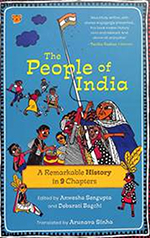
What could a history book look like if it weren’t interested in merely transmitting information or lining up facts to be memorized? How could history writing develop concepts and the ability to analyse the socio-political realities of the present which are intimately connected to the past? Here is a riveting and lucidly written history book aimed at speaking directly to its young readers, which centres the voices of the people of this large subcontinent with their rich, variegated histories. The past and the contemporary converse with each other effortlessly in the book, the narrative showing the fundamental links that shape the way things have come to be the way they are. The focus is on the ‘why’ of history, understanding an event from multiple perspectives and accounts, delving into the consequences of these events as they play out in our lives in the here and now, and urging readers to think for themselves.
The themes range from the big and debated issues like the Partition of India, contestations around who counts as a ‘citizen’ of India, and the history of the language-politics of India to the themes emerging from the ordinary, born from the everyday, such as aspects of war which have shaped the country, and are constantly being waged in the world or in the violent games on our devices, or the flow of rivers and its entanglements with colonialism, development, livelihoods, people’s movements. There are chapters around the socio-cultural histories of our clothes and how it shapes our identities, food habits and routines, the games and sports we play, and on what terms one is allowed to participate in what—all of which raise pertinent questions inviting discussion on the intersecting structures of caste, class, gender, region and religion. An accessibly laid out bibliography at the end conveys the centrality of verifiable sources in constructing historical accounts.
Initially published in Bengali as a series titled Itihase Hatekhori (loosely translated as First History Lessons), this effort was born out of the editors’ vision of creating non-standard history books for children. It is a kind of history-writing which falls neither within the bucket of drab, monotonous, talking-down-to-its-readers textbook format, nor a history-rewriting project that is set upon distorting histories to further narrow political interests or polarize people. The culmination of their efforts has been in the form of this much-needed work—factually informed, engaging, accessible and critical histories that create a sense of wonder, curiosity and empathy towards the many diverse experiences and practices of the people of India. From the original books in Bangla, they are now also available in English (in the form of this book) and Assamese.
Since this book emerged from a sustained interest in reaching out to children in West Bengal in Bangla initially, a focus in the oral histories and accounts remains on West Bengal, Assam, Bangladesh and nearby areas, within the larger subcontinent. Perhaps we need many more such history books that present locally situated, lived historical accounts with as much caution and curiosity to hear and see historical events through the eyes of the many under-represented communities across the length and breadth of the country.
Over the past few years, history-writing has been in the news for revisionism, deletions, and furthering an idea of mono-ethnic nationalism tied to a mythic ancestral territory of the Hindus. This book is a creative and critical example of employing an intersectional lens to honour the rich tradition of plurality, inclusivity and egalitarianism that form the bedrock of our country’s various pasts. It foregrounds the multiple experiences and narratives that shape events from our past and provide a footing for understanding contemporary issues of debate. In doing so, it challenges the too-neat binaries of us/them, insider/outsider and raises questions of how these categories are historically constructed and constantly changing. In focusing on the stories of people, their experiences and lives, rather than solely on the macro structures of nation-states or told through the eyes of the country’s powerful leaders, the book is suffused with a sense of empathy, fraternity and justice towards our fellow-people.
The People of India would be an excellent addition to the book-collections of middle-school readers who are independent readers in English or have a parent/teacher/peer to help them with it. As a teacher, I found it to be an extremely valuable and rich resource to share with others and will definitely be bringing to use the wealth of stories, anecdotes, songs, poems, illustrations, and snippets of people’s writings referred to in the book, in my classes. The book is priced at Rs 599, which would perhaps make it less accessible than a book like this should be, to readers across diverse contexts. The wonderful chapter-opener illustrations by Kavita Singh Kale and the consistency of tone and rigour across the book, despite each chapter being written by different contributors, shows the careful thought put into this book by the authors, editors, translator and illustrator.
Ragini Lalit has been working as a teacher and loves exploring using music, children’s literature, and writing with her students. Presently she is pursuing a Ph.D. from Ambedkar University, Delhi.