
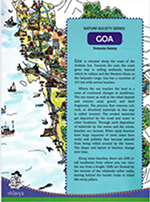
The Nature Society Series is a series of booklets, one on each State of India, for middle and high school children. Eklavya has had a long experience in curriculum, materials and pedagogy development at the elementary level. In the late 1980s, the curriculum team was faced with the challenge of creating an understandable and vibrant picture of a State through maps when it was grappling with the issue of a critical pedagogy for the social sciences for middle school children. The understanding of space on two dimensional maps, through symbol and scale, which was assumed as given for the learners, was found to be totally missing among them. Pictorial maps were developed as part of the textbook exercise. In the 1990s began the struggle to create pictorial maps for a larger audience than the eight schools where Eklavya’s experiment was being done. It required the skills of a cartographer, an artist and a geographer to undertake this task. Nine booklets of this series have come out, Goa and Bihar being the latest.
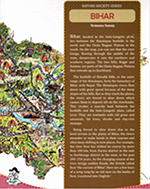

The introductory part has a box with basic information about the State (except for the area, number of districts and density of population). The text does not discuss any of the aspects related to food, religion, languages. While the text does attempt to introduce the major regions, it is very sketchy, and without reference to the map (which is missing from the text) it is difficult to make sense particularly for young readers. A few distinct aspects of each State could be selected and communicated with a more vivid narrative.
The section on Nature and Society attempts to discuss the way people use and manage the natural resources of the area through agriculture. The section on People also attempts to do the same with other resources and the interaction of tribals with others. Both Bihar and Goa have very low tribal populations, but both have large minorities—Muslims in Bihar and Christians in Goa. There are also very crucial differences between communities in many aspects of life. For example, the agricultural management of gaonkari or communidade system is unique to Goa, very different from the zamindari and bataidar system in the rest of India. In addition there are crucial differences between the gaonkari system which exists among Hindus and the communidade system among the Christians, which has been glossed over. Nor is much mentioned about the cultural specificities and interactions between the religious communities, except for the mention of the Bhagalpur riots in the Bihar booklet.
The section on Environment draws attention to the environmental crises each State is facing, due to the impact of policies of development on both people and environmental degradation in both the States—sand mining in Bihar or iron ore mining in Goa, or silting and eutrophication in Bihar and waste of urbanization in Goa. This is an important section.
Each booklet has a pullout pictorial map, with natural features and a legend. The maps were painstakingly made on much larger paper and carefully preserved. In printing them on too small a surface, the maps have become very cluttered. The legend takes up more space than the map—the symbols for wildlife and vegetation are far too many. As the symbols are not really symbols but pictorial representations, they could have been understood directly from a larger map.
There are no exercises to explore the spatial patterns on the maps. In the Goa booklet, there are a couple of questions like ‘Find national parks and wild life sanctuaries on the map’. But none in the Bihar booklet.
These booklets are a useful resource for middle school classrooms in the hands of a committed and intelligent teacher. However, the booklets need to be improved further with larger maps, more pages and better photographs.
Anjali Noronha has a background in Economics and retired in 2020 from Eklavya, Madhya Pradesh, where she worked for nearly four decades on curriculum development, teacher education particularly on Language through children’s literature. She has worked on Social Science and National Educational policies and plans with a special focus on inclusion.