
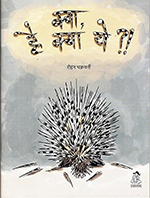
Rohan Chakravarty’s Kya, Hai Kya Yeh?! is a lovely addition to the growing pool of ecologically minded picture books in India. Chakravarty is best known for his comic Green Humour and his quirky cartooning skills are at their most impressive as he draws wonderfully expressive animals, from tigers in the jungle, to stray dogs on the streets of Nagpur, all the way to the protagonist of our story, the Indian Crested Porcupine.
The story follows the (temporarily) displaced porcupine, who is initially not quite sure how he has found himself in the middle of a wet Nagpur Street one quiet Bakrid morning. Through the gently paced narrative of the porcupine finding his way back to a home in the wild, Chakravarty teaches us a lot about this fascinating creature, while also busting several myths about the porcupine (with characteristically hilarious illustrations).
The narrator is the porcupine itself, which helps readers step outside their own human-centric perspective and see not only the wild world of the porcupine, but also our own frequently illogical and chaotic world with fresh eyes. The small details peppered throughout both the written narrative as well as the illustrated narratives add a lot for readers young and old; some may recognize and chuckle at the hoardings and advertising boards in the background, while others would enjoy the mobile-phone-toting, sunglasses-wearing youth videoing the scene. By setting the story on the day of Eid and illustrating many Muslim characters and settings in the backdrop, the author gently reminds us of the plurality in our cities and country, at a time when many would rather forget. While not his focus, and perhaps not even his intention, it is such a valuable and needed aspect of this book.
I especially enjoyed some of the smaller touches in the illustrations, such as expressions of the male and female forest officers, the ‘professorial’ pose the porcupine adopts to bust myths, and many more that I will leave for the readers to discover for themselves.
There’s a lot of information provided through this book, all of it in a fun and engaging manner: we learn about the porcupine’s habitat, preferred foods, predators, defence mechanisms, and more. We also get to see a broadly positive set of interactions between humans and this wild animal, which is a pleasant contrast to so many stories where we only see violent and destructive behaviour from humans towards the wild. This book too acknowledges the various damages humans are doing; we learn from the narrator that porcupines used to be much more commonly seen and known before deforestation and urbanization reduced human interaction with them. However, all the humans in the story keep a careful distance from the lost porcupine, and call in the forest department to help out, who do so gently and respectfully. Increasingly, this feels like an important message for young people: while there are bad things happening due to our negligence, it is also in our power to be respectful of and caring towards the wild.
One hopes that we will see many more such stories from this author, perhaps a series focusing on different animals, cities, and landscapes.