
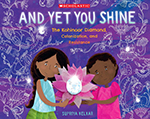
An important contribution to the limited array of colonial children’s literature, the book And Yet You Shine highlights the British loot through the example of Kohinoor diamond. In this review, I share the immense beauty of the book as I experienced it, but also hesitantly put forth ideas for enriching this narrative.
Beautifully printed, the book sparkles with its colours and glow. Using a collage from paper cut-outs, beautiful fabrics, real items like beads and necklaces, filled in with a small sketch where needed to close the picture, the author and mixed-media illustrator Supriya Kelkar has marvellously brought alive the colours of India. Many pages artistically don the colours of the content, reds of the fire, greys and blacks of the evil man, blues and greens of the water and mountains, or the bright magentas and purples as the book converses about rulers.
Tracing the journey of Kohinoor, the exclusive diamond that changed hands over the centuries, the author brings out how British colonization took what was valuable from India and its different people. Religious markers in the images show this diversity. Further the author highlights that in spite of all its journeys and experiences, where it found itself eventually cut down to suit the outsider’s standards of beauty, the diamond continues to shine. In a way, it is a call upon us to find our internal strengths and to recognize what we hold within us.
The after note is very helpful for teachers and adults to take forward the conversation and fill in the questions, and urges to know more about the history of the Kohinoor diamond and understand a bit about colonization. The section on decolonizing our minds and keeping some questions open ensure that the book is not just a history book but is a call for reflection and action.
Through her several other books, as My Name and Brown is Beautiful, Supriya has managed to find the articulation and imagery that supports the Indian diaspora child in understanding and accepting oneself. While And Yet You Shine also tends to speak to this audience primarily, it has a universal language and will be enjoyed immensely by children in India too.
Yet I believe a couple of sentences would have ensured that it also spoke at a deeper level to the children of working-class families. Opening up the identity of the ‘brown hands’ who in all likelihood, were the ‘poorest of the poor’ who dug out the diamond in vulnerable conditions, could have opened another layer of colonization and resistance in the story. Connecting this history to the plunder and loot of the Adivasi lands by neocolonial forces in today’s India (in the afterword) would have enabled the reader to ponder on the continued havoc on people’s lives and see the parallels of stories as they play out on different sections of society.
In the end, I would say that the book is quite a delight and offers something new and critical for readers of varied age groups and should be in all libraries and schools. Further, adult facilitators can open up the various conversations this book directly and indirectly offers.
Shivani has been engaging with varied realities of Adivasi and Vimukta people in her work in education and human rights. She is part of the publications team at Muskaan, which strives to bring in diversity and unheard voices in children’s literature.