
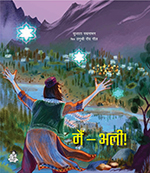
It’s me, Ali! is a beautiful, and heartbreaking, portrait of a family and community separated by Partition and the subsequent war over the State of Jammu and Kashmir. While we have a body of subcontinental literature set around the Partition of India and Pakistan, and even some wonderful children’s literature (such as Tulika Books’ wonderful Mukund and Riaz by Nina Sabnani), It’s me, Ali! depicts a rarely seen perspective, that of the Balti community, a Tibetan ethnic group native to the Gilgit-Baltistan and Ladakh regions of what are now considered Pakistan and India.
The story by Sujata Padmanabhan and Tanushree Roy Paul follows young Ali, separated from his parents by Partition at a young age. We meet him on the banks of a river, staring at a village across the water, seemingly very near, but it could just as well be hundreds of kilometers away. The narrative skips back and forth between Ali’s past and the present; we learn about how Partition took his family and village by surprise, Ali left behind in what became India, while the pastures his parents had taken the village livestock up to were deemed to be in Pakistan. While the non-linear storytelling could be slightly confusing for younger readers, it helps us see the complexities of Ali’s emotional landscape through his own eyes.
Ali is brought up by his adoptive Apo, grandfather. There are a few words of the Balti language sprinkled throughout the text, a nice touch that introduces us to another culture, while remaining easily understandable in the context of the story.
Tanushree Roy Paul’s warm and detailed illustrations bring alive the love and joy, as well as the lingering grief that Ali and his families experience. They evoke folktale or even fairy-tale imagery which works well for the most part but can sometimes also feel a step removed from the tone of the text. The illustrations certainly add to our appreciation of a culture we rarely see in our media, with attention paid to dress, homes, and landscape.
The Hindi translation of the book by Vinatha Vishwanathan, Main—Ali!, captures all of the nuance, beauty, and sadness of the original English story. The translation is careful to not simply rewrite the story word-for-word in a different language, but is responsive to the different ways in which sentences and passages are structured in Hindi as compared to English. The language level is perhaps slightly more advanced in the Hindi text, as compared to the English.
Throughout the story, at different points we are encouraged to think in different ways about the fundamental futility and unnaturalness of borders. Even as he learns to move past the suddenness of the separation, Ali muses on how animals, birds, rivers, and stars are not bothered by borders, and throughout the book we are painfully aware that though Ali lives just a river across from his parents and the sister he never got to know, it is nearly impossible to visit them.
A remarkable aspect of this story is that it doesn’t shy away from the sadness, grief, and uncertainty that is at its centre, as many children’s books are wont to do. The story in its structure mimics the hopelessness and isolation, along with the hope and community that so many people have experienced as a consequence of Partition. Without spoiling the experience for the reader, I will say that we are left at the end of the book perhaps sadder than at the start but enriched by it all the more.
Dhruva Desai has been a schoolteacher at different schools across the country for primary and high school age groups, teaching languages, social science, theatre, physical education, and engaging in library work. He currently works with undergraduate students and spends most of his time trying to get them to read more picture books.