
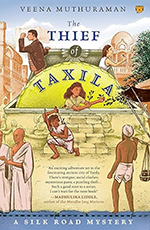
Veena Muthuraman’s book Thief of Taxila is a thrilling story based on the ancient history of Taxila. But it is not just an exciting journey; the entire novel, seen from the perspective of a child or a teenager, has its own time and context. EL Doctorow’s dictum rings very true here: ‘The historian will tell you what happened, the novelist will tell you what it felt like.’ In this novel, class discrimination and the lack of access to education for Dalits and common people are depicted in detail. For example, Ekla tells Xuan, ‘Here’s lesson number one: you don’t get into any of the schools if you are someone like me, regardless of how good you are. If they even see me in the vicinity, they will attempt to kill me by pouring molten lead into my ears.’
There are comments throughout the novel about the dullness of school education. School education confined to a boring routine may have always been as uninspiring as it is today. For instance, ‘I had no intention of confining my education to religious quackery. I was in a city of learning that was by all accounts unlike any other; I intended to learn real-life skills—such as medicine.’ Or, ‘If you are looking for something interesting, you won’t find it at the schools.’
The Thief of Taxila takes readers on a fascinating adventure through the lively, ancient city of Taxila. Mixing history, mystery, and friendship, this book is perfect for young readers who love a good puzzle and want to peek into India’s past.
The story happens a long time ago, during the rule of King Kanishka. Taxila is a busy place, full of traders and travellers.
Into this city comes Xuan, a curious boy from China, and his teacher Fa-Li. Fa-Li hopes to learn more about the Buddha at the famous Jolian Monastery. Their plans take a sudden twist when a precious Buddhist treasure is stolen from the city’s treasury. Ekla’s father, a chariot-maker, is blamed, and Xuan is determined to help clear his friend’s name. Along with his new friends—Ekla, a skilled archer; Anahita, a brave general’s daughter; and Nelli, the clever daughter of a healer—Xuan dives into the mystery to find the real thief.
One reason this book is special is how it brings ancient Taxila to life. The author weaves in real facts about the city—its busy markets, different kinds of people, and exciting trade routes—all the while telling an action-packed story. The friends have to face challenges and even unfairness. For example, Xuan and Nelli are treated differently because they are outsiders, but that doesn’t stop them from being brave and smart.
The book shows that both boys and girls can be heroes and thinkers. Anahita and Nelli prove they are just as important in solving the mystery. The story also talks about different languages and people from places as far away as Rome and China, making the city feel truly global.
The book keeps you guessing, just like the twisty paths inside a fortress, and you’ll find yourself cheering for Xuan and his friends as they work together and take risks. The author doesn’t fill the story with too many little details, so it’s never boring—instead, the focus is on teamwork, courage, and friendship.
For anyone curious about history or just looking for an exciting story, The Thief of Taxila is a great pick. You’ll uncover the past, meet children from different backgrounds, and learn a little about ancient scripts and famous kings along the way. It’s a fun, thrilling, and thoughtful read that shows how friends can make a difference, no matter where or when they live!
Upasana Chaubey, literature and academic professional based in Ghaziabad, India, specializing in language pedagogy, art in education, and Indian literature, is a freelance writer. She is the author of two short story collections, a novel Desk Par Likhe Naam (NBT India), and children’s books Udne Wala Phool (unbound script) and Baingan Nahi Aaye (Eklavya, Bhopal).