
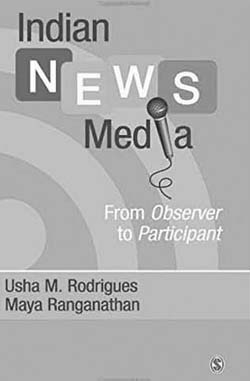
Usha M. Rodrigues
The book provides interesting insights into key developments that have informed and configured the Indian news media in recent times.
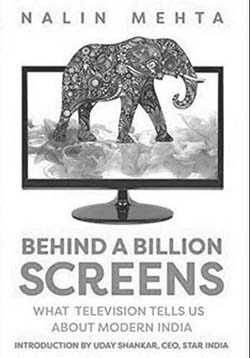
Nalin Mehta
Since the advent of television in India the number of licensed television sets in India grew from 55 in 1964 to a lakh in 1975 and to just over two million connections in 1982; in 1991 a total of thirty-four million families owned television sets, growing to 65% of the Indian population owning television sets by 2014—the societal and political landscape has transformed quite dramatically.
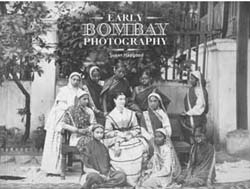
Susan Hapgood
In the age of digital photography where more and more images are being taken to be stored in the hard drives of computers a certain fascination with photography of the distant past has resurfaced.
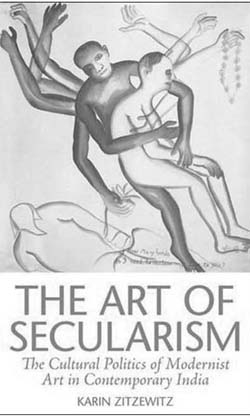
Karin Zitzewitz
Chapter 4, on page 99 of Zitzewitz’s book The Art of Secularism begins with a quote by painter Gulammohammed Sheikh where he says, ‘in one sense it is the communal situation that opened doors to understand the role of religion in life.
Mahesh Rangarajan
2015
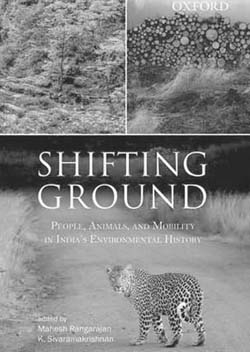
History always offers rich pickings and an edited volume of rigorous historical research seldom disappoints. Shifting Ground: People, Animals and Mobility in India’s Environmental History is an excellent example and one thing can certainly be said about it—that even though a little unevenly, it shifts ground very effectively.
Divya S. Iyer
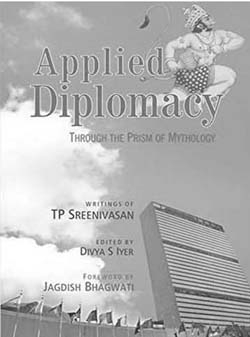
This is a collection of forty-nine articles, transcripts of speeches and lectures by a former diplomat divided into seven sections of seven pieces each; seven to represent the sapta-chiranjeevi or seven immortal beings in the Hindu pantheon; each section carries a helpful subtitle, Hanuman as the first Indian diplomat to be sent abroad, Vibheeshana who stands for righteousness and so on.
Nirode Mohanty
The Indo-US relationship assumes importance in a multipolar world with shifting alliances—new partnerships are being formed, some are being renewed and others are breaking up. The US and India have never been as aligned as they are today.
Rashid Amjad
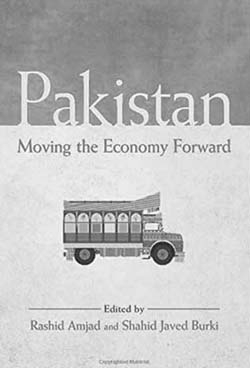
Given the plethora of debates that have come up in the last few years on the stability of Pakistan, Pakistan: Making The Economy Move Forward, makes an attempt to address this key stability-instability paradox, by critically examining the strengths and faultlines of Pakistan’s economy.
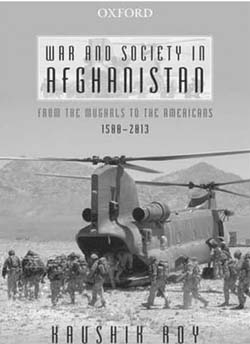
Kaushik Roy
Kaushik Roy takes a long view of the processes that have shaped the geo¬politics of Afghanistan, unlike most of its recently published military histories. In his words, this publication consists of a political and military narrative of Afghanistan’s conventional and unconven¬tional warfare spanning five centuries.

Sumbul Halim Khan
This book is based on the karkhanajat papers comprising roznama or roznamcha (daily ledgers), arhsatta (provide details on income and expenditure), siyah (lists details on the raw material in a karkhana), taujih jama kharch (gives details on raw material, the process of manufacturing and finished items, remarks on the wages and the operational techniques of the craftsmen) and rare documents available in the Town Hall Museum at Jaipur and the Rajasthan State Archives, Bikaner.
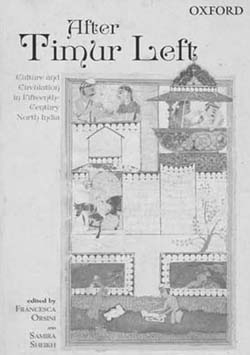
Francesca Orsini
Amidst the resurgence of regional and local forces, the poets, performers, merchants and scribes found new and diverse sources of patronage, and as they travelled around in search of patrons and opportunities, they came in touch with, and interacted with new ideas and worldviews, creating in the process a hybrid and multilingual space.
K.N. Panikkar
This book’s review has been unduly delayed but it is fortuitous in a way as the main theme that the author dwells upon has become more relevant over the past year than in its year of publication.
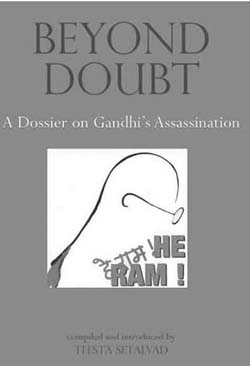
Teesta Setalvad
2015
In a lecture titled ‘What is a Nation?’, delivered in the late 19th century, the ideologue of the French Empire Ernest Renan laid out a survey of the bonds that weld a people together.
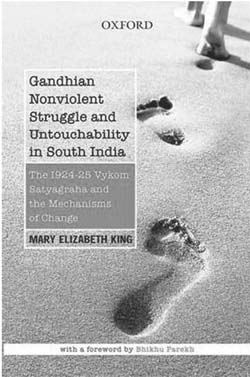
Mary Elizabeth King
Travancore’s princely family governed this Siva temple and the four roads around it, which until the satyagraha’s substantial if partial success were open to caste Hindus, non-Hindus and animals, but not to Ezhavas and their ilk.
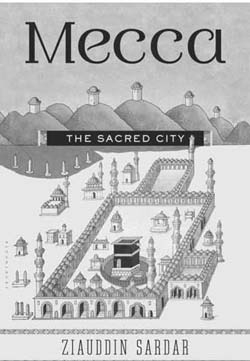
Ziauddin Sardar
In 2002, when I took up a posting in London with the Indian High Commission, Ziauddin Sardar, already established as one of Britain’s leading public intellectuals, was one of the most interesting voices in the argument that overshadowed all others, on whether the West, led by the US with the UK in tow, should invade Iraq to overthrow Saddam Hussein.

Peter Pannke
Peter Pannke, the author, a German from Cologne, stumbled across an L.P. re cording of dhrupad maestros Nasiruddin and Aminuddin Dagar made by the legendary Alain Danielou in the 1960s for UNESCO. Something about the music struck a chord, he was reminded of free-flowing blues and jazz vocalists.

Ruskin Bond
n the Preface to his book, A Gathering of Friends, Ruskin Bond mentions his critics, the ones who have sometimes felt that his stories are less stories, more character sketches, for want of a plot. In his inimitable style, with gentle humour, he points out, that life doesn’t come with a plot. One can imagine him, glint in his eyes from the witticism, continuing tell the everyday tales of life, from the observable and plausible, to the fantastical. Bond has been an intrepid chronicler of life in the slow lane.
Amar Mudi
2017
Land and its acquisition being a hot topic in the media today, this book comes as another reminder of the rights of those who originally owned the lands. As the author says, ‘For thousands of years the black people thrived in the jungles, walking barefoot, wearing a loincloth and eating fruits and leaves.
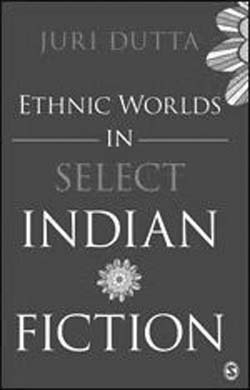
Juri Dutta
Ethnography can be defined as the systematic study of people and cultures—an exploration of cultural phenomena from the point of view of the subject of the study. By this definition, a large amount of literature that we read is indeed ethnographic and diverse, even though it may only be a documentation instead of a faithful and authentic representation.
P. Sivakami
The book appears at first glance to be undecided about its genre or raison d’être: is it a novel or an essay? Does it wish to tell a story or discuss/debate women’s issues? Being an award-winning book notwithstanding, this disconnect stays with the reader throughout the book.