
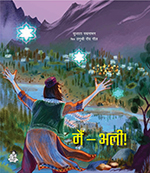
By Sujata Padmanabhan. Illustrations by Tanushree Roy Paul. Translated from the English into the Hindi by Vinatha Vishwanathan
Ali is brought up by his adoptive Apo, grandfather. There are a few words of the Balti language sprinkled throughout the text, a nice touch that introduces us to another culture, while remaining easily understandable in the context of the story.
Tanushree Roy Paul’s warm and detailed illustrations bring alive the love and joy, as well as the lingering grief that Ali and his families experience.

By Aruna Shekar. Illustrations by Charbak Dipta. Translated into Hindi by Kavita Tiwari
There is very little text in the book, and the illustrations are beautiful. They are full of emotions, showing expressions vividly. With just a few words,
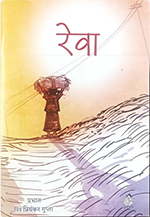
By Prabhat. Illustrated by Priyankar Gupta
2025
An attempt has been made to simply present the intricacies of a relationship between two ordinary people. But in doing so, it also brings out a picture of complex social perceptions, beliefs and systems in a seemingly regular society. In this story, two alternate situations are presented from time to time,
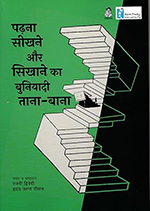
by Rajni Dwivedi, Hriday Kant Dewan Eklavya and Azim Premji
What is good about the books is that technical terminology and names of specific concepts have been written in the Devanagari script and given in English in brackets, for example, ‘zone of proximal development’ and ‘bottom-up model’, etc. On the other hand, in the case of a few articles, while it has been mentioned that the articles have been translated from English, and the source has also been mentioned,
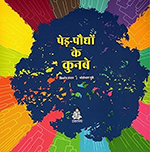
By Kishore Panwar and Bholeshwar Dube. Illustration/Design by Rohit Kokil
One of the most enjoyable aspects of the book is how the authors complement scientific facts with common proverbs or couplets. For example, while discussing Apiaceae, they cite, ‘ऊँट के मुंह में ज़ीरा’, connecting the plants to familiar sayings, which makes them easier to remember.
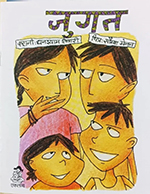
By Ghanshaym Tiwari. Illustrations by Saumya Menon
2025
This twist in the story brings an interesting point to think about. On the surface, their trick works; they get the mangoes. But the method they use isn’t morally right.
By Mark Hussey
What gives Mrs Dalloway its distinction, however, is not the plot but the speculative and lyrical sensibility with which the heroine Clarissa is endowed. Though a ‘tinselly’ party-giver, she is yet shown to sympathize and even identify with a shell-shocked war veteran, Septimus Warren Smith, whom she has never met.
By Saikat Majumdar
Through its exploration of colonial and postcolonial education policies, The Amateur reminds us, colonial education does not only alienate the subject from her culture but also uses education as a tool to impart and spread imperialism. The notorious Bantu Education Act (1953), which restricted resources for coloured students, was a stark institutionalization of ‘education apartheid’
By Upamanyu Chatterjee
The first story from which the book derives its title is about Abani, an adolescent who is accidentally left behind on a ship, completely unaware of his dangerous position as an ‘extra’. The ship’s captain, and the other officials don’t wish to jeopardize their immigration procedure in a foreign port with this unlisted sailor. A ruthless decision is taken to float Abani in a boat

By Adil Jussawalla
2025
Jerry Pinto’s crisp and meaty introduction opens The Diamond-Encrusted Rat Trap: Writings from Bombay. ‘The 1970s were Bombay’s 1960s,’ he recalls Imtiaz Dharker’s words. The book gathers Jussawalla’s prose from 20 years, beginning 1980. There are articles, reviews
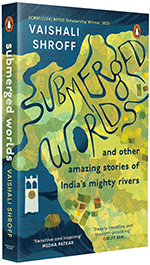
By Vaishali Shroff
While countries like New Zealand, Colombia and Bangladesh have secured legal rights for their rivers, India appears to march blithely on, ignoring environmental laws and the rights of not only the people who are sustained by the waters but the rights of the rivers themselves.

By Malashri Lal
The simple words effortlessly touch upon the unique experience of Indian women who face the duality of a culture that celebrates the divine feminine and simultaneously flounders to protect women from violence and indignity. The Stuti adds a note of optimism and wisdom that suffuses Lal’s writings and commitment to social causes. The anthology ends on a personal note celebrating her bond with her own mother.
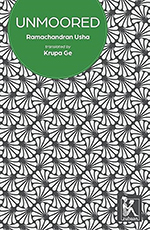
By Ramachandran Usha Translated from the original Tamil by Krupa Ge
The experiences of the main characters also provide two illuminating insights. The first is that it is not only men who travel away from the safety and security of home in search of a better life for their families. The second, especially in the context of this particular book, is that a well written story about complex human relationships and the capacity of individual men and women for generosity and meanness, loyalty and betrayal
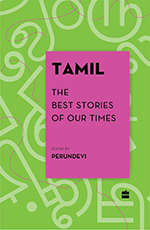
Edited by Perundevi. Translated from the original Tamil by Janani Kannan
The collection brings in formidable stories on the diaspora, showing how exile fractures belonging but also sharpens resistance. The story of Appadurai Muttulingam’s ‘Catch a Chunky Goat’ stands as a testament to it. While the protagonist’s courage and desperation to write the letter is to be appreciated, the series of events leave one confused about his guilt.
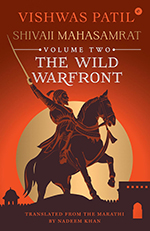
By Vishwas Patil. Translated from the original Marathi by Nadeem Khan Eka,
Vishwas Patil is a writer who thrives on dramatizing historical figures for popular consumption: Sambhaji, Netaji Subhas Chandra Bose, Anna Bhau Sathe, and now Shivaji. His strength lies in producing vivid, accessible portraits that can capture/consolidate public imagination.
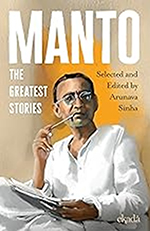
Selected and edited by Arunava Sinha Ekada
Manto’s protagonists are the most marginalized members of society, portraying life in its very base and ugly form. The historian Ayesha Jalal in her book, The Pity of Partition: Manto’s Life, Times

She was an interested observer of the process of editing the translation series: Past Continuous in the late 1990s, and an invitee at the Rashtrapati Bhavan when the three translations were received by President KR Narayanan from the translators.
A visit to an institution is an eye-opener because of the heterogeneity of children, both in terms of age, gender, medical condition, and their legal status.

By Sukanya Durgashankar Dharmik, Balkishan Sharma, Yogesh Malviya, Vinod Gupta
The textual narrative highlights the tensions and dilemmas faced by parents and students regarding their school’s expenditure, teachers’ attitudes, administrative norms for the duration and timing of holidays and vacations, and the balancing of home responsibilities with the school’s demands.

By Yamini Aiyar
Aiyar’s scholarship is significant in this context, as she critiques the dominant ‘plumbing’ view in public policy, where problems are seen as technical bottlenecks to be fixed by better design.