
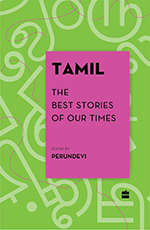
Tamil: The Best Stories of Our Times is a collection of 22 short stories spanning the past three decades, written by some of the incisive contemporary voices in Tamil. Moving between Tamil Nadu and its far-flung diaspora, the anthology portrays society’s encounter with modernity’s promises and dislocations while its people hold onto what is irreducibly human. These stories, ranging from the absurd, agonizing, humorous and tender, remarkably balance nuances of everyday existence alongside the tectonic shifts of caste, gender, migration and belonging that underlie modern society.
In her introduction, Perundevi underscores how writers such as Charu Nivedita, Perumal Murugan and Nanjil Nadan first tested their voices in the crucible of local magazines. This acknowledgement praises the rigorousness of literary writing in any form and platform, both grassroots circulation and rigorous experimentation. This acknowledgement situates the anthology within a longer genealogy; Pudumaippithan, the father of modernist Tamil literature, envisioned the short story as a window onto life (Pudumaippithan, p. 29); the tales gathered in this collection affirm that vision. What unites them is not merely their fidelity to truth, but their fearless engagement with the contradictions of living between tradition and rupture, solitude and community, homeland and elsewhere.
What intrigues the critical eye most about this anthology is its insistence on resisting clear explanations. Instead of affirming a timeless ‘human essence’ as grand narratives do, the select stories reveal how life unfolds in strange, fragile and often elusive ways. Consider Latha’s ‘Cheenalatchuni’s Queue’ or Sureshkumara Indrajith’s ‘Football and Her’, which pause on life’s ambiguous nature: the former centres around the obsession of waiting in long queues and marrying someone for the love of sport in the latter one. With humour and compassion, these tales mirror our half-understood encounters and fleeting memories of life. While the woman protagonist in Imayam’s ‘Heartbreak’ cries that, ‘perhaps this is how life is. Whether the problem is with the uterus or the sperm, it is always the woman who has to suffer’ (Imayam, p. 214), the line pierces through fiction into reality. These moments remind us that behind abstractions like fertility, marriage, or propriety lies the raw weight of bodily pain and social blame. A similar trope of shame, propriety, and agency collide in intimate, bodily ways in Perumal Murugan’s ‘The Blouse’ and S Ramakrishnan’s ‘Soundaravalli’s Moustache’.
Challenging the idea of grand narratives, the fractured idea of the nation looms large in Vanna Nilavan’s ‘The Flight’, where a poor village worker moves into a bigger town to repay his debt. He feels swallowed by the large buildings and constant surveillance until his workplace feels like a prison. In Kanmani Gunashekaran’s ‘The King’s Way’ the irony is sharper. Centred on the performing art of ‘therukkoothu’, a street theatre form practised in Tamil Nadu, the story portrays the sad status of artists, that those who play the role of king at night must beg during the day even for a seat on a town bus, often in vain. Both stories remind us how quickly dignity collapses under economic precariousness.
The collection brings in formidable stories on the diaspora, showing how exile fractures belonging but also sharpens resistance. The story of Appadurai Muttulingam’s ‘Catch a Chunky Goat’ stands as a testament to it. While the protagonist’s courage and desperation to write the letter is to be appreciated, the series of events leave one confused about his guilt. In Shobasakthi’s ‘Uprising’, the immigrant protagonist devises a successful strategy to rebel against a simple garment, an underwear. Narrated with wry humour, wit and a trickle of irony, the story also echoes the humiliation the protagonist endured during the political conflict in his homeland and his rebelliousness sprouting from the same incident. Tamilnathy’s ‘Mirage’ in a repetitive frame explores the life-struggle of a young Tamil immigrant who wants to be more than a poor refugee and is seriously addicted to gambling. It asks serious questions of assimilation, immigration, and racial prejudices. These stories emphasize that migration is not just legal or political but deeply personal, shaping interior lives. The narratives indicate how social, cultural, and economic structures are malleable.
Through magical realism, Keeranur Jakirraja’s ‘The Saga of Butchery’ asks poignant questions about religion and local customs. For instance, when the severed head of the camel continues to speak in the same unidentifiable manner, the narrative prompts the reader to wonder who speaks, who listens and whether the conversation will ever end. In a similar but rebellious story, Perumal Murugan’s ‘The Blouse’ interrogates civility and its absurdities. An innocent old woman, compelled to conform to the propriety of wearing a blouse to cover her breasts, develops a cyst–a mysterious tool that may enable her to assert agency over her own choices. Perhaps the most thought-provoking story in this oeuvre is Sundara Ramawamy’s ‘The Breaking of a Story’. As the media rushes to cover an unfolding event, the narrative raises a deeper question: if news is not digitized, does it exist at all? Have the external mediations of images, sound bites, and stories engulfed us and consumed our very capacity for wonder?
Given that Tamil is a prominent language and culture outside Tamil Nadu, including notable writers from abroad, it is worth mentioning that Latha from Singapore, Shobasakthi from France, Muttulingam and Tamilnathy from Canada make the collection diverse. Particularly notable is the rendering of gendered prejudices in a nonconventional way in ‘The Rules of the Game’ by JP Sanakya. The story traces the hypocrisy in the unspoken rules of patriarchy. Kanniyammal and her husband, who are struggling with primary infertility, are stopped at night while returning from a movie and she is gang raped. Initially, her husband comforts and assures her, but later, in order to protect himself from untoward shame, he discloses the incident when his wife becomes pregnant. Insecure because of his impotency, he allows her to be ostracized. Kanniyammal’s resolve not to go back to him and remain a single parent is empowering and enlightening. This and the other stories in the anthology are community-driven narratives that map Tamil modernity’s textures with an immediacy that unsettles as much as it illuminates.
The stories in the anthology, deeply rooted in Tamil life, caste realities, migration struggles, and gendered experiences, show that the ‘local’ is not provincial but capable of entering the bloodstream of world literature. In this regard, translators of these stories do more than carry words across languages; they shape the architecture of global literary circulation, ensuring Tamil stories converse with Chekov, Marquez and Hemingway on an equal footing. Thereby, Tamil literature, translated to English and other languages, adds to the growing polyphony of global voices, countering the dominance of a few literary traditions and enriching the shared reservoir of human imagination. Each translation is not just a transfer but a rebirth: texts gain new resonances in new cultural contexts, reminding us that world literature thrives precisely because it is never finished; only renewed. The anthology affirms that Tamil short stories are not bound by geography or community. In their translated form, they enter the global commons of literature, inviting readers everywhere to recognize themselves in familiar yet distant voices.
While the anthology is ambitious and wide ranging, its strengths hint at certain limitations. The selection of only 22 stories over three decades inevitably leaves out other significant voices and styles, making the representation partial. At times, the emphasis on caste, gender, and migration risks foregrounding themes over narrative experimentation, and some stories may feel unresolved or opaque to readers unfamiliar with Tamil cultural contexts. Finally, as with any translation, certain idiomatic subtleties may not fully survive in English, creating moments where the original’s force is only partially conveyed.
Yet these very constraints also reveal the collection’s distinctive achievement: meaning does not arise from fixed definitions but emerges in everyday practices. By weaving fractured and plural voices of women, workers, migrants and rebels that sketch the messy, lived contours of Tamil modernity together. If there is no single essence to hold onto, these stories suggest that it may be in the fragile, fleeting connections—between writer and reader, homeland and diaspora, loss and survival—that we find what endures.
References
Pudumaippithan, ‘Sirukathai’, Pudumaippithan Katturaikal, Star Publications, 1945, p. 29
Imayam, ‘Heart Break’. Tamil: The Best Stories of Our Times, translated by Janani Kannan, edited by Perundevi, Harper Perennial, 2025, pp. 196-214
Shilpa Nataraj is a research scholar in English and Cultural Studies at Christ (Deemed to be University), Bengaluru, India. Her interest areas include Urban Studies, Spatial Literary Studies and Environmental Humanities.