
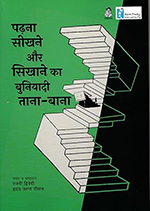
The two edited books reviewed in this section are part of a series, ‘Anuvaad Pehal’ or ‘Translation Initiative’ programme of the Azim Premji University. Under this programme, articles published in different academic journals and research publications have been translated into Hindi and Kannada. While many of the copyright free articles, originally published in Hindi or Kannada have been included in the compilations, some of the articles have been specially translated for the series. Reading and writing are the two important skills of any language and the responsibility of teaching these skills squarely lies upon the teachers. Hence, these books are an important contribution to the field of teacher education since these translations make research on reading and writing accessible to the Indian students who are not proficient in the English language. Included are one article by a foreign author and others by Indian authors. The books ensure that pre- and in-service teachers, teacher educators as well as scholars and people interested in the teaching of language skills can access research-based articles published over the years in several journals and magazines in one place. They demystify the whole process of reading and writing and ensure that the readers learn useful and practical strategies for teaching these skills.
Padhna Seekhne aur Seekhaane ka Buniyadi Taana-Baana contains 18 chapters focusing upon different aspects of the pedagogy of reading. There are articles on the nature and process of reading, such as ‘Padhna Kisse Kehte Hain,’ which focuses on how despite being conventionally divided into subskills, reading is a holistic act. There are several articles reiterating that background knowledge plays an important role in reading and that meaning-making is central to the act of reading. R Amritavalli’s article introduces different models of reading that need to be adopted at different times as per the needs of the students. Anil Singh’s article provides an overview of the Four Resources Model of Literacy given by Luke and Freebody (1990) which highlights the role of the reader within them. Kirti Jayram’s ‘Samajhkar Padhna Seekhna’ is in two parts and outlines the strategies and activities that can be adopted pre-, during- and post-reading to ensure that children read with meaning which will surely be of interest to pre- and in-service teachers. Sushil Joshi’s ‘Bachhe Padh Kyun Nahi Paate’ features a section called ‘Ek Darjan Aasan Tarike Apnaiye aur Padhna Mushkil Banaiye’ which unveils the common mistakes teachers commit that makes reading difficult and boring for the students such as the constant focus on accuracy and pronunciation. There are several articles that highlight the drawbacks of excessive focus on phonics-based approaches in teaching reading in the Indian classrooms. The article by Rajni Dwivedi emphasizes the need for creating space for purposeful reading in teacher education programmes.
Likhna Seekhne-Seekhaane ka Buniyadi Taana-Baana has 24 chapters divided into five sections. This division into sections has ensured thematic unity and readers can pick and choose chapters based on their interest in particular topics. The first section is ‘Likhna Kya Hai?’ which includes seven chapters focusing upon the nature of writing. It posits that children have a natural desire to express themselves which extends to writing as well and suggests creating a bridge between reading and writing, and creating the right environment for writing. A product-based approach to writing along with an uninteresting context, focus on mechanics and accuracy in writing, lack of awareness of the purpose of dictation, and a fragmented approach to teaching writing are all part of an ill-conceived pedagogy of writing practiced across Indian schools. The second section, ‘Likhna Sikhana’, details the classroom strategies for teaching writing to young ones. They not only provide experiences from the field but also suggest several activities such as wall newspapers, writing observations, discussing children’s artwork, and writing at the primary level. At the middle level, the suggestion is to build upon their writing skills and encourage writing across different subjects in the curriculum. Using samples of children’s work written during COVID, Pratibha Sharma has outlined how diary writing can be attempted by the younger and older children alike.
The third section, ‘Pariprekshya’ (Perspective), includes perspective-based articles on writing. HK Dewan’s ‘Rashtriya Dastavezon mein Likhna Seekhne-Seekhaane ki Samajh’ traces the development of understanding about the nature of writing through the lens of various national level policy documents. Kalu Ram Sharma’s ‘Nibandh par “Nibandh”’ deserves a special mention since he highlights the importance of linking essay writing to children’s experiences in a scenario where classroom teaching and examinations work in tandem to deny any freedom of creativity or expression to children.
The fourth section titled ‘Aankalan and Vishleshan’ includes four chapters on assessment which highlight teachers’ preoccupation with accuracy in children’s writing at the cost of creativity and self-expression. Blueprints used for assessment bind the teachers in looking for specific vocabulary and ideas to the exclusion of rewarding creativity. The last section of the book ‘Likhna Sikhaane ki Taiyyari’ includes two chapters focusing on teacher preparation for teaching writing which suggest experiential writing by teachers as suitable reading materials for teacher development programmes as well as the kind of understanding and attitude towards teaching writing that teachers need to adopt.
What is good about the books is that technical terminology and names of specific concepts have been written in the Devanagari script and given in English in brackets, for example, ‘zone of proximal development’ and ‘bottom-up model’, etc. On the other hand, in the case of a few articles, while it has been mentioned that the articles have been translated from English, and the source has also been mentioned, the name of the article in English is missing from the footnotes/endnotes. However, this is just a minor shortcoming. Overall, the books, through their examination of reading and writing skills drawn from rich field experiences rooted in the Indian context spanning over two decades, deserve a space on the bookshelves of scholars, teachers, and teacher educators alike.
Nidhi Seth is Assistant Professor, Department of Education, Shyama Prasad Mukherji College for Women, University of Delhi, Delhi. She teaches Pedagogy of Language to pre-service teachers. Her areas of interest are children’s literature, Pedagogy of English, Women’s Education, and Educational Technology.