
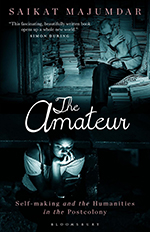
Saikat Majumdar’s The Amateur exemplifies post-critical literary activism—the book is a turning away from the ‘professionalization of literary study’ (p. 13). We know, the outsider’s gaze into western literary forms shaped postcolonial writing; and western canonical disdain for colonized subjects provided fodder to the counter-narratives in postcolonial literature. Building on this, Saikat Majumdar dissects the psycho-epistemology of writers from various post-colonies–India, Africa and the Caribbean—irrespective of the author-subjects’ association with institutional scholarship. He traces their amateur years of self-making and/or their reading for pleasure while on their path towards popularity, scholarship and professional writing. In so doing, Majumdar politicizes reading, thinking and writing from the margins.
Through its exploration of colonial and postcolonial education policies, The Amateur reminds us, colonial education does not only alienate the subject from her culture but also uses education as a tool to impart and spread imperialism. The notorious Bantu Education Act (1953), which restricted resources for coloured students, was a stark institutionalization of ‘education apartheid’ (p. 68) that was being followed in South Africa for decades. Majumdar relays the bildung of African scholars and writers—Njabulo Ndebele, Peter Abrahams, Sindiwe Magona, among others. Here, self-making is a ‘deep and bitter struggle’ (p. 75), particularly for women in African households marred by poverty, superstitions, traditional rites that forbade critical thinking, (and sometimes also) early pregnancies and patriarchal abuse. Here, in South Africa, the first taste of formal education was allowed only after one’s seventh birthday and personal pursuit of knowledge was possible only through periodicals and newspapers discarded by white families. Even later library visits remind one of their young readerly self’s resourcelessness, dispensability and socio-political relegation. To put it plainly, Magona’s story—the journey of a mother, domestic worker and teacher from poor alleyways in African neighbourhoods to a postgraduate student in Columbia University—stayed with me long after I finished reading The Amateur.
The autodidactism of Caribbean authors is itself a decolonial project, who, instead of discarding western history and literature, made use of its rich archives to create their own writerly selves. The Amateur traces the trajectories of CRL James, Dionne Brand, Jamaica Kincaid, VS Naipaul, among others. Their passionate textual engagements with Shakespearean works, Romantic poetry, Victorian classics and DH Lawrence’s writings—all the while challenging imperialist ideologies and racist notions of personhood in English literature and European history— ‘reinvented’ (p. 105), aided the rewriting of multiple genres, and created a new literary order by incorporating postcolonial context to established writing praxis.
Autodidacts and writers, stuck in their colonial and postcolonial realities, often feel the chasm between the language they read (here, English) and the communities they inhabit, or the postcolonial cultures they represent in their writings and the otherhood they experience in global literary circles. While Naipaul’s literary passion and pursuits of Eurocentric knowledge estranged him from his immediate social reality and invoked a sense of betrayal towards his own community, the pervasive boredom induced by colonial education and postcolonial curricula rendered English readers in India isolated and detached even within communal university spaces.
The case of Pankaj Mishra’s inability to situate Edmund Wilson’s references of Gustave Flaubert within its socio-historical setting, and instead, contextualizing it with caste atrocities in 1980s’ rural Uttar Pradesh is exemplary intellectualism made possible only by an amateur whose autodidactism allows dissociation from the academic way of interpreting literary texts.
This, Majumdar argues, ‘enables…literary humanism’ (p. 164). Majumdar also follows the bildung of other Indian scholars and public writers—Arvind Krishna Mehrotra, Nirad C Chaudhuri, Sanjay Seth, Toru Dutt. In his study, boredom perpetuated by university syllabi, note taking in dreary lecture rooms, rote learning and long exams is pitted against the delight in autodidactism and amateurism. He explains, rote learning and examination as assessment were shaped by scholarship usual to Universities of London and Oxford, not Cambridge, which harboured free thinking and practical criticism.
Late colonial era in South Asia saw innovative cultures of reading not only as an anti-colonial act or as an alternate to lifeless engagements with the imperial project, but mainly as a form of rebellion, as ‘deliberate acts of inconsequence’, or more specifically, as ‘modes of refusal, [and] nonproductivity’ (p. 165). In independent India, the absence of adequate employment opportunities coupled with the lingering spirit of anti-colonial resistance led intellectuals from affluent or liberal households to embrace autodidactism as a mode of self-formation—often prioritizing it over the prospect of money-making.
In his attempt at celebrating the amateur reader, Saikat Majumdar offers a rich archive of reading practices around the global British Empire. And in his reframing of amateurism as a mode of being rather than as a lack, he acknowledges the accidental learners’ ability to inhabit otherness while striving to build themselves despite all odds. Here, misreadings and accidental discoveries become sites of possibilities, defiance and selfcreation. He situates such practices as central to decolonizing the humanities. For readers committed to studying pedagogy and postcolonial epistemology, The Amateur provides an urgent and generative vision of progressive politics.
Shamayita Sen (PhD) is a poet, scholar, and literary commentator. She is the author/editor of three collections of poetry.