
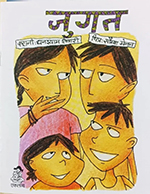
Jugat is a short book where illustrations say more than the text. In fact, the story cannot be understood by just reading the text which is boxed. It is a picture story where the text and images together create the complete narrative.
The story revolves around a group of young children who desperately want to eat mangoes from a farm. But there’s a problem: the mango farm has a strict, hot-tempered watchman who doesn’t allow anyone near the trees. When the children approach him, he scolds them harshly. Yet, their desire for mangoes doesn’t stop, and soon they come up with a plan. They break a beehive, forcing the bees to chase the watchman away, and while he is distracted, they climb the trees and collect the mangoes.
This twist in the story brings an interesting point to think about. On the surface, their trick works; they get the mangoes. But the method they use isn’t morally right. It causes trouble to the watchman. Could there have been another way?
If we imagine alternatives, the children could have tried making friends with the watchman or perhaps buying the mangoes. But the story makes it clear that neither option is possible: the watchman is too angry to be approached in a friendly manner, and the children, being very young, do not have money to spend.
In this sense, the choice of breaking the beehive, though morally questionable, seems to be the only practical solution available to them.
Jugat is the story of ‘jugat’ (tactic). The simple illustrations make it more appealing.
Bihu Anand, a pottery artist based in Bhopal, having been home-schooled, has found a space to explore his interest in working with clay, reading, and writing.